


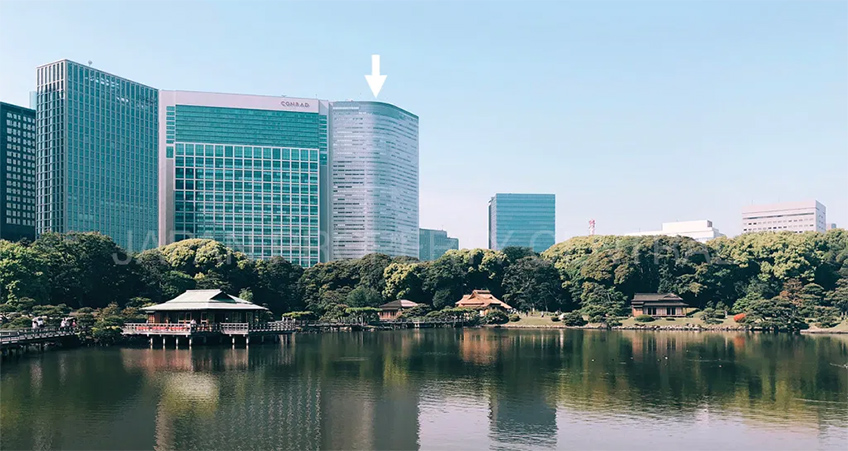
Advertising and public relations giant Dentsu Group is considering selling their head office building in Shimbashi, Tokyo. With an estimated price somewhere around ¥300 billion (US$2.9 billion), this could end up as Japan’s most expensive single-building sale. Several potential buyers are apparently already lined up.
The group’s headquarters typically has 9,000 staff on-site, but only 20 percent are commuting into the office due to the pandemic. The abundance of empty floorspace has led the company to reconsider their real estate holdings. After the sale, they would continue to lease space within the building. Dentsu’s advertising revenue has fallen since the start of the coronavirus pandemic, with the company expecting to post a loss for the second year running.
The 210-meter tall, 48-story office tower was built in 2002 as the Caretta Shiodome mixed-use redevelopment on the site of the former Shiodome Freight Terminal. French architect Jean Nouvel designed the office tower, while American architect Jon erde designed the retail component.
The complex includes restaurts, retail, museum, and a theatre. The total floor area is 231,700 square meters (2.4 million square feet), which may explain the high estimated price. It had a book value of ¥181.4 billion (US$ billion) as of December 2019.
According to JLL, the largest single-building transaction in Japan’s history was the sale of Pacific Cenutry Place Marunouchi in 2006 for ¥200 billion to Davinci Holdings.
Up until now, the major office buildings in Tokyo’s prime buisiness districts have been tightly held by Japan’s conglomerates, making this current environment incredibly enticing for foreign funds seeking a once-in-a-lifetime chance to acquire some rare assets. Bargain sales, however, are still not apparent.
There is the looming risk that office demand may not fully recover should the telework trend become permanent. Maor coporations are reconsidering their floorspace requirements both from a cost-cuttig perspective and from having fewer eployees in the building at any one time. Japanese homes and apartments, however, are notoriously small and cramped, both in the city center and out in suburbs, so it will be interesting to see how long employees are willing and able to work from home. According to the Cabinet Office, only 21.5 percent of employers across Japan had implemented some form of telework as of December 2020. In Tokyo, the ratio was 42.8 percent down from 48.4 in May 2020.
For more on this story, go to Japan Property Central.