


Mark Sarkisian
Structural and Seismic Engineering Partner, Skidmore, Owings & Merrill
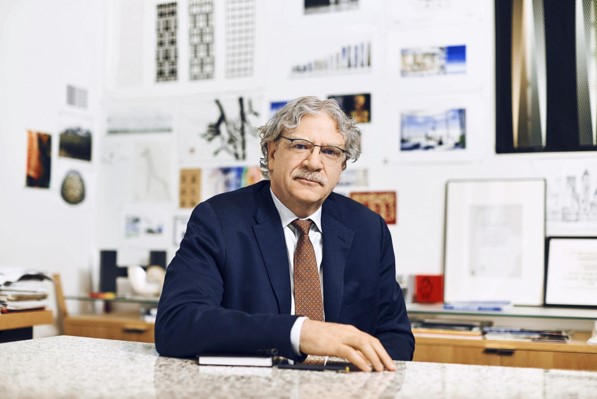
When students were learning to spell basic words in Mark Sarkisian’s second grade class in Cromwell, Connecticut, his father, Peter, a technical electronics expert, taught him to spell and understand the meaning of “experimentation” and “exploration.” When his teacher asked if any students knew how to spell any “big” or “special” words, Sarkisian immediately raised his hand. Those words became lessons for the class, and would come to define his career.
Across four decades as a structural engineer and partner at Skidmore, Owings & Merrill (SOM), Sarkisian has redefined the structure of the modern skyscraper. His structure for Shanghai’s Jin Mao Tower, the first for ultra-tall tower to use an octagonal-shape core lateral system connected to eight mega-columns with outrigger trusses—and which led to his invention of the Pin-Fuse Joint—has been replicated in hundreds of buildings and keeps today’s skyscrapers resistant to wind and earthquakes. He has developed some of the world’s most efficient structural diagrids, written the definitive textbook on engineering tall buildings, holds fifteen U.S. and international patents for innovations in seismic resilience and environmentally responsible design, and has published more than 150 papers detailing his solutions for towers around the world.
Nature has been the inspiration behind Sarkisian’s wide body of work, from the pliability of trees in the breeze to the spiraling wind patterns of a hurricane. “Nature and the principles of engineering have the same goal—efficient design,” Sarkisian said in a graduation address to the University of Connecticut’s 2025 class of engineers. “Our challenge has been, and will continue to be, finding ways to interpret the natural phenomenon and apply its principles to design and construction.”
Sarkisian’s road to engineering began as an undergrad at UConn, where he developed an interest in art, architecture, math, and science. At the time, his mother Jane worked as an executive assistant to Michael Marino, the Director of Public Works in Cromwell, who encouraged him to pursue a degree in civil engineering. With plans to focus on building design, Sarkisian enrolled in Lehigh University for a master of science in structural engineering. A Lehigh alum, William Bast, connected him with SOM, whose multidisciplinary practice offered the opportunity to unite his interest in architecture and engineering. In July 1985, he was hired by John Zils, CTBUH’s 2024 Fazlur R. Khan Lifetime Achievement Award winner. That month, he began working in SOM’s Chicago office under Zils and future Structural Engineering Partner Stan Korista, who became Sarkisian’s mentor.
His first major projects were the NBC Tower and 500 West Monroe in Chicago—two office buildings, under the direction of Korista, that were among the first to use post tensioned framing to create long and largely column-free floor spans. For 500 West Monroe, Sarkisian used post-tensioning around the perimeter frames to transfer gravity loads for columns that could not extend through lower level floors used for a parking garage.
© China Jin Mao Group Co Ltd
© SOM
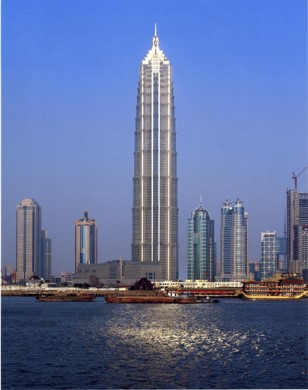
By 1995, Sarkisian rose to Associate Partner. Construction was underway on Jin Mao Tower, China’s tallest building at the time at 421 meters. With his structural team and lead Design Partner Adrian Smith, Sarkisian created the first skyscraper to use a concrete core connecting to a series of composite mega-columns through outrigger trusses. It used far less material than the typical tall building structure, setting a new standard for efficiency in skyscraper design. Sarkisian developed pins within the structure to allow the trusses to move freely during construction and enable the building core to move freely relative to the mega-columns—eliminating undesignable forces in the trusses that would have otherwise developed due to relative creep, shrinkage, and elastic shortening.
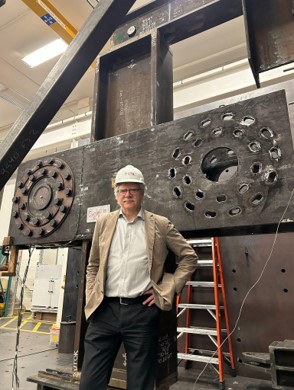
That idea led to the Pin-Fuse Joint—a collection of seismic systems patented by Sarkisian that allows contemporary skyscrapers to withstand seismic activity without permanent damage. Like the joints in the human body, these structural elements give towers the ability to pivot and slide during extreme seismic events, dissipating energy through friction rather than yielding base building structural material. The joints take the place of a typical moment or brace connections, which are allowed to be damaged by current code standards during an earthquake. The Pin-Fuse Joints are designed to remain in service without the need for repair after earthquakes and aftershocks have ended.
In 2001, shortly after the completion of Jin Mao Tower, Sarkisian moved to SOM’s San Francisco office, where he became the studio’s Structural Engineering Director. Twelve years later, he rose to Structural and Seismic Engineering Partner. Throughout that time, Sarkisian has led the engineering behind towers across China, Kuwait, and his adopted home city.
You have added this page to your collection.
You can view or share your full collection.