


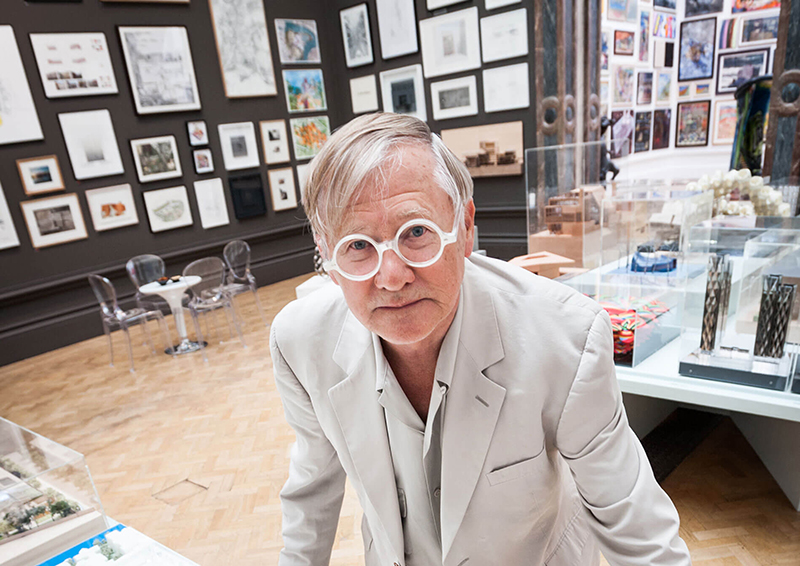
Sir Nicholas Grimshaw, one of Britain’s most visionary architects whose work fused engineering precision, high design ideals, and environmental sensitivity, died on 14 September 2025, aged 85. A figure of the late 20th and early 21st centuries who shaped not just individual buildings but whole infrastructures and landscapes, Grimshaw leaves behind a legacy that redefined public architecture.
By 1980 Grimshaw set up his own practice, Nicholas Grimshaw & Partners (later to Grimshaw Architects), stepping steadily into larger and more challenging commissions. Grimshaw Architects have been CTBUH members since 2013 and have participated in various events throughout the years like hosting the CTBUH New York Future Leaders Committee in 2018 at their NYC office for a panel discussion on affordable housing, and participating through the years in other initiatives relating to improving the urban realm.
Unlike his fellow contemporaries like Norman Foster or Richard Rogers, he was not a key protagonist in completed skyscraper projects yet his firm has worked on almost a half dozen tall buildings over 65 meters that have been completed (with many more unbuilt proposals) including: the 40-story Olderfleet in Melbourne (2022 Best Tall Building, 100-199 meter, Overall category winner); the renovation of the 27-story, 1970s building, 125 Old Broad Street in London; and the 25-story Poly Centre in Sydney (2023 Best Tall Building, Oceania region, Award of Excellence winner).
For Grimshaw, architecture was deeply tied to structure, to materials, to engineering as craftsmanship and not superficial ornament or stylistic excess. Many of his buildings emphasize transparency of structure, clarity of circulation, use of industrial or prefabricated elements, and concern for environmental responsiveness.
Grimshaw’s work spans industrial buildings, ecological icons, and major transport hubs. He was most well known for the Eden Project in Cornwall completed in the early 2000s. This daring project situated in a former industrial derelict site created large interconnected geodesic biomes in lightweight ETFE skin, transforming the area into a place of wonder and environmental education.
While Grimshaw did not often design skyscrapers, many of his station and large terminal projects play high above ground or over tracks and instrumental in the urban habitat; the scale is also similar in its structural ambition if not in height. His focus was rather on grand spans, exposed structural elements, sweeping roofs, vaults, large glazed façades—architecture where engineering and form are co-equal. Urban projects (train stations, transit hubs, urban renewal, transport interchanges) were central to his practice.
This includes: the Waterloo International Terminal (Eurostar Terminal) and Elizabeth Line Stations in London and the Southern Cross Station in Melbourne. He broadened what public infrastructure could look like showing that it could be more than functional and utilitarian, but inspiring, uplifting, with spatial drama and human interest.
Grimshaw’s earlier work such as industrial sheds, the Oxford Ice Rink, and factories demonstrated his formative high-technical approach in exploring space frames, exposed structures, clear function, and often strong geometry. He was part of a generation who saw that architecture is not purely decorative: its social, environmental, and infrastructural dimensions are essential. He championed large-scale public architecture and the more democratic of buildings—stations, terminals, airports—with so many people who pass through, elevating their importance as design objects and spaces.
He was knighted in 2002 for services to architecture, served as President of the Royal Academy from 2004 until 2011, and in 2019 received the RIBA Royal Gold Medal.
He is survived by his wife, Lady Lavinia, and his daughters, Chloe and Isabel.