


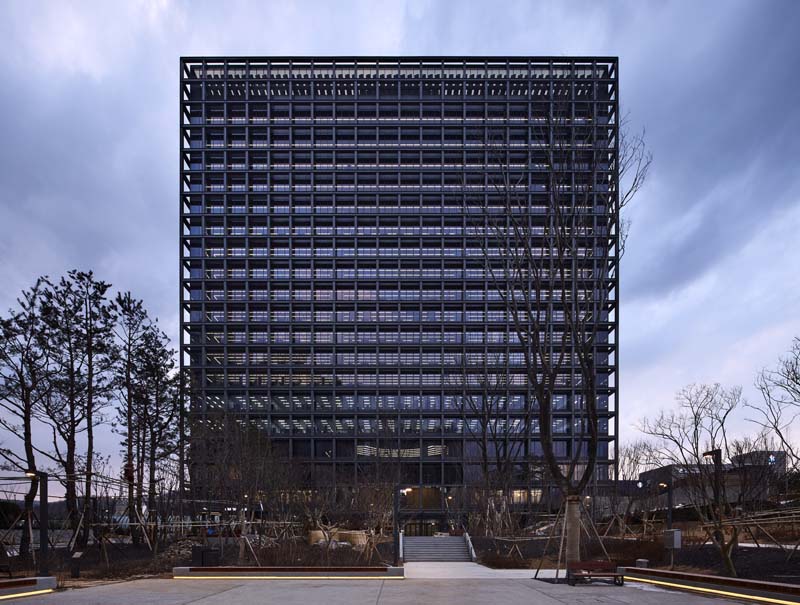
The new HD Hyundai Global R&D Center (GRC) in South Korea’s Seongnam Gyeonggi Province is located approximately 30 miles outside of Seoul, the nation’s capital city. Designed by Nikken Sekkei Ltd, the 20-story smart R&D office integrates several HD Hyundai Group companies and serve as the group’s new R&D Center, where some 5,000 researchers from various fields work.
As reported in The Korea Times, Hyundai Heavy Industries Group changed its name to HD Hyundai in late 2022. The 50-year-old group also held a ceremony to announce its new vision at the GRC, which replaces the prior facility in Jongno District, downtown Seoul.
The concepts of “CUBE,” “VOID,” and “GRID” were employed to foster a sense of unity for the building’s design. The “CUBE” is a symbolic façade that consists of 20 x 20 x 20 cubes that are visible from all directions. The homogeneous steel out-frame expresses both the company’s identity in using steel, and also its corporate attitude towards improving its impact on the environment. The cubic shape contributes to lowering the overall heat load, reducing surface area in hot, humid summers and cold winters.
The “VOID” is a large space at the center of the building that connects the entire facility and provides an area to tie the group companies together. It promotes exchange and helps reduce energy needed for lighting and air conditioning. A stepped deck makes office worker movements more visible, facilitates movement between upper and lower floors, and encourages human interaction.
The “GRID” is a 4.5m grid which maximizes efficiency while improving environmental performance by shielding against solar heat. The ceiling incorporates radiant heating and cooling as well as a “chilled beam” to create a draft-free environment. The ventilation system draws in outside air through the ceiling and returns it through the floor for efficient circulation – an important post-COVID-19 wellness feature.
A rich, comfortable indoor environment has been engineered to promote decarbonization goals. In addition, large-scale thermal water storage and on-site solar power generation reduce peak power consumption. Daily monitoring and feedback enable further performance improvements.
A DC power distribution system developed by HD Hyundai for has also been introduced for office lighting and electric heat pumps. As LED lights, solar cells, storage batteries, and other functions come to adopt DC power sources, systems with no AC-to-DC conversion loss represent advanced initiatives for future expansion.