


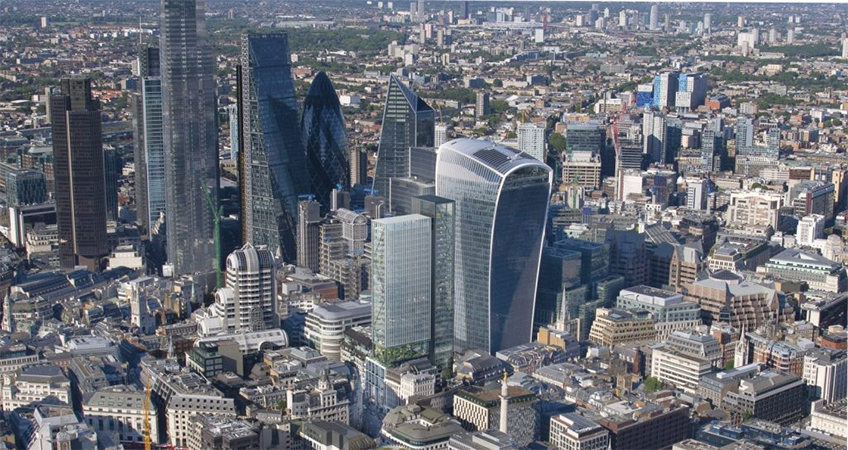
The City of London’s appetite for more steel-and-glass skyscrapers shows no sign of relenting, unaffected by either the global pandemic or the climate emergency.
In the first few months of 2021, three office towers, all taller than 145 meters, were approved by the City of London Corporation. They join three consented towers given the green light in the past few years – two of which are more than 250 meters tall, plus a further three under construction and another two in the planning process.
Patrick Wong, chief executive of Tenacity, Hong Kong-based developer behind two of the huge high-rise projects recently waved through in the Square Mile, is among those pushing the current drive to build more and to build quickly. He wants to crack on with his schemes “as soon as practically possible.”
At the same time, the City, in its just-released draft Local Plan, has spelt out how it aims to open up even more areas for potential skyscraper schemes both north and south of its existing cluster. The move could see tall buildings thrown up over a wider part of the City.
“Tall buildings of world-class architecture and sustainable and accessible design will be encouraged,” confirms Alastair Moss, who chairs the City of London’s planning committee.
“The planning pipeline is extremely busy and continues to show ongoing and increasing developer interest in tall buildings providing significant floor space in the City of London.”
But, despite the fanfare for new London office towers from developers and investors, many of whom are based overseas, the sector is facing some of its biggest challenges yet.
A major issue is the current collapse in the central London office-leasing market, caused by government-sanctioned home working for most employees during the Covid pandemic. Doubts remain about whether workers will ever return to offices full-time in the same numbers as pre-pandemic.
Can the glut of shiny new office space coming to the City of London still be shifted for a profit when home working or hybrid working cuts demand for desk space? And, if it can, where does that leave the swathes of existing, and increasingly empty, office space?
Added to this is the looming issue of the climate emergency – a growing concern for politicians, businesses, and the public alike. “It seems crazy to be building like this amid a climate crisis,” argues Simon Sturgis, an architect advocating net zero carbon design through his practice, Targeting Zero.
“The design of office towers hasn’t evolved,” he says. “It’s a 20th-century typology which we should be moving on from. Quite soon banks are going to shy away from these buildings as [maintaining them] will pose too a big a risk,” he told the AJ Summit last month.
So how are architects and developers redesigning – and future-proofing – the office tower? And when do experts predict an end to the seemingly insatiable enthusiasm for City of London skyscrapers – if ever?
Over the past year, the amount of empty office space in central London significantly exceeded the amount of space that was newly leased. According to real estate firm CBRE, roughly 2.3 million square meters of office space was available to let in central London in February 2021 –almost double the 1.2 million square meters reported in February 2020. This surplus can be explained by take-up rates: in the year to February 2020, about 1.2 million square meters had been leased in central London, compared with just 465,000 square meters in the year to February 2021. Of course, due to the pandemic, the new figures cover an “unprecedented” 12-month period. But the data also reflects a once-in-a-lifetime seismic shift towards home working, which is unlikely to completely disappear, even if the coronavirus does.
While the future level of home working is hard to predict and will vary by industry and sector, it looks likely that businesses will be consolidating their office floor space over the coming years as lease agreements end.
A survey by commercial estate agency Cushman & Wakefield and George Washington University found that 80 percent of businesses are expecting to switch to hybrid working in the future, while some companies, such as newspaper publisher Reach, have already said they will scrap almost all their London office space.
“Companies will still need space for days when most employees are in, and there will be a shift towards less densely populated offices”
Demand for Square Mile offices could also shift to outer London or even other cities. Firms such as Legal & General are lobbying the government to incentivise home working and working from local desk space as a way of promoting regeneration outside of central London.
The number of workers in the capital has also decreased. London’s population has tumbled by about 700,000 people, led by an exodus of foreign-born residents since the start of the pandemic, according to the government-funded Economic Statistics Centre for Excellence.
This all comes as the City of London sits on an enormous pipeline of new office space. In 2016, before either coronavirus or Brexit, the City of London estimated it would need an extra two million square meters of floor space by 2036. By the middle of 2020 it said it had already seen a net increase of floor space of 578,000 square meters, with 765,000 square meters under construction and 570,000 square meters granted planning permission. It now says it expects about three-quarters of its 20-year target to be met in the first 10 years – by 2025/26.
So, given the shifting sands of the “new normal,” will all this extra floor space go to waste?
Not necessarily. The director of one big London developer told the AJ that, even if the average worker were only to attend the office three days a week – 60 percent of the work time they used to spend there – companies would be unlikely to reduce their floor plates by the equivalent 40 percent. Instead, he argues, the impact is more likely to be a reduction in floor space of about 10 percent, since companies will still need space for days when most of their employees are in and because there will be a shift towards less densely populated offices.
Above all, developers behind skyscrapers believe their new products will be insulated from reduced demand for London office space. The problem of unlettable space will, they reckon, fall on secondary, lower-quality offices. “The key thing is to get the right building erected,’ says Wong, who says Tenacity will start building the Fletcher Priest-designed, 30-story 55 Gracechurch Street in about two years’ time.
Bernhard Dachs, a development manager for Mitsubishi Estate London, working on the WilkinsonEyre-designed 8 Bishopsgate, says its all-bells-and-whistles 50-storey office tower, completing next year, should be ‘even more attractive’ as a result of the pandemic. The thinking is that tenants will place a higher value on luxury office space – with its emphasis on wellbeing and collaboration – now that employers know that people can work intensely at a computer from home.
“The best workplace is not the office as we knew it; it’s not home; and it’s not the high street café,’ says Karen Cook, founding partner of PLP and the architect behind the recently completed 62-story 22 Bishopsgate. “The workplace of the future needs to offer the support and convenience of home, but also stimulation and collaboration with others.” 22 Bishopsgate and its neighbor, 8 Bishopsgate, will both have more than 10 percent of their floor space dedicated to amenity areas such as cafés, food halls, event spaces, outdoor terraces and even a climbing wall. British Land, meanwhile, has worked with architect 3XN to refine designs for 2 Finsbury Avenue, making lobbies more spacious and introducing more collaborative space into the scheme.
The next generation of skyscrapers will have a focus on comfort and wellbeing. Tech can allow tenants individual, tailored control of blinds and temperatures. State-of-the-art systems can ensure air is cycled over much smaller areas, reducing the risk of spreading airborne diseases. Biophilic features, such as the green walls planned for 70 Gracechurch Street and 50 Fenchurch Street, are being integrated into buildings to improve occupier wellbeing.
In its annual review of tall buildings in the capital, published this month, New London Architecture supports the claim that there is a plenty-big-enough market for office space in new towers. “Given that two-thirds of London’s office stock was built pre-2000, there is a lot of older, tired space in the market, which is likely to see diminishing demand from occupiers,’ the report states. “The focus [of tenants] is very much on high quality, best-in-class space, not least because the quality of offices is increasingly being used in the war for talent – an issue that will transcend the pandemic.”
Even if new skyscrapers are economically viable, can they ever be justified environmentally? Tall buildings have roughly twice the carbon footprint per square meter of small and medium-rise buildings, according to engineer and Arup associate director Tim Snelson.
This is largely because of the extra embodied carbon contained in the steel and concrete required for the stronger foundations needed for tall buildings to support their greater weight and wind loads.
The net efficiency of buildings also tends to reduce with height. The space required for elevators and service lifts means there is less lettable space as a proportion of the overall building. At the same time, the energy demand associated with moving people and goods up and down buildings increases with height.
‘To achieve RIBA 2030 targets [to meet net zero on all buildings by the end of the decade], even low and medium-rise buildings need to halve their carbon footprints,’ Snelson points out. “If skyscrapers create twice the amount of carbon per square meter than these buildings, they will need to reduce their carbon footprints by 75 percent to reach the 2030 target,” he adds.
“It’s almost impossible to demolish these towers… Once they are built, taking them down would be financially catastrophic”
Tall building advocates argue that looking at a building in terms of its embodied and operational carbon ignores the bigger picture. PLP’s Cook argues that the extra carbon cost per square meter is outweighed by the tens of thousands of extra workers the City of London can hold, almost all of whom travel to work on foot, on a bike or via public transport. She says: “The City is well-served by rail. And Crossrail will drive up even greater density in the City. Building towers like 22 Bishopsgate is one of the lowest-carbon-footprint things you can do.”
Arguments about density aside, architects and developers are keen to stress they are already working on reducing the embodied carbon of skyscrapers.
WilkinsonEyre director Oliver Tyler insists the structural elements on 8 Bishopsgate are “only as big as they need to be, to do what they need to do.” Its steel beams have been carefully sized to do deliver the necessary strength and stiffness, while the provision of double-decker lifts means the building core can be reduced, he says, adding that the building will have a “stripped-back” finish, with steelwork and concrete cores exposed.
British Land, on the other hand, plans to use recycled steel in 2 Finsbury Avenue and has designed the building for deconstruction. Fletcher Priest says 98 percent of the eight-storey block it is demolishing to make way for 55 Gracechurch Street will be recycled or re-used. And Kohn Pedersen Fox (KPF) says 70 Gracechurch Street will be five times more energy-efficient than the building it replaces – and have a 55 percent lower annual energy consumption.
But will a drastic change in the carbon footprint of skyscrapers require a shift from the glass-and-steel construction that has dominated the City of London skyline since its first towers emerged? John Bushell, design principal at KPF, thinks it might.
“The incorporation of embodied carbon performance into legislation and regulation will be hugely influential,” he says. “Designers, architects and engineers are all capable of designing within set limits, as has been shown with U-value and airtightness requirements over the past several decades. Such regulation would likely change material choices, construction methods and, of course, design aspects, such as structural grid sizes and floor-to-floor heights.”
The London Plan, published last month, introduces a first step on this road. It requires all schemes that are big enough to be referred to the Mayor of London, including all new skyscrapers, to undertake whole-life carbon emission assessments.
One long-touted solution for lowering embodied carbon is the use of structural timber, which stores carbon dioxide and requires less massive foundations, due to its lighter weight. PLP unveiled an all-timber “plyscraper” concept a few years ago, but the material is yet to be significantly used on a tower in the City of London. Understandably, fire safety issues prompted by the Grenfell tragedy and the consequent hardening of the insurance market have put off developers from using wood in towers. “The government needs to organise large-scale testing,” says Cook. “It would give clients the understanding of what is safe and what is insurable. At the moment they are reticent to take that on themselves.”
KPF’s Bushell believes façade design could also change to reduce embodied carbon, with more solidity being added in. ‘This might be in the form of terracotta, metal or something else; but we’ll need to consider the whole-life carbon and material efficiency during construction, in use and at the end of a building’s life,” he says.
Is a glass wall actually that bad though? The newest skyscrapers are using closed cavity façades (CCFs), a triple-glazed system with a blind in an enclosed cavity that has a continuous dry air flow to prevent condensation. Snelson is among those who think this might be the best solution.
“There is a small carbon penalty for the mechanical ventilation,’ he says. “But the glass has lower embodied carbon impact than an aluminium rainscreen on support rails and a backing wall.”
One problem is that current CCF systems need renewing as often as every 25 years, due to wear on the seals, but this is something the fenestration industry could address.
For skyscraper-sceptics, however, the greenest solution will never be a 50-storey tower. Snelson suggests the optimum balance between density and low embodied and operational carbon is a cityscape featuring buildings between four and 12 storeys high, developed by prioritising retrofit and extension, with new-build as a last resort.
In carbon terms, you can build twice as much mid-rise for the same carbon budget,’ he says. “It is also easier to deploy low-carbon materials, such as timber.”
If building more skyscrapers in the City of London seems hubristic, then perhaps it is. “Development as an industry is not logical,” argues Peter Rees, professor of place at the Bartlett and former chief planning officer of the City of London. “Some developers turn off the tap when they don’t see a chance of a profit. The problem is that investment in these buildings is often from high-net-worth individuals who don’t know what they are doing, advised by estate agents. They are from the Middle East and Russia particularly. And money is still coming from the Far East, from individuals who have accumulated wealth, rapidly in many cases, and want to make trophy investments.”
The City of London Corporation is undoubtedly enthusiastic about more towers – and why wouldn’t it be? The Corporation represents the interests of the financial services sector based in the City and many of its constituents stand to gain commercially from the skyscraper production line.
City of London residents make up just over a third of the electorate in local council elections, whereas representatives of businesses in the Square Mile make up 61 percent, according to 2011 Census data. And the financial, legal and insurance giants based in the City arguably have little to lose from a skyscraper boom. It is worth noting that the City’s planning committee chair, Alastair Moss, is himself a head of real estate at an international law firm.
But the future of skyscrapers in the City of London matters beyond London Wall – and not just because of their impact on the climate. “It’s almost impossible to demolish these towers, which is very sad,” says Barbara Weiss, co-founder of the Skyline Campaign. “Once they are built, taking them down would be financially catastrophic. These development decisions are irrevocable, and we haven’t put enough thought into the consequences.”
For more on this story, go to Architects’ Journal.