


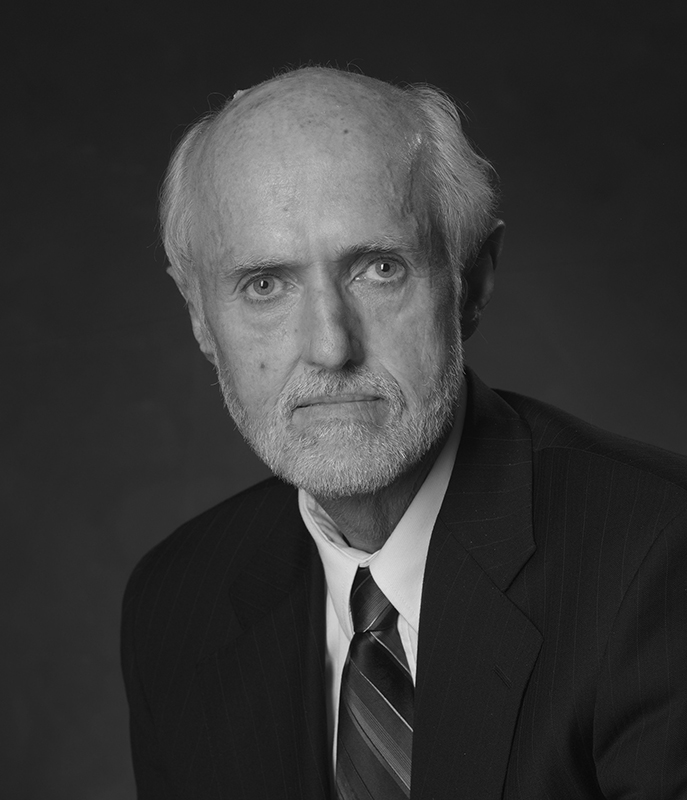
The Council on Vertical Urbanism (CVU), previously Council on Tall Buildings and Urban Habitat (CTBUH) is deeply saddened by the passing of Peter Irwin, co-founder of RWDI, and a pioneering figure in wind engineering whose expertise informed many of the most iconic buildings of our era, including Petronas Towers in Kuala Lumpur, Taipei 101 and the Burj Khalifa in Dubai. As an awardee of the CTBUH Fazlur R. Khan Lifetime Achievement Award (2014) and a former CTBUH Board of Trustee member, he was a deeply respected individual in our community whose leadership, insight, and quiet generosity shaped not only the Council but the global industry.
Irwin died peacefully at home in Guelph, Canada, on 15 November 2025 at the age of 80. His career was defined by sustained technical excellence and a commitment to advancing the understanding of wind effects on the built environment. After completing his bachelor’s and master’s degrees in aeronautical engineering at Southampton University, and later his PhD at McGill University, he began his professional career at the National Research Council of Canada (NRCC). In 1979, while at the NRCC, he invented the Irwin Sensor, a device for measuring pedestrian level wind speeds in wind tunnels which is now used at many wind engineering laboratories for assessing the wind environment around tall buildings. His early career revealed the qualities that would define his life’s work: boundless curiosity, intellectual rigor, and a talent for transforming complex ideas into elegant, practical solutions.
In 1986, Peter co-founded Rowan Williams Davies and Irwin Inc. (RWDI), which grew into one of the largest wind engineering firms in the world. As both President (1999–2008) and later Chairman (2008–2012), he guided the organization with the motto “complex issues made simple.” Drawing on the fundamental principles of aerodynamics and structural response, he used the wind tunnel and special analysis methods to inform on the effects of building shape, mass, stiffness, and damping. He also believed strongly in blending these principles with the dictates of architectural aesthetics and structural design, determining that a successful tall building requires close collaboration between the wind engineer, architect, developer, and structural engineer.
This collaboration was seen throughout his career. In the 1980’s Irwin worked closely with structural engineer Jacob Grossman on several New York City residential buildings of unprecedented slenderness (greater than 10:1 height to width ratio), including the 218.2-meter Metropolitan Tower on 57th Street and the 248.1-meter City Spire on 56th Street. These buildings pushed the limits of current motion criteria in the upper floors and the experience gained in the design, testing, and subsequent performance of those buildings helped set new standards for occupant comfort now used on many tall buildings.
In the late 1990’s Irwin worked with structural engineers and was instrumental in advancing the use of tuned mass dampers in North America—most notably designing the pioneering 300-ton pendulum damper in Chicago’s 257.4-meter Park Tower—and globally in designing and commissioning the 700-ton spherical damper in the 508-meter Taipei 101. Soon after, he was asked to study even taller buildings and introduced mesoscale meteorological modeling for supertall structures to evaluate wind behavior at the top, beginning with the Burj Khalifa and later applied this to Kingdom Tower studies (now known as the under construction Jeddah Tower) in Saudi Arabia.
Yet despite the global significance of his work, Irwin remained unfailingly modest, always attributing success to collaboration rather than individual achievement. This belief guided his long relationship with the Council. He contributed greatly to strengthening technical understanding in the industry at a moment when tall building innovation was accelerating worldwide. He was a principal author for Wind Tunnel Testing of High-Rise Buildings, published in 2013, that set forth general guidelines for wind tunnel tests, as they apply to tall buildings. He also contributed his expertise in Council events, committees, and other research. His leadership helped establish new standards of rigor and analysis and many in our community credit his influence for shaping not only their technical understanding but their values as professionals.
Irwin’s outstanding professional achievements have been recognized through numerous honors, including from the Council, his appointment as a Member of the Order of Canada in 2018, fellowship in multiple engineering institutions, and major awards such as ASCE’s Jack E. Cermak Medal and the American Association of Wind Engineering’s Industry Innovation Award.
His legacy endures in the buildings that stand taller and safer because of his insight, in the many professionals he guided, and in the lasting impact he had on our organization and the global tall building community.
He will be profoundly missed, and long remembered.