


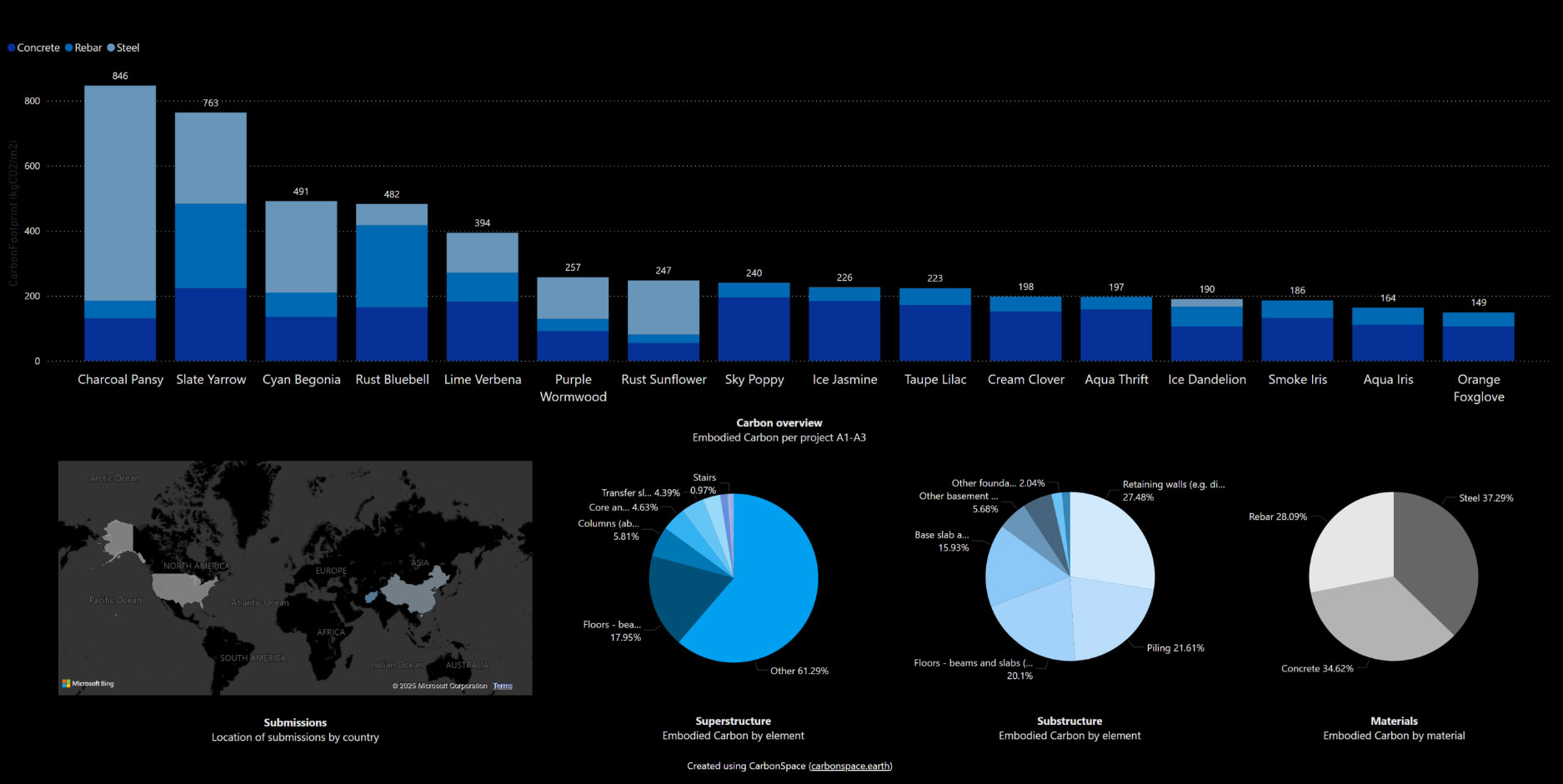
The CVU Carbon Commitment is a voluntary program inviting member organizations to measure, track, and share carbon and material usage data from their tall building projects. This data will be evaluated and consolidated, forming the foundation of a public-facing benchmarking dashboard that will allow designers, property owners, contractors, and engineers to make more informed, sustainable decisions when developing their own projects.
Who is involved in the Carbon Commitment?
Throughout the 2025 and 2026 CVU Awards Program, we invited submitters to commit to contributing carbon data on their projects, in addition to the existing submission requirements. During this time, nearly fifty global projects committed to share carbon data with CVU. These projects will help form the foundation of the database, and will provide a suitable collection of project data to benchmark against, with a diversity of regions, building functions, and height ranges.
How can my company get involved?
CVU is inviting member organizations to join this program and submit data on their tall building projects.
Details on the specific data fields being requested are provided in the CVU Carbon Commitment Program Overview packet. CVU Carbon Commitment partners are encouraged to submit any data that is available and partial data is also welcome.
To establish benchmarks, submitters will be asked to provide specific information and data points on their tall building projects. Acceptable data and formats are calculated according to recognized international standards, tools, and methodologies, including, but not limited to: the Royal Institution of Chartered Surveyors Whole Life Carbon Assessment (WLCA) 2nd Edition; World Green Building Council Net Zero Carbon Framework; London Plan Guidance for Whole LCAs; ICC/ASHRAE 240 P, the UK Net Zero Carbon Buildings Standard; and outputs from LCA software tools, such as One Click LCA, eToolLCD, Tally, Athena, LCA plugins for BIM tools, and more.
Relevant data that is ready to share can be uploaded to CVU’s servers.
In cases where partners have not already assessed their carbon factors or materials quantities of their projects, CVU has developed a simple-to-use data-collection tool for inputting the requested data.
How will my data be used?
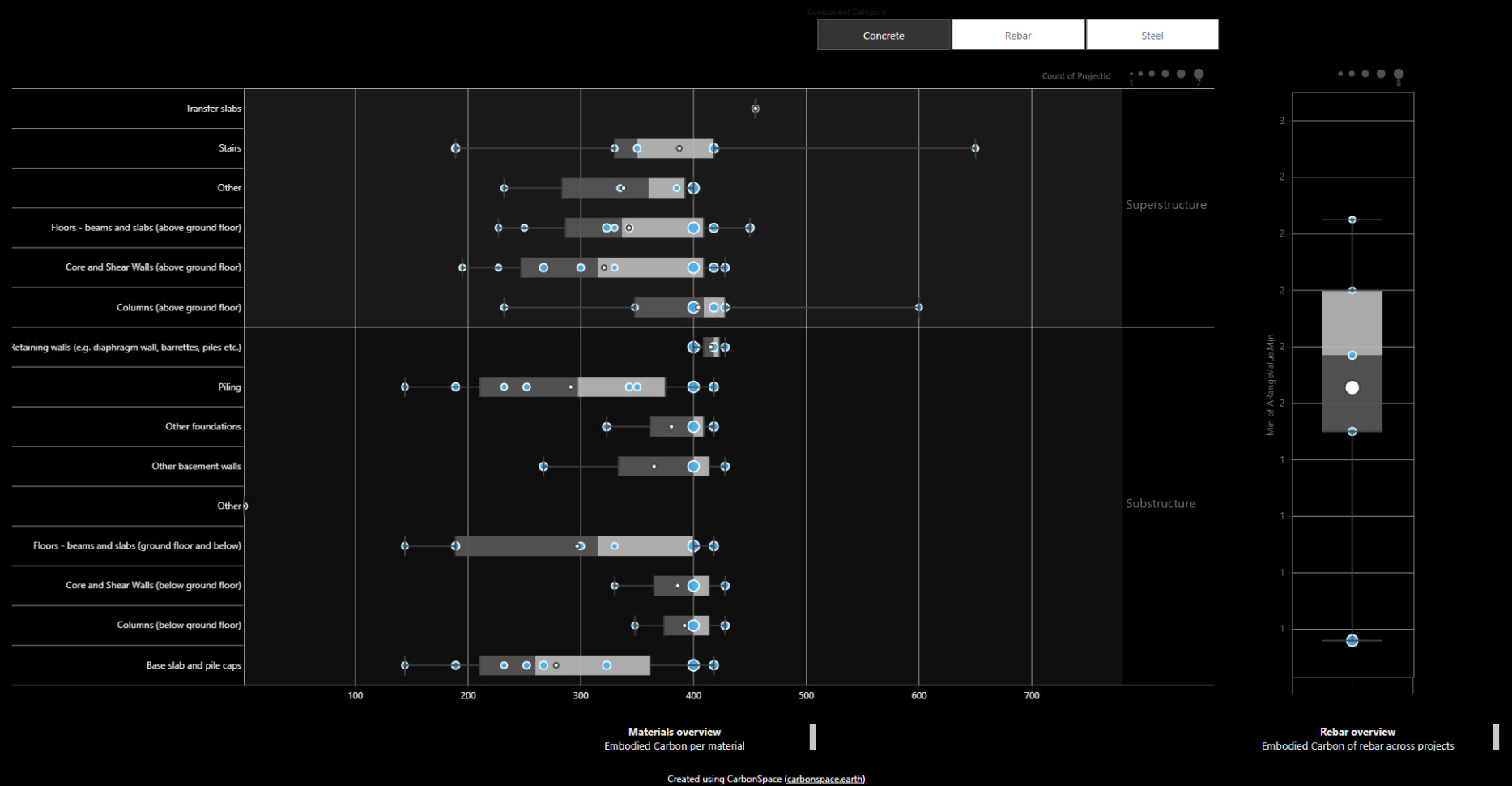
CVU will launch a public-facing dashboard, enabling designers, developers, and researchers to access a global comparison tool with carbon and material information for tall buildings using the data provided (see image above for example). This dedicated dashboard and database is being built within the CarbonSpace platform developed in collaboration with 2026 CVU Program Partner, MVRDV NEXT.
All data displayed on the public dashboard will be fully aggregated to reflect industry-wide patterns, with the goal to improve carbon literacy and data transparency, without highlighting individual project data, and maintaining anonymity.
CVU understands that carbon and material data may be commercially sensitive and the CVU Carbon Commitment is designed with confidentiality protections to ensure that partners can contribute data with confidence.
Upon request, aliases can be created for the building name and will never be publicly disclosed. Further, identifying project information, such as exact location, completion year, and height, can be classified into wider groupings, allowing the project to be compared and benchmarked against in the database, while protecting the identity of the specific building.
All data submitted will remain the exclusive property of the submitting organization and partners may withdraw their data at any time by providing written notice to CVU. More details on data usage and ownership is provided in the CVU Carbon Commitment Program Overview packet.
For 2026, CVU is targeting data from more than 100 tall building projects, and initial dashboard findings will be shared in front of a global audience at the 2026 VU Summit in London, 26-29 October.
To ensure you are included in these initial findings, share project materials before 30 June 2026.
Program Background and Why This is Important to CVU
The built environment accounts for 34% of global carbon emissions1, with a substantial and growing share attributed to the construction and operation of tall buildings. Despite this impact, the industry lacks the standardized, publicly accessible data needed to drive progress toward net zero targets.
Tall building projects are inherently complex and data-rich, yet the carbon and material quantity information embedded in each project has not been collected and collated in one location. Without shared benchmarks, designers, developers, and engineers are left without the reference points needed to set meaningful targets, evaluate design decisions, or demonstrate industry leadership.
As the world’s leading nonprofit organization dedicated to advancing tall buildings and cities and the developer of the world’s most comprehensive tall building database—with over 45,000 buildings tracked—the Council on Vertical Urbanism is uniquely positioned to collect, standardize, and share carbon and material usage data for tall building projects.
Be Part of the Change
Learn more about CVU sustainability-related programs, initiatives, and partnerships.
Notes
1. https://www.unep.org/resources/report/global-status-report-buildings-and-construction-20242025