


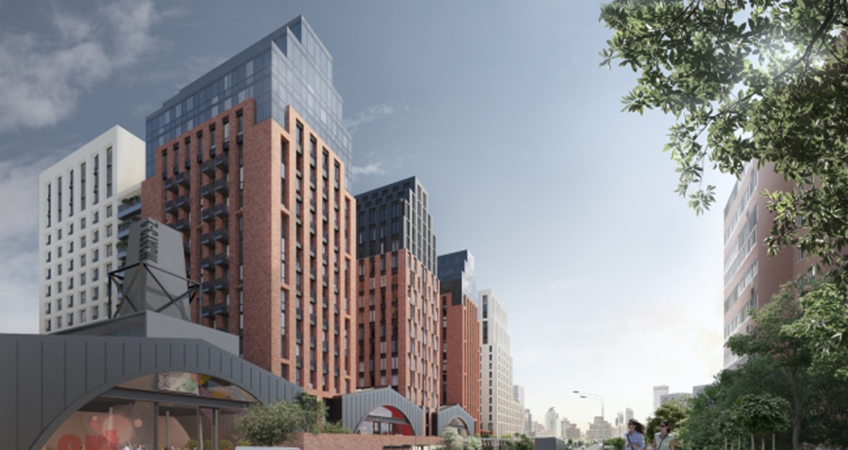
A new housing complex on the Malaya Pochtovaya Street is being built next to Moscow State Technical University, located in the Basmanny district of Moscow. This area is chiefly dominated by young and active graduates of the University, as well as many entrepreneurs. Despite the technical progress being made in this area, town planning is decades behind. The development of this territory is expected to gain extra momentum, thanks to the opening of a new additional entrance of the Baumanskaya metro station, which will reroute commuters through the industrial park adjacent to the neighborhood.
City Arch is proposing its own solution to the town planning problems of this area: a multifunctional housing development. The prevalence of the housing function will not only add to the housing stock in the city center, but also ensure comfort and safety of the city block. Additionally, the residents of the new complex will benefit from a 5-minute walking distance to the metro station, a 7-minute walking distance to Lefortovsky Park, and functionally eventful bottom floors. The metro station, the university, and the housing complex itself are significant gravity centers, so there is no doubt that street retail will be in demand here.
Because of its height difference and irregular shape, the construction site gave the architects an opportunity to inscribe the underground parking garage into the podium part of the project, which ultimately vacated extra area for landscaping. The client–MZATE-2–expects a density of about 39,000 people per hectare.
The complex consists of 10 towers. Five towers are lined up alongside the street, three are turned at an angle; one, seven stories high, was fitted into the yard, and one duplicates the street lineup, forming an arch leading into the yard. The street-side lineup is continued by the already-existing office building that belongs to the client. This building will host a museum of modern art.
Following an industrial theme, the façades of three towers standing along the street will be made of red Flemish brick. Many other components of the buildings are designed to emulate the neighborhoods of lower Manhattan in New York City. The public volumes, which unite the residential section on the bottom level, simulate the industrial architecture of the XIX century. This part of the podium is connected to the office building, and possibly will support large-scale museum exhibitions in the future.
For more on this story, go to Archi.