


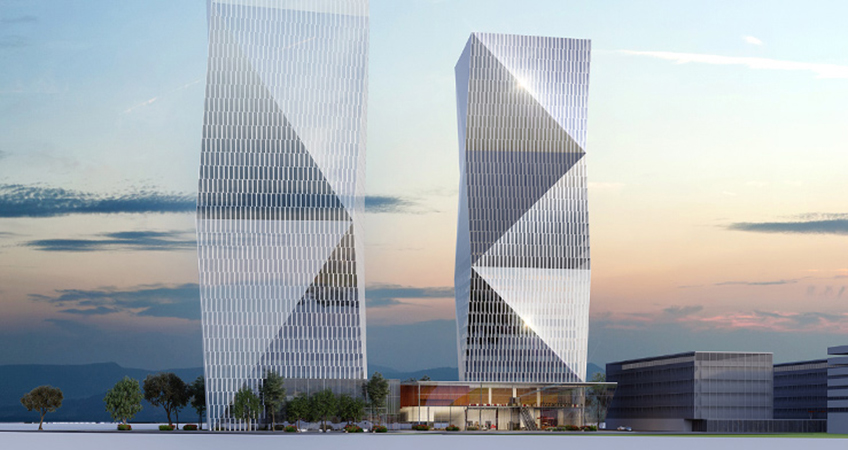
Kiryat Atidim is losing out to business districts closer to central Tel Aviv. The new plan aims to reverse this trend. Anyone traveling on Road 4 just south of Morasha Junction cannot fail to notice the eye-catching tall striped building of Kiryat Atidim to the west. Before too much longer, it will not be the only tower visible from the highway.
Kiryat Atidim is a dynamic business zone in northeast Tel Aviv adjacent to Ramat Hahayal and near the Ramat Sharett neighborhood. It is a joint initiative of the Tel Aviv municipality and Tel Aviv University. Kiryat Atidim CEO Sagi Niv says that revenue from the site amounts to ₪125-130 million (US$36-38 million) a year, divided between the municipality and the university. The site covers a total of 20 acres (8 hectares) and together with the 35-floor striped tower, it also contains an 18-story tower, 12 four-story buildings, and a low-rise administration building.
This location was once thought of as the end of the world as it was planned as a closed campus cut off from its surroundings. Visitors to Kiryat Atidim felt ill at ease due to the place being surrounded by a fence, the buildings being outmoded and designed institutional architecture to appear closed in, as well as almost no one in the public spaces throughout the day.
As the city grew, the nearby Ramat Hahayal business zone was transformed from an arts and crafts center into a tech, medical, and entertainment center, and the planning concept of separating business zones from daily life changed. All of this is recognized in the new master plan for Kiryat Atidim prepared by the municipality, whose vision aims to connect the site to the city. This plan will be implemented in several stages.
The existing urban building plan allows 6,550 square meters of additional construction, amounting to 815 square meters more in each building. In the first stage, Kiryat Atidim’s management intends to upgrade the existing buildings by making them thicker and taller where necessary, create green roofs, open the façades in the direction of the main street, and renovate what exists.
Kiryat Atidim is also trying to encourage various initiatives, and as part of this, a workspace has been opened with 1,000 square meters, called CityZone, an initiative of the municipality and the university designed to encourage urbanism startups. Renault-Nissan-Mitsubishi’s innovation lab is also in the area on a 1,600-square meter site in which Israeli startups developing improvements and innovations for the car industry are tested. Another important project is private hospital Merav, scheduled to open on the site in the first quarter of 2020 at an investment worth hundreds of millions of shekels.
Dr. Rina Degani of the Geocartography Knowledge Group points out the problems with Kiryat Atidim’s location. “In the competition over location, Ramat Hahayal and Kiryat Atidim are losing now, mainly because of problems in access by public transport and by car. The light rail route also gives competitive advantages to Hashalom Interchange and the surrounding streets (Yigal Allon, Menachem Begin, and Hararba’a), and to Jabotinsky Road from the Ramat Gan Diamond Exchange area to Ben Gurion Junction, including the BBC area. We detect a trend towards mature companies in need of more employees leaving because they are having difficulty hiring them in this area.”
“Kiryat Atidim has a significant advantage, it is jointly and correctly managed by the Tel Aviv municipality as an entity promoting innovation and differentiating this area in comparison with other locations in the city. The planned link to Road 4 is also designed to improve direct access to the area. In addition, there has been little construction in the area in recent years, so that the added space can (through focused and correct marketing by the municipality) generate demand in Kiryat Atidim,” she added.
In addition to renovating the small existing buildings, the planners are starting to look ahead. In September 2019, a plan for construction of a new building in Kiryat Atidim was presented to the Tel Aviv municipal engineer, entitled Tower 9. This 30-story, 61,5000-square meter tower will have 48,000 square meters of offices, a 159-room hotel, and a hall and commercial area with 1,800 square meters. There will also be an underground parking lot.
Veteran architect Moshe Tzur is responsible for the new Kiryat Atidim masterplan and also designed the new building. “In the lower part, there is a two-story atrium with cafes and a small restaurant, from which you can ascend to the hotel and a theater foyer,” he said.
Tzur says that the new tower’s architecture was designed to symbolize the change in Kiryat Atidim. “In contrast to the “zebra building,” it was important to us to for something new to be seen here. The double glass façades save energy, and their architectural appearance is good. The employees’ quality of life is at a completely different standard because with the double-skin walls, the internal glass is cooling, not heating.”
The vision for the site, however, goes far beyond one new tower, as does the potential profit for the municipality from it. Tel Aviv’s outline plan states that construction in this area can be up to eight times the area, 640,000 square meters. Since the area currently covers 250,000 square meters, this means an addition of 400,000 square meters.
For more on this story, go to Globes.