


The Michigan Opera Theatre confirmed on 31 January 2020 it’s pausing a plan to develop a new building, just days after Bedrock Detroit acknowledged it is scaling back the size of Hudsons Tower to the point that it will no longer be in the running to be the city’s tallest building.
The opera company said the driving force behind its decision was changing market conditions.
“Ultimately,” Erica Hobbs, the theater’s communications manager, said, “we are looking for a development that maximizes our economic growth and our ability to expand artistic and community offerings.”
At 480 feet (146 meters), one height reportedly envisioned for the opera building, the new high-rise would have changed the city’s skyline, making it one of the city’s tallest structures, just under the 496-foot (151-meter) Guardian Building and slightly more than the 475-foot (145-meter) Book Tower.
It’s unclear whether the two decisions to scale back tall buildings are an indication that downtown real estate owners are reining in projects in anticipation of a cooling economy or less confidence about the future.
But Hobbs said the opera company’s vision, after receiving several proposals, is “on hold” because the proposals “did not significantly improve our revenue over what we already earn from the surface lot and the parking center.”
In spring 2019, the opera theater asked for proposals for a mid- to high-rise tower that could accommodate a hotel, office space, apartments, condominiums, ground floor retail, and underground parking on a lot it owns that is just under 1 acre (0.4 hectares).
The Detroit Opera House building opened in 1922 and was purchased by the Opera Theatre in 1988. The Opera Theatre has called the site where the tower was envisioned one of the premier vacant parcels, just steps away from the theater district, sports arenas, the QLINE Streetcar along busy Woodward Avenue.
In addition, Hudsons tower has been heralded as a project that also was to dramatically change the city’s skyline, and it still will, just not to the degree that Bedrock had been boasting it would.
“What we concluded is we wanted an iconic building,” Matt Cullen, CEO of Bedrock, said the week of 27 January 2020 at the Detroit Regional Chamber’s annual policy conference. “The need to be the tallest wasn’t on our highest list of priorities anymore.”
The US$909 million project is expected to be built at the site of the old J.L. Hudson department store, which closed in 1983 and was razed in 1998. The tower, which had been slated to rise 912 feet (278 meters) with 62 floors, broke ground in December 2017. In comparison, the Renaissance Center, the city’s tallest building, is 727 feet (222 meters) with 70 floors.
Cullen promised that the tower is still “going to be a tremendously impactful” building.
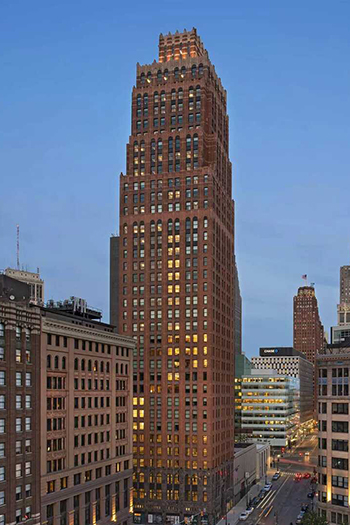
Among the announcement of these scale-backs, another Detroit high-rise, the David Stott Building has been renovated. Bedrock Detroit bought the Art Deco skyscraper in 2015 for US$14.9 million and had been working on renovations for the past several years. It needed a lot of work as the previous owners, Shanghai-based investment firm DDI, did considerable damage to the historic building through just two years of mismanagement.
Now redevelopment on the Stott is complete, Bedrock finished the final pieces of restoration in summer 2019. It had been steadily opening floors and offering units for lease since 2018.
The total work required was extensive. There was damage from a substantial basement flood and malfunctioning elevators. Bedrock replaced windows, terra cotta, and approximately 60,000 bricks on the exterior; installed new mechanical and electrical systems; and thoroughly cleaned the ornamental ceiling lobby and marble floors.
In addition to restoration, Bedrock undertook the complicated task of converting 27 of the building’s 38 floors from offices to apartments to modern standards.
“The floor plan of this building is a square with a huge core in the center containing six elevators and a donut of office space around it. That’s not how you would design a residential building today,” says Melissa Dittmer, chief design officer at Bedrock. “We had to figure out how to take that historic floor plate and transition it to 2020 expectations.”
That resulted in some distinct floor plans at the narrow building, some of which wrap entirely around the elevator core.
“What we have now are a really unique and eclectic set of residences where you get historic details, nooks, and crannies, that were elements of the office floor plates,” Dittmer says.
Those 107 units lease for between US$1,420 for a studio to around US$5,000 for a three-bedroom. There’s also ground-floor retail and five floors of office.
Though the Stott is often overlooked in comparison to the nearby Guardian Building, it has many noteworthy architectural details, including sculptures by Corrado Parducci and a shimmering marble lobby and ornamental ceiling. Bedrock worked with Patrick Thompson Design and Kraemer Design Group to restore or recreate as many of the historic details as possible.
Dittmer says that this may be the first time since it opened that the Stott is operating “in its original essence.” Designed by renowned local architecture firm Donaldson and Meier, it was one of the largest buildings in Detroit after it opened in 1929, but the Great Depression hit soon after, and it’s undergone long periods of vacancy and neglect ever since.
“You’re basically walking into that lobby as if you’re walking into the 1920s David Stott,” Dittmer says. “When the door for the elevator opens, that’s also the same as if you’re in the 1920s Stott. Go up to the lobby of your floor, the marble wainscoting on the walls is original,” Dittmer added.
For more on these stories, go to the Detroit Free Press and Curbed Detroit.