


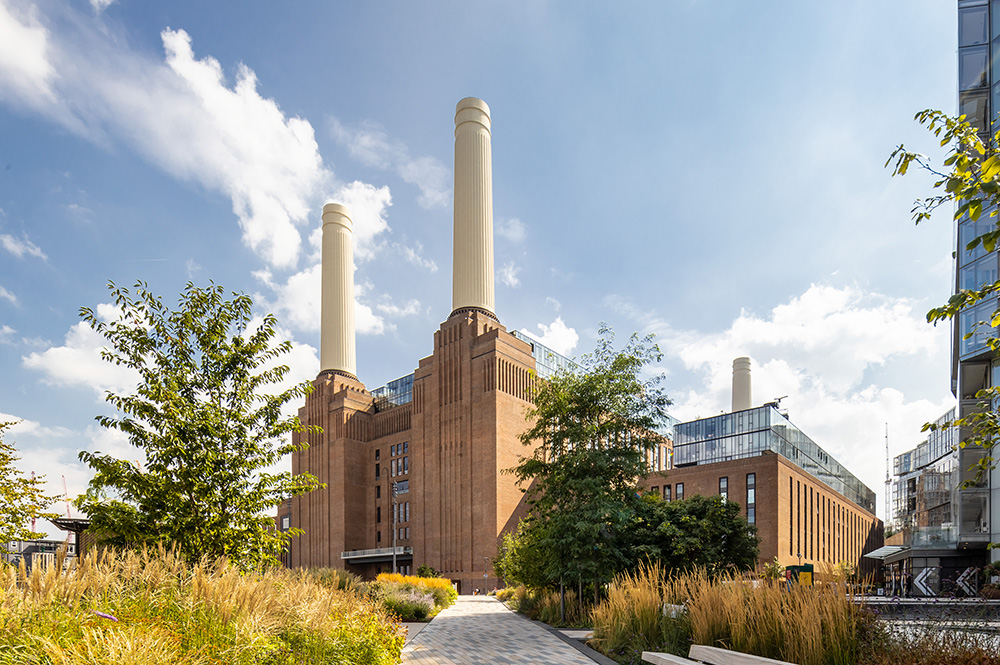
The £5 billion (US$6.7 billion) regeneration of Battersea Power Station has entered its final phase, with plans submitted for the remaining 16 acres (6.5 hectares) of the landmark London development. The proposal could add up to 297,000 square meters of residential, commercial, and leisure space, more than doubling the scale of the neighborhood developed to date.
Studio Egret West has updated the final phase from the original master plan by Rafael Viñoly, responding to changes in how people live, work, and use cities since planning for the development began more than 15 years ago. The revised scheme divides previously planned larger buildings into smaller, more distinct sites, improving sightlines toward the historic power station while creating a more varied network of public spaces and connections.
“The last decade has seen events like Covid-19 and digital integration into everyday life blur the boundaries between work, living and leisure time, all fundamentally changing how we interact with cities. Responding to this, our refreshed masterplan seeks to place community and connection at the core of Battersea Power Station,” said James Saunders, chief executive of Battersea Power Station Development Company.
Studio Egret West founder and director David West said the next phase would introduce more “playful, artistic and biodiverse public spaces,” while maintaining flexibility as the neighborhood continues to evolve.
Battersea Power Station currently contains more than 2,200 homes, approximately 74,300 square meters of office space, and more than 170 shops, restaurants, and bars. A consortium of Malaysian investors acquired the site for £400 million in 2012 and has since invested more than £5 billion in its redevelopment.
The original Art Deco power station operated as a coal-fired generating facility before being decommissioned beginning in 1975. Its transformation and the development of the surrounding land have since established a new mixed-use district along the Thames. The final phase will extend that transformation, with the revised master plan placing greater emphasis on public space, biodiversity, pedestrian connections, and maintaining the historic power station as the visual anchor of the growing neighborhood.
Read more at City AM.