


Carbon-Neutral Tall Buildings: Projecting the Impact of Optimized Structural Systems and Renewable Energy
Authors: Nirmal Kishnani, Mun Summ Wong, Alakesh Dutta, Falzatuzzahrah Rahmaniah
Excerpted from Vertical Urbanism Magazine, Issue 6
As cities worldwide strive to reach net-zero carbon targets by 2050, it remains unclear whether tall buildings—ubiquitous in most urban centers—support or hinder this goal.
Past research argues that low-rise, high-density (LRHD) development represents the optimal pathway for low-carbon urbanism. The case for low-rise construction stems from two constraints that define the carbon profile of structures.
First, reliance on solar photovoltaic (PV) cells for on-site power generation is limited by the tall building structure’s geometry and current PV technology efficiency. PV performs optimally when installed on rooftops, particularly in low- to mid-latitude locations. Mounting panels on facades reduces efficiency and increases cost. Additionally, some facades in urban settings may be overshadowed.
Second, concrete—the material of choice in most tall building structures—adds substantially to lifecycle emissions. This material, particularly its cement component, accounts for approximately 8% of global CO2 emissions.1
Low-Rise High-Density
Pomponi et al. (2021)2 concluded that LRHD offers the better pathway to lowering carbon emissions. This perspective is cited in academic literature and reinforced in academic literature and reinforced in editorial commentaries, such as “The Best Cities for Low Carbon Emissions Aren’t the Tallest,“3 which advocate for LRHD urban forms as a foundation for low-carbon cities. Several similar studies also suggest that mid-rise buildings (5-20 stories) integrated with transit-oriented development represent solutions for sustainable urbanism.4
High-Rise High Density
Tall buildings remain ubiquitous in dense urban environments worldwide, particularly in Global South and developed Asian economies, where real-estate values and rapid urbanization drive vertical development.5,6 Asian cities have experienced the most significant surge in urban population growth over the past 50 years, a trend which is expected to continue.7 This has directly fueled vertical construction, with the total number of tall buildings increasing by a staggering 460% from 2000 to 2018.8 Asia (excluding the Middle East) contributed 75.3% of all new tall buildings in 2018 and 69% in 20199—highlighting the persistent demand for tall buildings, particularly in this region.
Mitigating Emissions in Tall Buildings
A growing body of research offers insights into strategies for mitigating lower life-cycle emissions (LCE) in tall buildings.
Facades With Solar PV:
Fanning et al. (2014)10 found that high-rise buildings ranging form 38 to 54 stories with on-site PVs achieve lower LCEs. While roof areas present inherent constraints for on-site installations, several studies demonstrate that facades offer significant capacity for PV integration, transforming them in productive assets.11,12,13
Timber as Material of Choice:
Timber is a low-carbon building material. However, it comes with concerns about material strength, fire safety, and durability.14 Lamination and hybrid structures—combining timber with concrete and/or steel—help overcome these limitations, to a degree.15
Such innovations have yielded notable projects including the 18-story Mjøstårnet in Norway completed in 201916, the 20-story Sara Kulturhus in Skelleftea, Sweden, completed in 202117, and the 40-story hybrid timber structure for the Atlassian Central in Sydney, currently under construction.18
Improved Structural Design:
A building’s structure is the largest contributor to its embodied emissions.19 This is especially true for tall buildings, which are often designed to support high dead and live loads. Helal et. al (2020)8 and Foroboshi et al.20 (2014) discuss the potential for reducing emissions by optimizing structural design at the early design stage: trimming the (over)design of elements and minimizing waste through, say, modularization and off-site prefabrication.21 Certain structural elements, such as floor slabs, also lend themselves to low-carbon alternatives, such as timber.
The limitation of much of the current scholarship on form and carbon is that it relies on the performance of today’s materials and technologies. This study looks to the future of PV technology and low-carbon concrete production to reveal how improvements may fudnamentally alter the carbon equation for tall buildings.
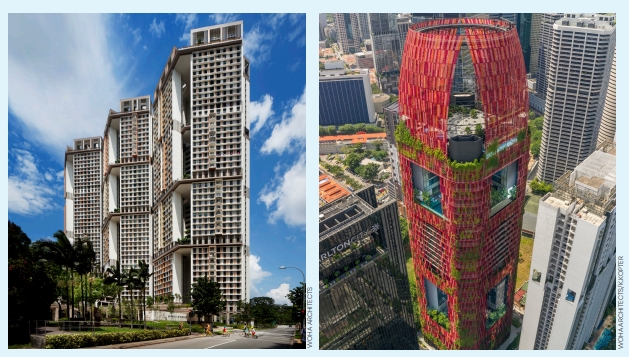
The study relies on two tall buildings in Singapore as reference projects which represent best practices in tropical design: SkyVille @ Dawson and Oasia Hotel Downtown. Both projects outperform comparable buildings by incorporating passive design strategies, extensive building-integrated greenery, and vertically distributed social spaces that are suited to Singapore’s climate and urban context.
Critically, the adopt form strategies wherein the building is vertically subdivided into clusters of offices hotel rooms or apartments, separated by community floors for shared access by occupants. Furthermore, Oasia Hotel Downtown has a double-skin envelope, wherein the outer layer is a porous and vegetated surface.
The study looks at three key reference years: 2025 (current baseline), 2035 (midpoint scenario), and 2050 (deadline for net-zero emissions under the 2015 Paris Agreement). For 2025, the two buildings are retrofitted with higher-performing elements and systems available today. For 2035 and 2050, new versions of the same buildings, with identical forms, are construction, but with PV and concrete available at the time.
CVU members can read the full paper in the digital Vertical Urbanism Magazine, Issue 6.
Discussion
The findings from this analysis challenge prevailing assumptions about tall buildings while revealing new pathways for achieving carbon neutrality in dense urban environments.
These arrive at a crucial moment in global urban development. With 75% of required infrastructure by 2050 yet to be constructed, this research provides a framework for reconciling vertical urban growth with climate standards. Rather than abandoning tall building typologies, the path forward involves better designed high-rise development that maximizes both urban density and carbon emissions, thereby contributing to, rather than hindering, the pathway to net-zero carbon cities by 2050.
Acknowledgment
This research work has been made possible with the kind support of Sun Hung Kai Properties and the Council on Vertical Urbanism (CVU), previously the Council on Tall Buildings and Urban Habitat (CTBUH), through the CTBUH 2024 International Research Seed Funding.
Notes
1. Purton, Michael. (2024) “Cement is a Big Problem for the Environment. Here’s How to Make It More Sustainable.” World Economic Forum. https://www.weforum.org/stories/2024/09/cement-production-sustainable-concrete-co2-emissions/.
2. Pomponi, Francesco, Ruth Saint, Jay H. Arehart, Niaz Gharavi, and Bernardino D’Amico. (2021). “Decoupling Density from Tallness in Analysing the Life Cycle Greenhouse Gas Emissions of Cities. Npj Urban Sustainability 1. https://doi.org/10.1038/s42949-021-00034-w.
3. Poon, Linda. (2021). “The Best Cities for Low Carbon Emissions Aren’t the Tallest.” Bloomberg. https://www.bloomberg.com/news/articles/2021-08-25/to-cut-carbon-think-low-rise-buildings-not-skyscrapers.
4. Tekbas, Zehra Lara, Audrey-Frederique Lavoie, and Kely Galopoulou, K. (2024). Shifting The Density Discourse: The Future of Soft Densification. UCL School of Management.
5. Birch, Kate. (2023). “Top 10 Cities in Asia to Invest in Real Estate.” BusinessChief Asia. https://businesschief.asia/corporate-finance/top-10-best-cities-in-asia-to-invest-in-real-estate.
6. Lai, C., & Tam, N. (2020). “CBRE Comments on Hong Kong SAR Government’s Second Relief Package.” CBRE. https://www.cbre.com.hk/press-releases/hong-kong-holds-spot-as-worlds-priciest-residential-property-market.
7. Asian Development Bank (ADB). (2019) Asian Development Outlook 2019 Update. ADB.
8. Helal, James, Andre Stephan, and Robert H. Crawford (2020). “The Influence of Structural Design Methods on the Embodied Greenhouse Gas Emissions of Structural Systems for Tall Buildings,” Structures 24, 650–665. https://doi.org/10.1016/j.istruc.2020.01.026.
9. Council on Tall Buildings and Urban Habitat (CTBUH). (2020). “CTBUH Year in Review: Tall Trends of 2019 Tall Buildings in 2019: Another Record Year for Supertall Completions.” CTBUH Journal 2020 Issue 1: 42–49. https://www.jstor.org/stable/27034441.
10. Fanning, Keara, Gordon Gill, and Katrina Fernandez. (2015). “The Environmental Impact of Tall vs Small: A Comparative Study.” International Journal of High-Rise Buildings 4 (2): 109–116
11. Ghazali, Azhar, Elias Ilias bin Salleh, Lim Chin Haw, Sohif Mat, and Kamaruzzaman Sopian (2017). “Performance and Financial Evaluation of Various Photovoltaic Vertical Facades on High-Rise Building in Malaysia.” Energy and Buildings 134: 306–318. https://doi.org/10.1016/j.enbuild.2016.11.003.
12. Giostra, Simone, Gabriele Masera, and Rafaella Monteiro. (2022). “Solar Typologies: A Comparative Analysis of Urban Form and Solar Potential.” Sustainability 14 (15). https://doi.org/10.3390/su14159023.
13. Whittington, Jan, Feiyang Sun, Sofia Dermisi, and Qing Shen. (2022). “Solar Glazing for Tall Mixed-Use Buildings: Prospects for Policy and Performance.” CTBUH Journal 2022 Issue III: 38-45.
14. Fast, Paul. (2019). “Does Building Tall with Timber Make Sense?” The Institution of Structural Engineers. https://www.istructe.org/resources/blog/building-tall-with-timber-factors-consideration/.
15. Larsson, Carl. (2023). Timber-Concrete Hybrid Structural Systems. Linnaeus University Press.
16. Pintos, Paula. (2020). “Mjøstårnet The Tower of Lake Mjøsa / Voll Arkitekter.” ArchDaily. https://www.archdaily.com/934374/mjostarnet-the-tower-of-lake-mjosa-voll-arkitekter.
17. Kothari, Kruti Choski. (2024). “One of World’s Tallest Timber Buildings is Carbon-Negative.” Ecogradia. https://www.ecogradia.com/blog/one-of-the-worlds-tallest-timber-buildings-is-carbon-negative/.
18. Harrouk, Christele. (2020). “The World’s Tallest Hybrid Timber Tower is Under Construction in Sydney, Australia.” Arch Daily. https://www.archdaily.com/942496/the-worlds-tallest-hybrid-timber-tower-is-underconstruction-in-sydney-australia.
19. Burton, Mike and Dave Cheshire. (2020). “The Carbon and Business Case for Choosing Refurbishment Over New Build.” AECOM. https://aecom.com/without-limits/article/refurbishment-vs-new-build-the-carbon-and-business-case/.
20. Foraboschi, Paolo, Mattia Mercanzin, and Dario Trabucco. (2014). “Sustainable Structural Design of Tall Buildings Based on Embodied Energy. Energy and Buildings 68 Part A: 254–269. https://doi.org/10.1016/j.enbuild.2013.09.003.
21. Teng, Yue, Kaijian Li, Wei Pan, and Thomas Ng. (2018). “Reducing Building Life Cycle Carbon Emissions Through Prefabrication: Evidence From and Gaps in Empirical Studies. Building and Environment 132: 125–136. https://doi.org/10.1016/j.buildenv.2018.01.026.