


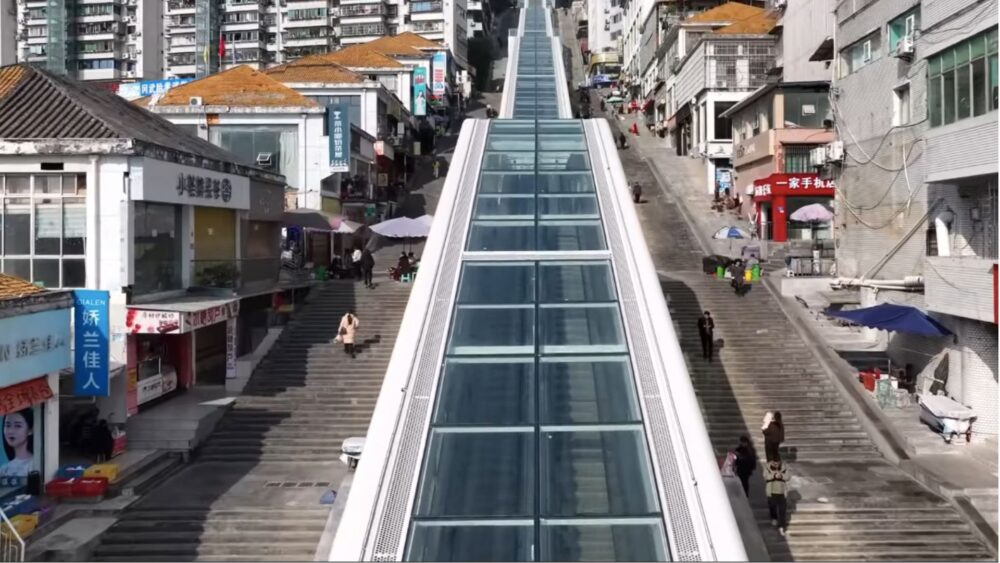
A remarkable new piece of urban infrastructure, known as the “Goddess” escalator, has opened in Wushan County, located within the broader municipality of Chongqing. The system stretches nearly 3,000 feet (approximately 914 meters) and rises 800 feet in elevation—roughly equivalent to the height of an 80-story high-rise. It is now open and carrying residents and visitors through one of China’s most topographically challenging landscapes.
It is located in an area defined by steep terrain and dramatic elevation changes that have long complicated everyday mobility. The project, developed over four years at a reported cost of US$23 million, offers a new model for pedestrian infrastructure in highly vertical urban environments.
Designed with a modular glazed structure to minimize visual bulk, the system also incorporates three public viewing platforms overlooking the Yangtze River, reinforcing its civic and experiential role beyond mobility alone. The installation comprises 21 escalators, eight elevators, four moving walkways, and multiple pedestrian bridges, creating a continuous vertical transit route that takes approximately 21 minutes to complete. Manufactured by Schindler, the system replaces a lengthy stair route and significantly reduces travel time in an area where road journeys can take up to an hour during peak traffic.
The project offers an important example of non-building vertical mobility infrastructure, demonstrating how escalator systems, elevators, and skybridges can operate at an urban scale to overcome extreme topography.
Currently in a trial phase, the escalator is reportedly serving approximately 9,000 daily users, underscoring the growing relevance of integrated vertical circulation systems as cities adapt to complex terrain and dense urban growth.
Read more at The Smithsonian Magazine.