


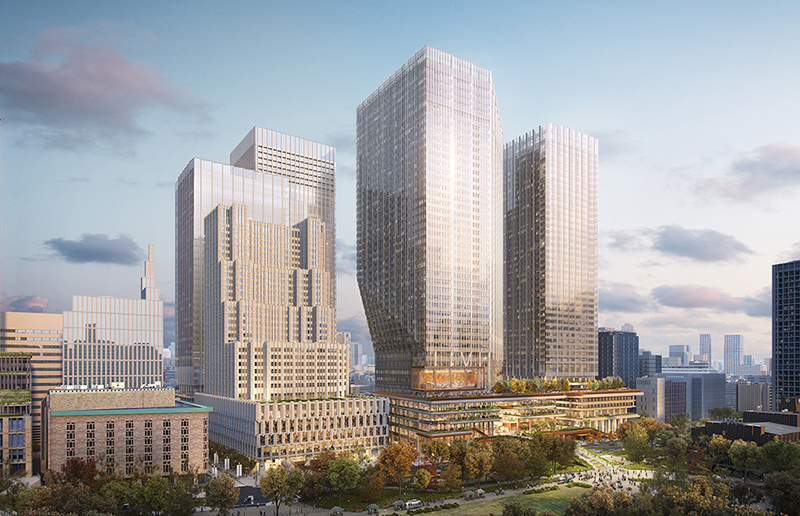
Construction officially began on the 230-meter NTT Hibiya Tower on 5 December 2025, launching one of Japan’s most ambitious mixed-use high-rise developments. Totaling 361,000 square meters, the building will serve as the new global headquarters for the tech company NTT, redefining the role of the corporate skyscraper through advanced digital infrastructure, sustainability, and mixed-use urban integration.
Developed by NTT Urban Development and Tokyo Electric Power Company, the high-rise is purpose-built around IOWN (Innovative Optical and Wireless Network)—NTT’s light-based digital platform that delivers dramatically higher data capacity, ultra-low latency, and significantly reduced energy use compared with conventional networks. The system enables the building to function as a real-time, adaptive environment for work, culture, and public life. The building will deliver 150,000 square meters of pillar-free office space, where workplaces dynamically respond to user needs through biometric sensing, AI-driven environmental control, and robotic reconfiguration. An innovation hub spanning Levels 7–10 will bring together industry and research partners focused on urban systems, ICT, and energy.
At the base, the three-story Cross Gate atrium integrates retail, cultural, and civic uses animated by immersive digital displays. A 400-seat cultural hall on Level 9 connects in real time with venues across Japan and internationally, while a 31-meter-high rooftop park introduces a new elevated green space overlooking Hibiya Park and the Imperial Palace. NTT Hibiya Tower is a central element of the Tokyo Cross Park Vision, a 1.1 million–square-meter masterplan transforming 6.5 hectares of central Tokyo into a mixed-use district anchored by four high-rises, new public spaces, and the redevelopment of the historic Imperial Hotel. The wider site and master plan is expected to complete in 2037.
Sustainability strategies for the building target ZEB Ready performance, BELS 5-star certification, and long-term carbon neutrality, combining energy-efficient design, AI-optimized operations, low-carbon materials, and future-ready clean energy systems. Together, these elements position it to operate as an intelligent urban platform rather than a static building, aligned with Tokyo’s long-term ambitions for a resilient, connected city.