


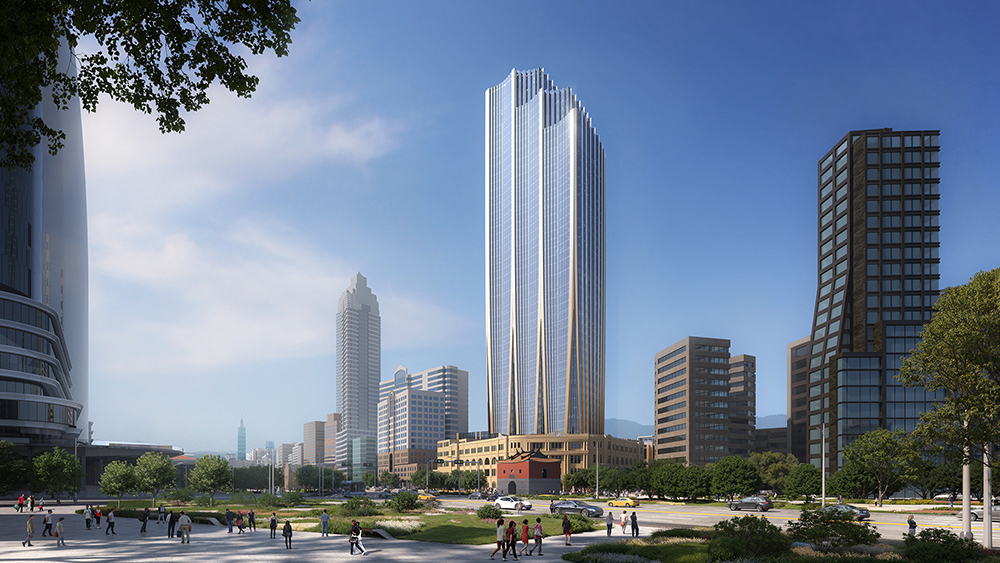
Zaha Hadid Architects, in collaboration with C.Y. Lee & Partners, has been selected through an international competition to design the National Innovation, Creativity and Finance Center (NICFC) in Taipei, and includes a 47-story landmark building. The 175,000-square-meter development will anchor Taipei’s Beimen district while consolidating four institutions under Taiwan’s Financial Supervisory Commission, including the stock exchange, futures exchange, and depository and clearing corporation.
Positioned at the intersection of Zhongxiao West Road and Bo’ai Road near Taipei Main Station, the project occupies a strategic site within the city’s Western Gateway redevelopment framework. The design prioritizes walkability and public connectivity, linking surrounding civic and cultural landmarks through a network of plazas, courtyards, and pedestrian routes. A central element of the plan preserves and restores the adjacent 1930 Taipei Beimen Post Office, converting the heritage structure into a museum and community hub while removing later extensions.
The development’s five-story podium aligns with the scale of the historic post office and introduces a new public courtyard sheltered by a sculptural glazed canopy. Above, a 47-story tower rises with a form inspired by the fluted structure of Taiwan’s native Phalaenopsis orchid. Stepped back from the heritage building, the tower establishes a distinct vertical presence while maintaining legibility within Beimen’s historic streetscape.
The tower’s planning supports efficiency and institutional separation, with floor area usage exceeding 70 percent. Dedicated zones accommodate each financial institution, complemented by shared flexible offices, meeting areas, and a conference center. Three independent elevator banks serve institutional, rental, and dignitary/service functions to ensure operational security and efficiency.
Façade articulation varies by orientation, responding to Taipei’s urban axes and surrounding landscapes. Concave northern bays frame views toward the Qixing and Guanyin mountains, while eastern façades align with Taipei 101 and the Xinyi District. A pleated façade system regulates solar exposure and airflow, enhancing environmental performance in Taipei’s humid subtropical climate. At upper levels, stepped massing provides shading and mitigates wind forces.
Targeting LEED Platinum and EEWH Diamond certification, NICFC is designed to operate at net-zero carbon emissions. High-performance double-glazed curtain walls, integrated photovoltaics, rooftop solar arrays, rainwater harvesting, and modular structural systems contribute to reduced operational and embodied carbon. Digital modelling and orientation studies have informed façade optimization and material selection, reinforcing long-term durability and efficiency.
By integrating heritage preservation, civic space, and advanced environmental systems within a high-density financial hub, NICFC exemplifies a contemporary model of vertical urbanism—where institutional infrastructure, public realm, and sustainable design converge in the heart of the city.
Learn more at DesignBoom.