


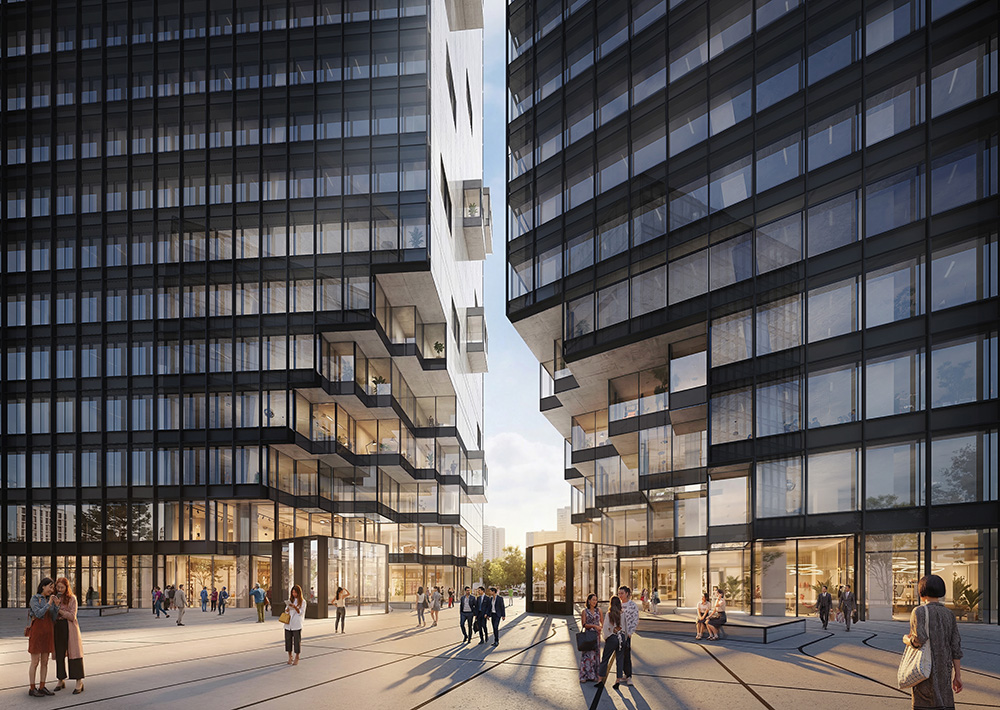
Designs have been unveiled for Nangang Pair, a two-tower office development that will create a new urban gateway for Taipei’s rapidly evolving Nangang district. Developer JUT Group has commissioned architecture firm MVRDV to design the development. Reimagining a conventional office slab by dividing it into two complementary high-rises, the design creates a public plaza that connects directly to Kunyang Station and the surrounding neighborhood.
Located at one of Taipei’s busiest transportation hubs, where high-speed and regional rail lines converge, the project responds to intense pedestrian movement by splitting the building mass to create a generous public passage rather than obstructing circulation. The resulting plaza frames views toward nearby Hsin Hsin Park while establishing a clear point of arrival for the district.
The result is that the two high-rises appear as a single building that have been pulled apart. Along the inner faces, balconies and recessed volumes create the impression of a fractured form, reinforced by contrasting façade treatments. The outer elevations feature a glass curtain wall with pronounced mullions, while the inner façades are finished with a smoother, flush surface that emphasizes the opening between the buildings.
At street level, sculpted corners and angled structural columns create column-free entrances that accommodate spacious lobbies, retail spaces, cafés, and restaurants. Shared tenant amenities, including lounges and video conferencing facilities, occupy the third floor, while small pavilion-like structures activate the public plaza with seating and kiosks.
The project also integrates several sustainability measures, including rooftop photovoltaic panels, rainwater harvesting systems for landscape irrigation, and detention tanks designed to support urban flood management. A rooftop garden provides additional outdoor space for tenants.
Recently, Nangang has transformed into one of Taipei’s principal centers for technology, finance, and innovation. As redevelopment has accelerated across the district, Nangang Pair seeks to establish a distinct architectural identity while reinforcing the importance of transit-oriented, pedestrian-focused urban design.
Read more at MVRDV.