


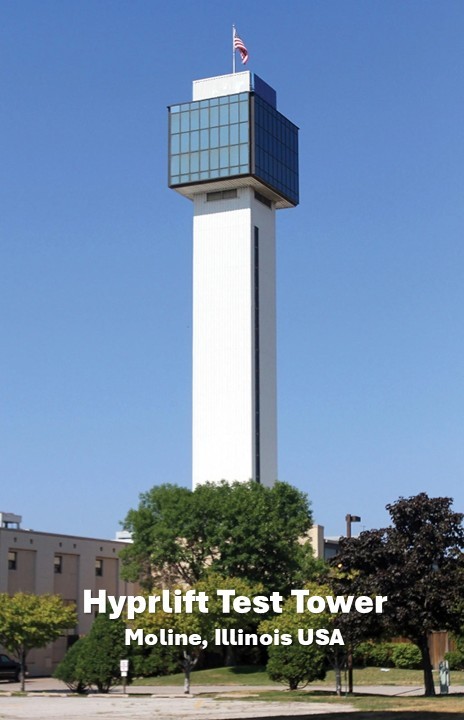
The City of Moline in Illinois has announced a new partnership with Hyprlift and the National Science Foundation to transform the historic Montgomery Elevator test tower into a center for next-generation vertical mobility research and testing. The collaboration will repurpose the tower as a certification and development facility for advanced elevator technologies, positioning Moline at the forefront of innovation in vertical transportation.
Constructed in 1966 by Montgomery Elevator, the test tower has long been a defining feature of Moline’s riverfront and a symbol of the city’s role in the evolution of the elevator industry. Under the new agreement, the tower will be integrated into the Moline River Front + Centre redevelopment plan, bringing federal innovation funding and new economic activity to the area while preserving a landmark of industrial heritage.
Hyprlift approached the city in search of a suitable facility to test and certify its next-generation elevator systems. Moline offered access to the Montgomery tower, aligning the company’s technical needs with the city’s broader redevelopment and preservation goals. In return, the City of Moline became Hyprlift’s commercial partner in securing a Technology Enhancement for Commercial Partnerships (TECP) award from the National Science Foundation, accelerating the startup’s path to commercialization and anchoring federal research investment locally.
“This collaboration preserves an important piece of our past while positioning Moline where the elevator industry’s next chapter of technological advancement will be written,” said Bob Vitas, Moline’s city administrator. City officials emphasized that the partnership represents a rare convergence of history, technology, and economic development.
Founded in 1892 as the Moline Elevator Company, Montgomery Elevator operated in the city for more than a century, helping establish Moline as a center of vertical transportation innovation. When the city acquired the riverfront property in 2022, plans for redevelopment called for removing several surrounding structures, but the test tower was identified as a key architectural and cultural asset to be retained as part of the skyline.
By adapting the Montgomery Elevator test tower for contemporary research and testing, the partnership underscores how legacy vertical infrastructure can be reimagined to support the next generation of urban technology. For CVU, the project highlights the continuing importance of vertical mobility innovation as cities grow denser and the value of preserving industrial landmarks as active contributors to the future of vertical urbanism.
Read more at Elevator World.