


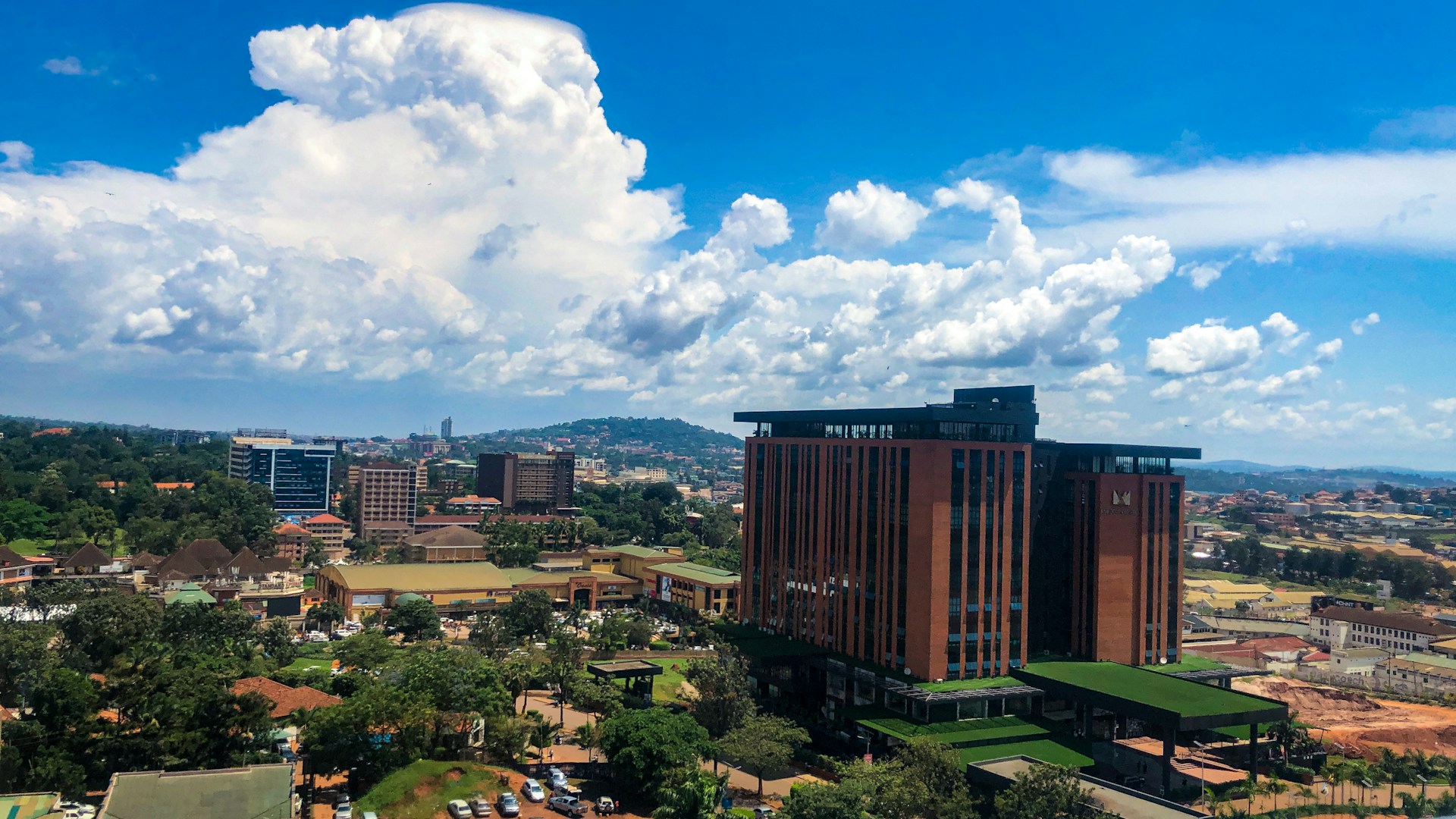
Following the completion of Pearl Tower One, Sudhir Ruparelia has unveiled early details of the next major expansion of Kingdom Kampala, advancing Phase Two of the mixed-use development in the heart of Kampala. The new phase centers on a 21-story building topped with a rooftop helipad, reinforcing the long-term role of Ruparelia Group as a central private-sector force shaping the city’s commercial and urban evolution.
Architectural renders released in early 2026 depict a contemporary high-rise rising from a multi-level podium integrated into the existing Kingdom Kampala Mall complex. The design combines vertical glass façades with brick framing, landscaped terraces, and green roof elements intended to soften the building’s mass while enhancing its civic presence. A defining feature is the inclusion of a rooftop helipad and heliport—still rare in privately developed commercial real estate in Uganda—positioning the project firmly within the premium segment and targeting senior executives, investors, and international business travelers.
At podium level, the development emphasizes permeability and urban connectivity, with wide terraces, arched openings, and generous walkways accommodating retail, office, and public-facing commercial uses. These elements build on the foundation established by Phase One, completed in 2019, which transformed a prime CBD site into a high-activity mixed-use destination combining retail, Grade-A offices, and structured parking, and has since played a key role in revitalizing this part of the city.
Phase Two signals a broader ambition to evolve Kingdom Kampala toward a “vertical city” model, where commercial, hospitality, residential, and leisure functions are layered within a single, walkable urban precinct. As Kampala’s population and economic density continue to rise, developments of this scale are increasingly seen as critical to meeting demand for premium space while strengthening the city’s competitiveness within the region. As construction progresses, the expansion underscores growing confidence in Uganda’s urban future and the role of long-horizon private investment in shaping a modern African capital.
Read more at CEO.co.ug