


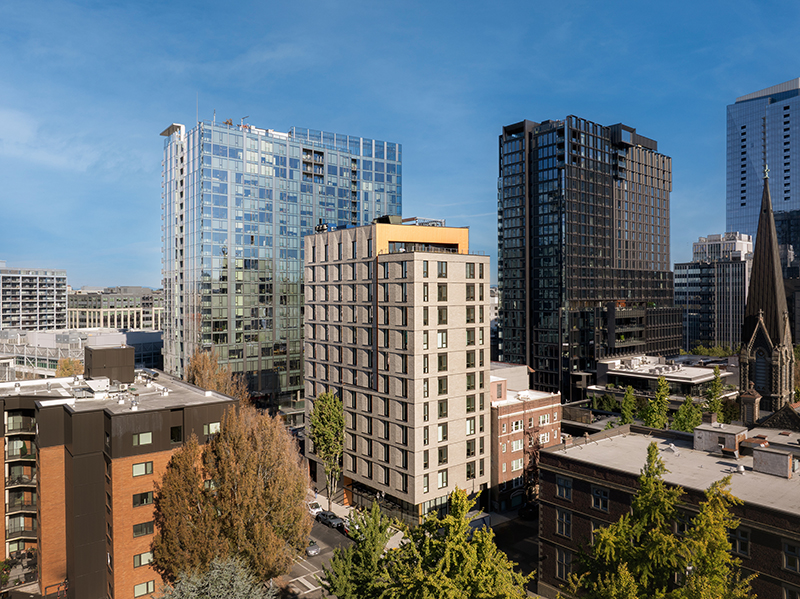
A new milestone in equitable and sustainable urban development has been reached in downtown Portland with the opening of Julia West House, a 12-story mass-timber residential building that provides permanent supportive housing for some of the city’s most vulnerable residents. CVU (previously CTBUH) joined the opening celebrations with speakers from the city and the project, including Jessica Woodruff, Chief Development Officer of Community Development Partners, Councilor Mitch Green of District 4, City of Portland, and Multinomah County Chair Jessica Vega Pederson.
The building has become Oregon’s tallest mass-timber residential building, transforming a formerly underutilized 5,000-square-foot (464.5-square-meter) lot into a vertically oriented community designed around resilience, affordability, and restorative living. Developed by Community Development Partners (CDP) and designed by Holst Architecture, with structural engineering by KPFF and construction by CTBUH member Walsh Construction Co., the 56,000-square-foot (5,203-square-meter) project delivers 90 units reserved for individuals earning 30 percent or less of the area median income. The building targets older adults experiencing or at risk of homelessness—a population that now represents nearly a quarter of Portland’s unhoused residents, with BIPOC individuals disproportionately affected. As of early November, the building is more than 65 percent occupied.
At the event, Chair Pederson acknowledged and congratulated the project, stating that it is an example of “being intentional about what inclusiveness needs to be and what our city needs to be.”
Julia West House originated from a long-standing vision of the First Presbyterian Church of Portland (FPC), which acquired the site in the 1980s for community use. CDP purchased the parcel in 2024, continuing the church’s mission by replacing the former single-family home—named for Julia West Lindsley, wife of the church’s first pastor—with a high-rise supportive housing community.
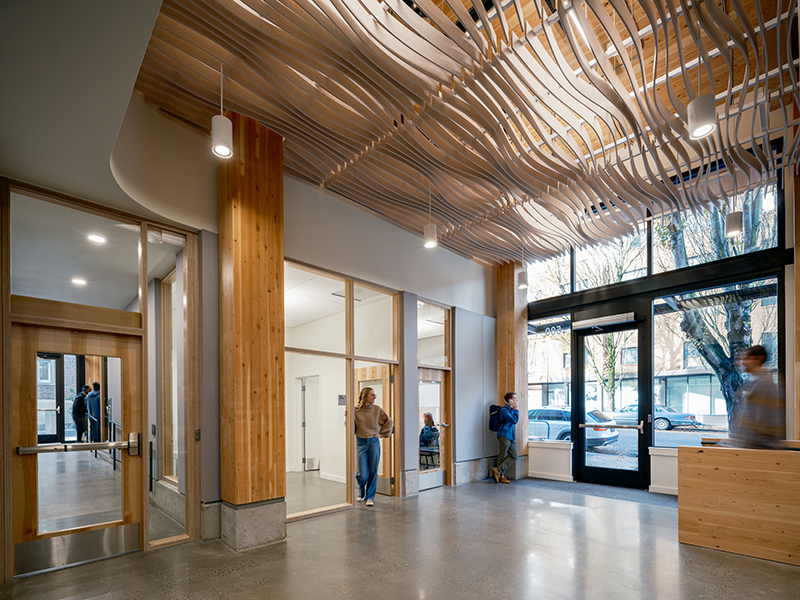
The project exemplifies the growing role of mass timber in mid-rise and tall residential construction across the United States. Early commitment to a mass-timber structural system enabled the team to pursue one of Oregon’s first Type IV-B buildings, with exposed glulam beams, columns, and ceilings contributing to the building’s warm material identity. The façade expresses communal spaces as large carved openings, connected vertically by a basalt-like fissure that evokes the historic waterways of the Columbia River basin.
In addition to its architectural ambitions, the building advances regional sustainability goals. Julia West House is on track for National Green Building Standard and Energy Star certification. Funding support—including USDA Wood Innovations grants, Low-Income Housing Tax Credits, and Portland Clean Energy Community Benefits Fund (PCEF) contributions—reflects public-private alignment around low-carbon construction and long-term operational efficiency.
A robust network of local service providers animates the building’s supportive-housing mission. Northwest Pilot Project (NWPP), the Native American Rehabilitation Association of the Northwest (NARA NW), Community for Positive Aging (CfPA), and Lift Urban Portland work in partnership with Multnomah County’s Homeless Services Department to identify residents and deliver comprehensive wraparound care. Dedicated case management focuses on aging in place, stability, social connection, and—through NARA NW for 20 units—recovery programs rooted in Native American cultural traditions.
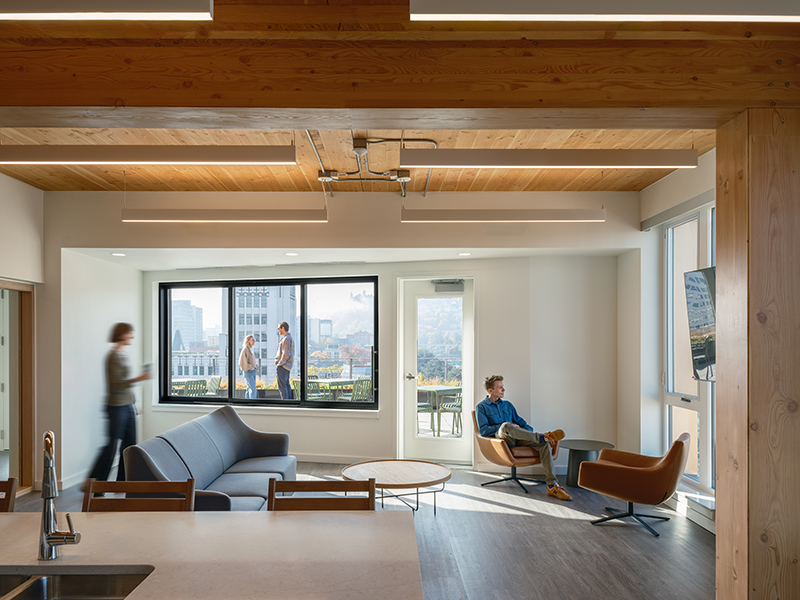
Residents also benefit from a range of shared amenities, including a community room, lounge, communal kitchen, rooftop patio, laundry facilities, bike storage, and on-site offices for property management and service teams.
Julia West House demonstrates how mass-timber high-rise design, integrated community services, and sustainable construction practices can converge to address housing insecurity and embodied carbon within dense urban environments, creating a more equitable vertical urbanism.