


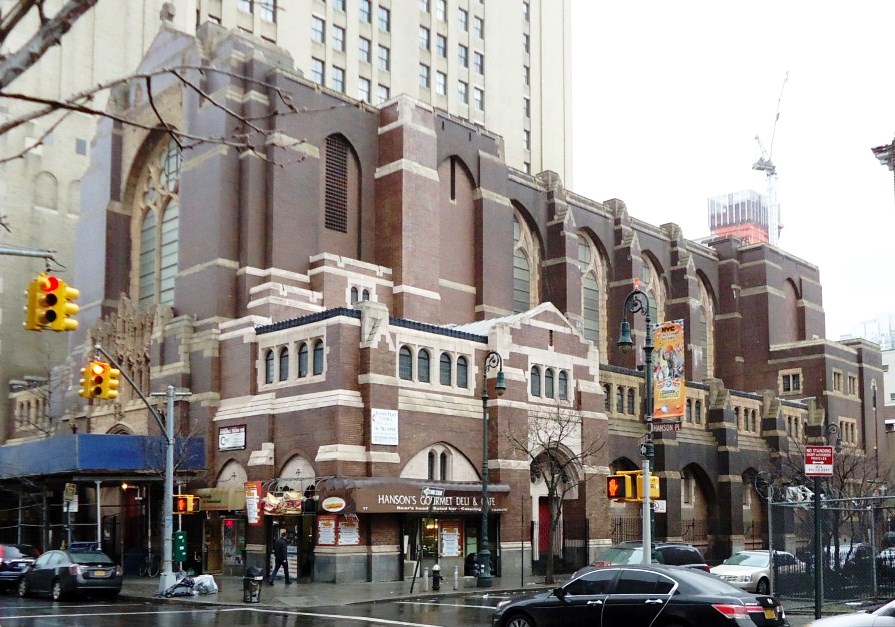
A major adaptive reuse project is moving forward after the New York City Landmarks Preservation Commission approved plans for a 24-story residential high-rise rising from the base of the currently vacant former Hanson Place Central United Methodist Church in the Fort Greene neighborhood of Brooklyn.
The neo-Gothic church, an ageing property built in 1931 at the southeast corner of Downtown Brooklyn, had been vacated in 2019 and sold to developer Watermark Capital Group in early 2024, after years of declining membership and mounting maintenance costs. Although the uniqueness of such buildings typically makes them challenging to repurpose, the proposed 87-meter (284-foot) tall concept design led by FXCollaborative and Acheson Doyle Partners Architects for a residential building rising within the footprint of the historic church provides an innovative direction for the future while preserving the original exterior facade of the church.
With a recently revised design that had reduced the height by 4 meters (13 feet) from earlier submissions and more closely aligning its massing with the church’s geometry will provide a substantial adaptive reuse and vertical addition. The approved scheme includes the restoration of the church’s St. Felix Street and Hanson Place facades, masonry and ornament repairs, preservation of key religious iconography, upgraded windows, and the introduction of new retail and community space at the lower levels. Responding to the surrounding historic context, the new high-rise is designed to remain visually secondary to the district’s landmark skyline presence.
The project highlights a growing urban challenge: how cities can responsibly adapt underused religious buildings while responding to housing demand. Commissioners described the scheme as a potential model for church adaptive reuse, balancing preservation with contemporary urban needs. It marks a significant step toward reintegrating the site into Brooklyn’s evolving vertical residential fabric.
Read more at Brownstoner.com