


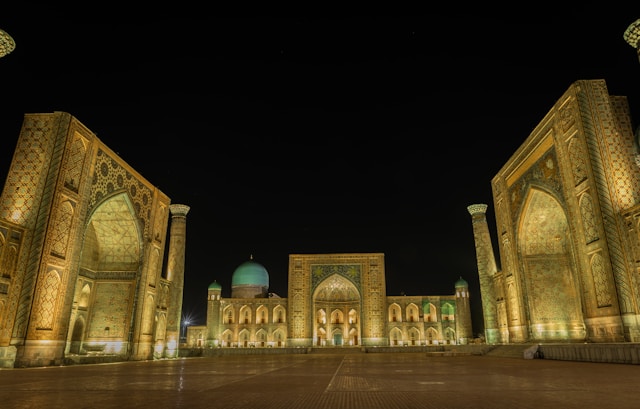
The government of Uzbekistan has released a draft master plan for Samarkand extending through 2045, outlining an ambitious strategy for managing rapid urban growth while balancing heritage preservation, infrastructure expansion, and higher-density development.
Published for public discussion by Uzbekistan’s Cabinet of Ministers, the plan was prepared by the Samarkand regional government following directives from President Shavkat Mirziyoyev. The framework establishes long-term policies for land use, transportation, infrastructure, construction controls, and socio-economic development in one of Central Asia’s fastest-evolving urban centers.
The plan projects substantial population growth, with Samarkand expected to expand from approximately 560,000 residents today to as many as 1.2 million people in the coming decades. To accommodate this growth, the city’s development boundary could expand from 11,272 hectares to more than 28,000 hectares.
A central feature of the proposal is a zoning framework that differentiates between conservation, reconstruction, and redevelopment areas. Conservation zones would restrict new construction to preserve Samarkand’s historic and natural heritage, while redevelopment districts would allow the replacement of obsolete industrial sites and low-rise housing with larger integrated urban projects.
In designated reconstruction zones, authorities would permit high-rise development as part of broader urban densification efforts, subject to infrastructure capacity and public consultation requirements. The approach reflects a growing regional emphasis on concentrating growth within existing urban areas rather than allowing unchecked peripheral expansion.
The master plan also places significant emphasis on environmental and public-space strategies. Officials propose creating an additional 11,000 hectares of green space alongside an 18,000-hectare green belt surrounding the city. If realized, the initiative would double per-capita green space to approximately 10 square meters per resident.
Transportation infrastructure forms another major component of the strategy. Alongside upgrades to existing road networks, the plan calls for 837 kilometers of new roads, expansion of 160 kilometers of current highways, and the introduction of tram infrastructure spanning 27 routes, signaling a major shift toward more comprehensive urban mobility systems.
Read more at UZ Daily.