


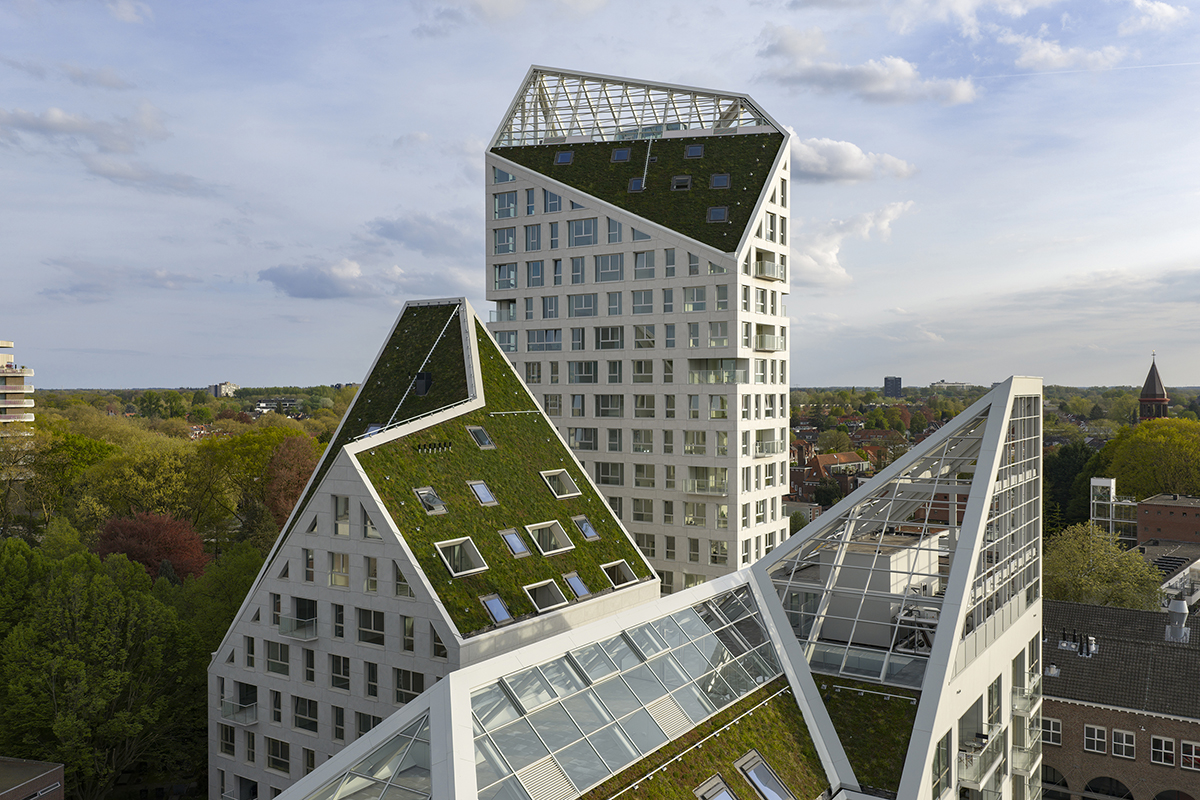
MVRDV has completed Nieuw Bergen, a seven-building residential development in the heart of Eindhoven that adds 237 homes while demonstrating how higher-density housing can be integrated into a historic urban neighborhood without sacrificing sunlight, green space, or local character.
Developed by SDK Vastgoed, the project combines five new buildings with the adaptive reuse of two former police station buildings in the city’s Bergen district, one of Eindhoven’s oldest neighborhoods. The development introduces a mix of housing types, ranging from social housing and apartments for singles to family residences and luxury penthouses.
A defining feature of Nieuw Bergen is its distinctive series of sloping rooflines, which create a mountain-like silhouette across the neighborhood. Rather than serving as a purely aesthetic gesture, the roof forms were shaped by daylight studies. Roof surfaces follow 45-degree angles from neighboring buildings, helping preserve sunlight access to apartments, streets, and public spaces while allowing for increased density on the site.
The development transitions in scale from six-story residential buildings to a 17-story tower, creating a gradual relationship with the surrounding low-rise urban fabric. This progression is reinforced through a changing palette of façade materials and colors, moving from the darker brick of the historic buildings to lighter tones on the taller structures.
Nieuw Bergen places significant emphasis on shared outdoor space and biodiversity. Green roofs and photovoltaic panels occupy the sloped rooftops, while communal terraces and a rooftop greenhouse provide opportunities for residents to gather, garden, and host events. At street level, largely car-free public spaces and ground-floor retail create an active urban environment that extends the character of the surrounding neighborhood.
The project also incorporates several sustainability measures. Reusing existing buildings reduced embodied carbon, while energy-efficient systems, solar panels, and extensive rooftop planting help lower operational impacts. Green roofs contribute to rainwater management, urban cooling, and biodiversity within the city center.
According to MVRDV founding partner Jacob van Rijs, the goal was to transform a collection of municipal buildings and parking lots into a mixed-use neighborhood with activity throughout the day while maintaining the area’s distinct identity.
The completed development offers a contemporary example of urban intensification that combines housing, public space, adaptive reuse, and environmental performance within a compact city-center site.
Read more at MVRDV