


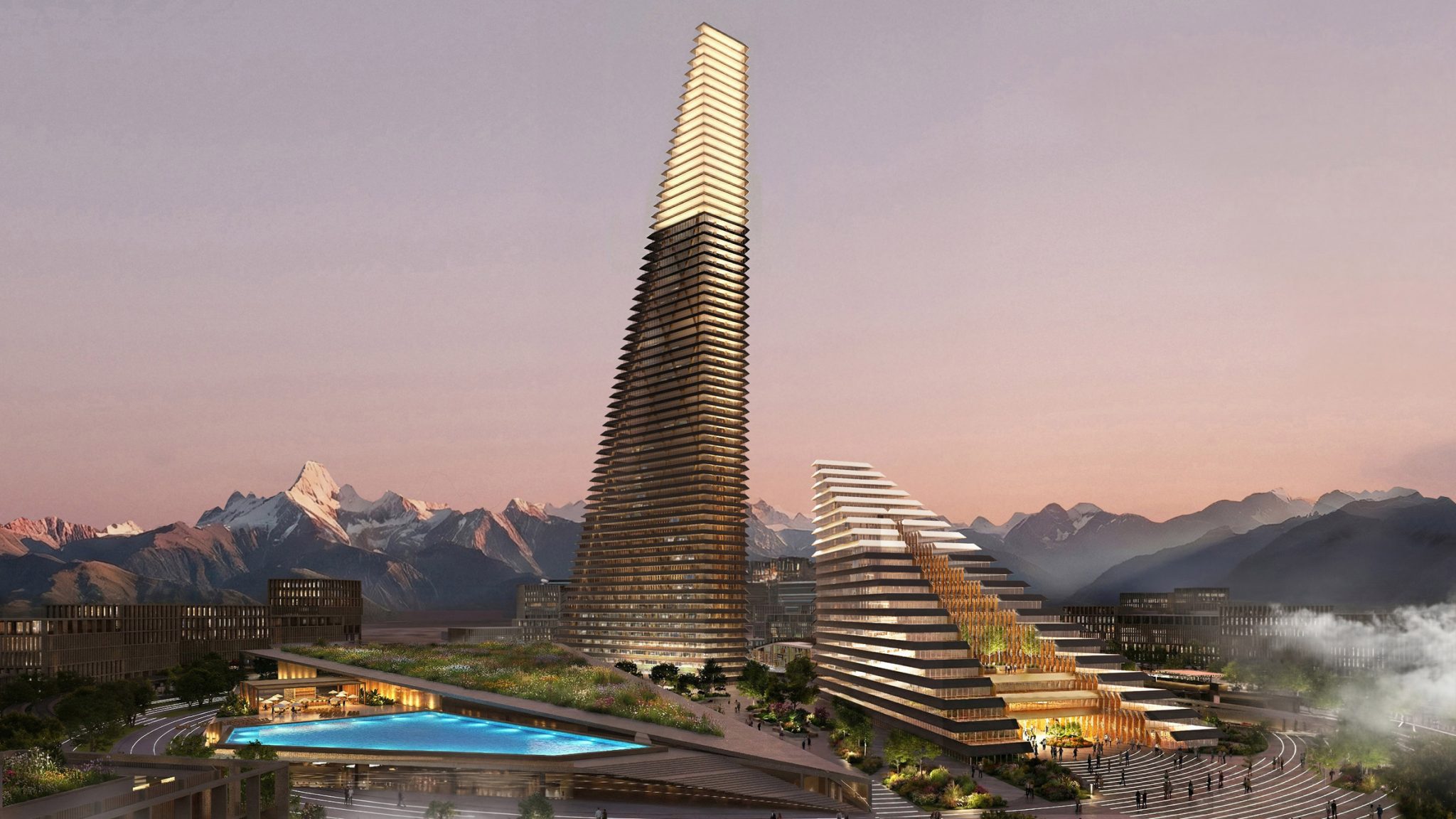
Designs have been revealed for the Alatau Iconic Complex and Gateway District, a mixed-use development planned as the centerpiece of the emerging city of Alatau that is a new high-density urban core taking shape in Kazakhstan, near the city of Almaty.
Architects Skidmore, Owings & Merrill (SOM), the proposal introduces a pair of stepped, wedge-shaped buildings conceived as a defining landmark for the new city. The primary building will reach a height of 272 meters and will accommodate office and residential space, while an adjacent 80-meter building will house a luxury hotel and branded residences. Together, they form a 276,800-square-meter vertical district, establishing a dense, mixed-use nucleus within the broader 88,000-hectare master plan.
Drawing inspiration directly from the nearby Trans-Ili Alatau mountain range, the design translates its layered topography into architecture through stepped forms and cascading external terraces at each level. The largely glazed façades are punctuated by large central atria, which bring daylight deep into the interiors while framing panoramic views of the surrounding landscape. These openings are expressed as stepped voids with glazed fronts and integrated terraces, reinforcing both environmental performance and spatial connectivity.
At the base, a three-level, 58,000-square-meter podium terraces into the public realm, accommodating retail, cultural venues, and event spaces. Landscaped public areas extend outward, creating a pedestrian-oriented environment that anchors the development within its urban context.
The project is strategically located along the Almaty–Qonaev highway, part of the Western Europe–Western China transport corridor, positioning Alatau as a key node for regional connectivity and economic growth. The surrounding Gateway District is planned as a transit-oriented hub, integrating future express rail and light rail systems with walkable streets, green boulevards, and public plazas. Environmental performance and resilience are central to the scheme. High-performance façades and integrated shading strategies reduce solar gain, while the towers incorporate advanced seismic design, including damping systems suited to the region’s high seismic activity.
Led by the Alatau City Development Group with government support, the project reflects Kazakhstan’s ambition to establish a new generation of cities defined by density, mobility, and economic diversification. Once complete, the Iconic Complex is expected to serve as both a symbolic gateway and a functional center—setting a new benchmark for vertically integrated urban development in Central Asia.
Read more at SOM.