


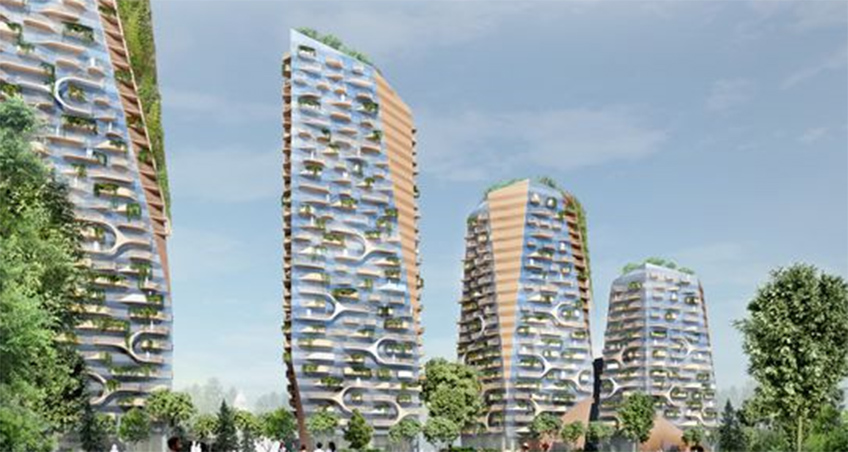
Imagine: It’s 2035. As you look across False Creek toward downtown Vancouver, the two arms of a ceremonial gate rise alongside the Burrard Street Bridge. It’s flanked by distinct towers with façades punctuated by imagery created by Indigenous artists and surrounded by green landscapes and copses of red cedar.
This is a Vancouver where the Squamish Nation has a strong presence on the skyline – and a serious impact on the city, having built 6,000 homes in a new neighbourhood called Sen̓áḵw.
Fourteen months after the proposal was publicly introduced, its architecture is largely complete, and it has evolved. “The expression of Squamish values is becoming more and more clear,” said Khelsilem, a Squamish councillor who is leading the project for his Nation in partnership with Westbank. They plan to start construction late in 2021.
Khelsilem recently described the project together with its lead architect, Venelin Kokalov of Revery Architecture. It will be the largest and most prominent example yet of Indigenous city-building in North America, and its urban design breaks dramatically with convention: Senakw will be compact, green and dense, bringing public life across the site and below ground.
The four-million-square-foot (371,612-square-meter) project will occupy a three-pointed, 10.5-acre (4.7-hectare) fragment of traditional Squamish land along False Creek. The site includes the area under the bridge and a strip alongside Vanier Park.
The project, which is not subject to city regulation, now consists of nearly a dozen buildings ranging from 26 to 59 stories. Since last year, the Squamish and Westbank have added an office tower. It will include low-carbon construction and energy-efficient architecture as well as a rich mix of activities.
“Because we’re in control as landowners and developers, there are many opportunities to shape different aspects of the project,” said Khelsilem, who uses only one name.
One theme is sustainability, which for the Squamish means a strong push away from private vehicles. The transit hub on the bridge, Khelsilem said, serves this goal. It would link buses, a future LRT line, and a bike garage with space for 6,000 bicycles and hundreds of e-bikes available for rent. There will be “minimal” car access and parking.
All this would be marked by a gateway, designed by an Indigenous artist. “There’s a strong desire to express Squamish identity though the public realm,” Khelsilem said, “and through the rest of the development.”
Senakw will run on a new low-carbon district energy system. And Mr. Kokalov said that, while Senakw’s tall buildings will have structures of concrete – generally an energy-intensive material – the team is pursuing low-carbon cement which can reduce the concrete’s carbon footprint substantially, and engineering that can significantly reduce the quantity of concrete in the floor slabs. The towers will be faced with screens that provide shade, displaying imagery that holds significance to the Squamish: a fish, for instance, a symbol of regeneration.
Senakw will also be quite literally connected to the earth. Mr. Kokalov, who leads Revery Architecture, uses the phrase “Towers in the park” to describe the scheme. Usually this refers to a modernist vision of tall towers, surrounded by light and air, in a sea of green space. The contemporary convention in urban design, particularly in downtown Vancouver, has thus far been the opposite: buildings typically present a clear, consistent face to public streets.
While the latter may generally be a valid approach in busy urban contexts, it has its limits. How would it work on a site like this, with oblong fingers stretching in three directions and a bridge overhead, that aspires to be as pedestrian-oriented as possible? In normal practice this site – if it was developed at all – would have a handful of buildings that are short and squat. As is the case with a planned development by Concord, next door on the old Molson brewery site.
The Squamish have a different view, Khelsilem said. The Senakw buildings will cover approximately 10 per cent of the site and the abundant outdoor spaces around them “will be accessible by the residents and also by the general public,” he said.
Meanwhile bike storage is reached by long, shallow ramps to the underground parkade. (Cars, very few of them, will get the next level down.) Shops and restaurants will be dispersed throughout the ground level.
All this makes for a powerful, almost utopian vision: Roughly 9,000 people can live in proximity, moving on foot or e-bike from home to daycare to green space – and freely sharing their neighbourhood with the community. This, Khelsilem said, is familiar. “It’s about opening up, and not alienating people,” he said. “It’s a village feeling, reminiscent of our historical community here.”
For more on this story, go to The Globe and Mail.