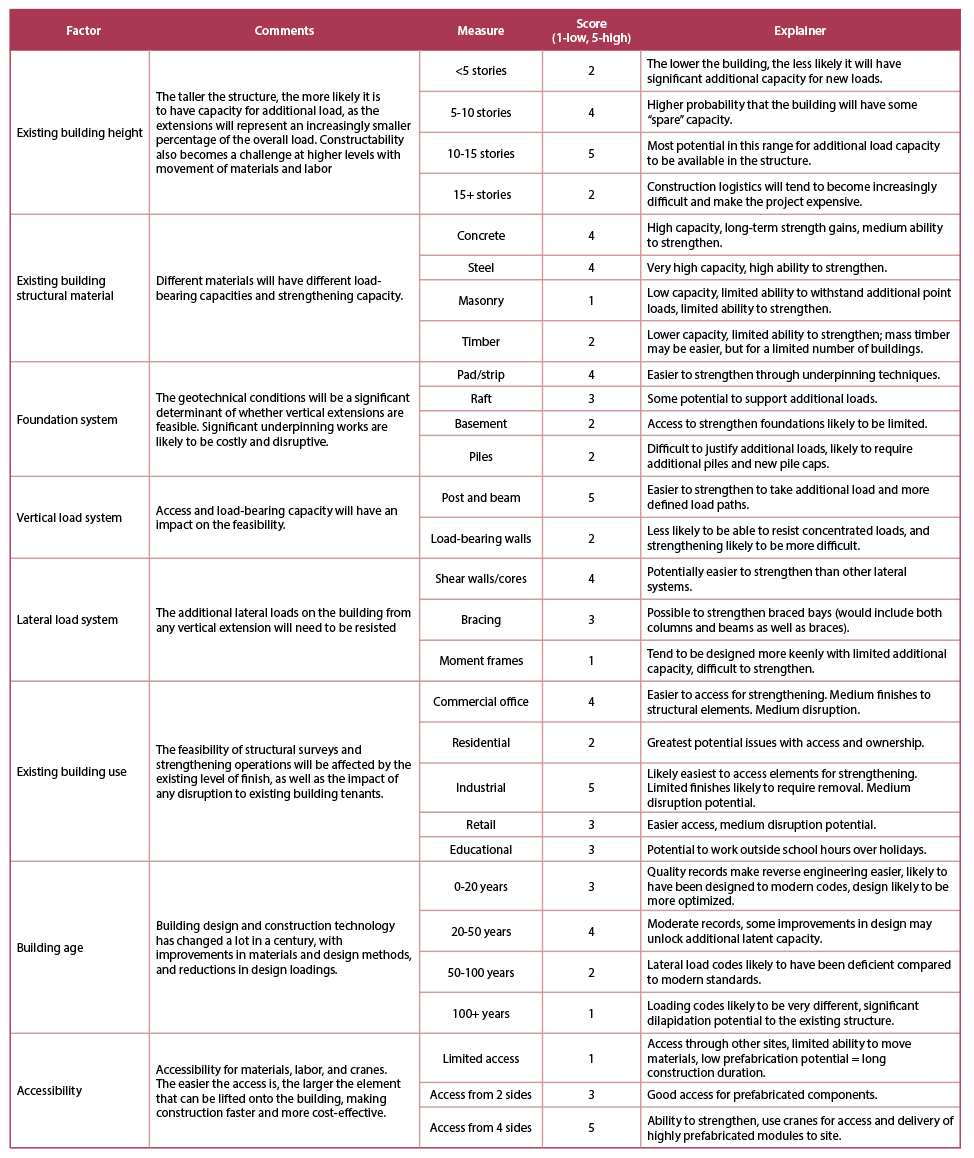
The keys to applying a vertical extension solution to an existing building require several important requirements to ensure success. Critical to the assessment of a vertical extension project is access to existing information relating to the existing building. Structural drawings—for example, around reinforcement and wall, column and floor details—are essential to the assessment and justification of the approach.
The capacity of the existing structure must be carefully assessed to see if any additional capacity exists, thus minimizing any additional strengthening requirements for columns, the stability system, pilings, and other substructure concerns. In addition to the capacity assessment, all viable options to install strengthening measures must be evaluated to find the optimum solution for the project.
Common Foundations and Strengthening Options
Such an assessment requires a review of different options and the likely consequences on the architecture of the building, the access required to install walls and larger footings or strengthen columns, and the extent to which demolition is required to enact the preferred solution.
Concrete Pad
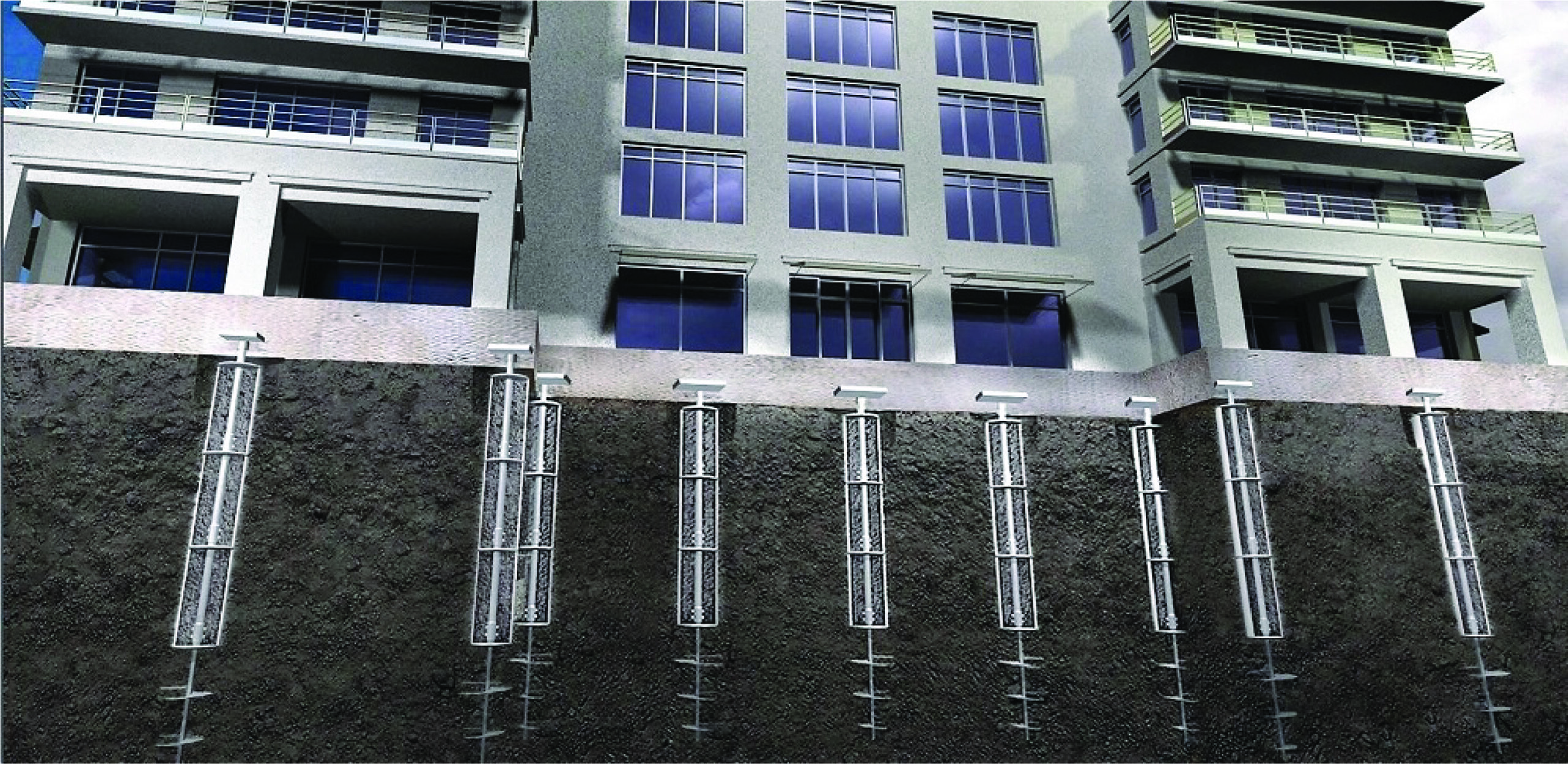
In a building with a concrete pad as the base support, it should be kept in mind that these are reliant on spreading the load from the structure over a large enough area to avoid overloading the soil. Care needs to be taken to check the loading on individual pads relative to each other. If the vertical extension is only over part of the existing building footprint, then it is possible that adjacent footings could see very different loads, and this could lead to differential settlement and potential damage to the existing structure. To strengthen, existing pads or strips could be underpinned to increase capacity. This could take the form of traditional mass concrete underpinning down to soil of a higher capacity (see Figure 2). Alternatively, piling or micro-piling could be tied into the existing pads to increase capacities. Pad foundations represent one of the easier foundation types to strengthen.
Concrete Raft
Rafts represent a good option for extensions, as they tend to spread loads over larger areas. Overall stability loads for the building are likely to be the key factor, as the magnitude of overturning loads increases with height. Additional vertical loads are spread over a large area and may be able to be justified without strengthening. Larger overturning loads may require strengthening through underpinning around the perimeter.
Basement
Basements may behave more like a raft and spread additional load over a wide area. Strengthening or underpinning of a deep basement is likely to be complex and costly. Strengthening would be limited by available equipment. Micro-piling rigs may be able to access lower levels, and could be used to add additional capacity.
Piles
The design of piles is very dependent on the soil conditions, and they could be based on skin friction or end-bearing. They could accommodate additional load, but it would be very difficult to justify without extensive installation records. Strengthening of piles is likely to include the installation of additional piles adjacent to existing ones and tying them together with a new pile cap.
Superstructure Options
The superstructure refers to all the structural elements above ground floor, although for the purposes of this paper, the stability systems have been separated out. The ability for an existing structure to support additional load is very dependent on the material used, with the higher capacity materials (concrete and steel) being far more likely to be able to support additional loads, as these are more likely to be used in taller buildings.
Steel structures tend to make good candidates for vertical extensions. Depending on the design codes applicable at the time of construction, there may be additional vertical capacity that could be demonstrated through a more sophisticated understanding of the material. Steel structures can often be easier to strengthen. Typically this is done by either: welding additional vertical load-bearing elements to the structure, encasing with reinforced concrete to share the load, or reducing the tendency for buckling by providing restraint to the columns.
Stability System Strengthening Options
Stability elements are the structural components of a building which allow it to resist horizontal loading, typically mainly due to wind or earthquake loads. They must resist the horizontal loads at each level and transfer these down to a suitable foundation system. Several types of systems and options for strengthening were considered.
Shear Walls/Cores
Typically, these will be constructed from reinforced concrete. Lateral loading is resisted through walls running parallel to the direction of load, and the walls behave like a vertical cantilever from ground. These could be strengthened through the thickening of walls, or by adding in other tensioning elements to resist additional overturning.
Bracing
Commonly used in steel structures, bracing is often placed in strategic locations around the building to provide resistance to lateral loads. Diagonal bracing elements join between column/beam nodes and resist the loads through tension or compression. It is possible to strengthen braced bays through welding additional strengthening members or reinforcing connections. However, it may be simpler to add braced bays across the floor plate, should the building layout permit.
Moment Frames
Used in either concrete or steel buildings, moment frames resist the lateral loads by spreading the load across multiple columns and beams and designing the connections between them to behave rigidly. Moment frames are typically less stiff than shear walls or braced bays, and can increase the size and expense of the frame. They are not often used in taller buildings for these reasons. They are likely to offer limited additional capacity for load without significant modification. Strengthening would be more likely to be cost-effective through adding in bracing or shear walls to take additional loads, rather than trying to strengthen the moment capacity of the connections.