Resources
Research
Research Papers
Paper

Exposed Mass Timber in High-Rise Structures: A Practical Discussion of a Complex Fire Problem

Fire & Life Safety

No alt text found

1 / 10

Abstract

High-rise mass timber buildings with structures of cross-laminated timber (CLT) and glued-laminated timber (glulam) are being planned and constructed globally. However, high-rise buildings have strict performance requirements for fire safety, such as being able to withstand fully developed fires without collapse. Exposed mass timber in a fully-developed fire has been explored through full-scale fire testing, but only in compartments of up to 90 square meters of floor area. Tests show that large areas of exposed timber, and the specific configuration of these areas, have a significant impact on fire dynamics, compared to non-combustible structures. Designing a building with exposed mass timber requires an understanding of current research to identify and address the hazards introduced. To meet market demand for low-carbon construction, pragmatic design standards for fire safety are required. High-rise buildings can be designed with limited areas of exposed timber, but design decisions for fire safety will influence the building architecture.


Keywords: Fire Safety, Mass Timber, Tall Buildings

Introduction

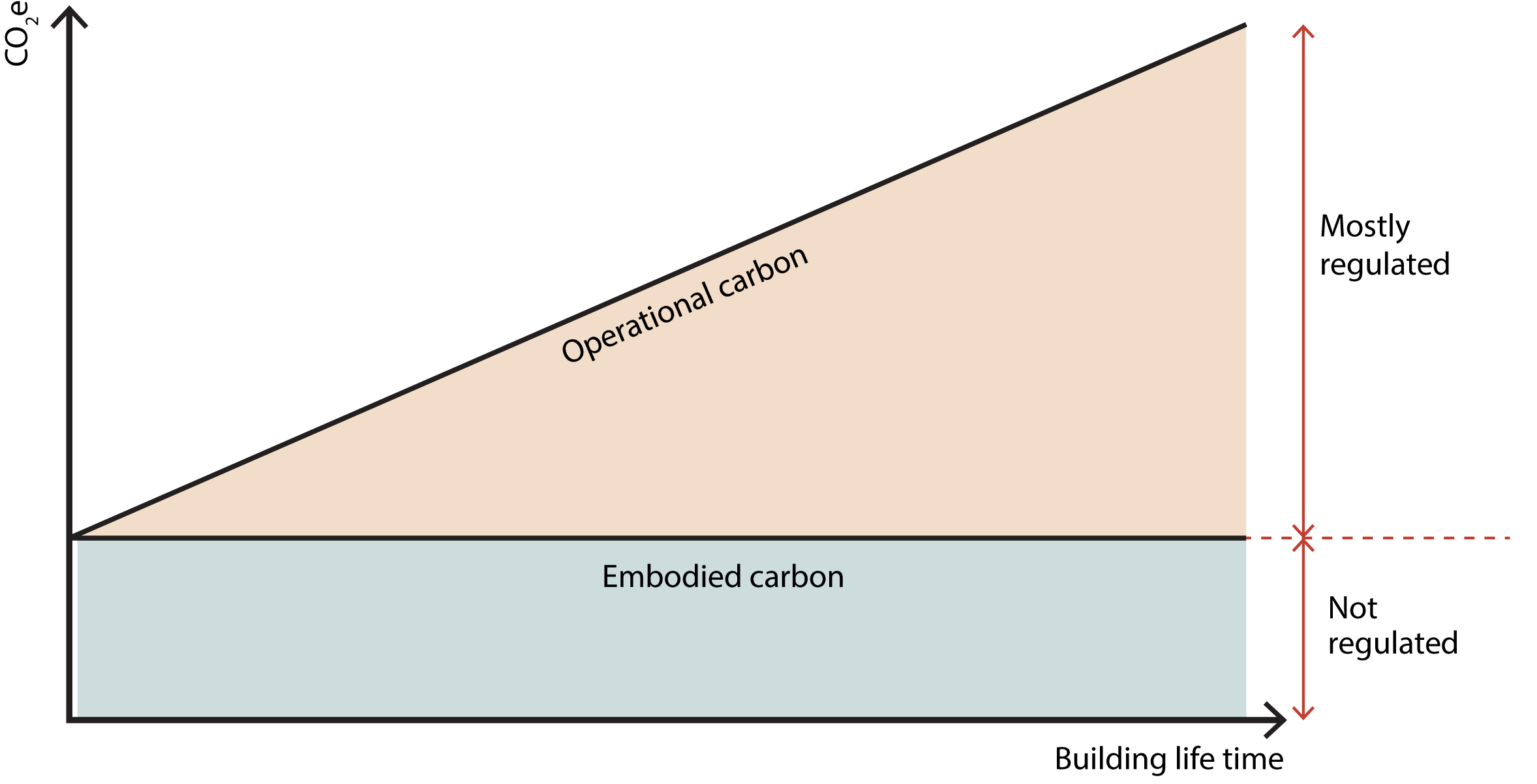
The development of multistory buildings utilizing engineered mass timber, such as glued-laminated (glulam) and crosslaminated timber (CLT), are becoming globally prevalent, as they are aesthetically distinctive and reduce embodied carbon (see Figure 1). Mass timber buildings typically use a combination of glulam for the structural frame with CLT floors and walls.

While combustible, engineered timber has f ire resistance ratings for standard fire exposures that have been well researched and understood (White 2016) with results applicable for low- and medium-rise buildings (i.e., those buildings with lower consequences of failure and lower design reliability). To date, the design of multistory mass timber buildings has been predominantly based on protecting timber elements with gypsum board products to improve their required fire resistance rating (FRR) at the expense of the carbon footprint and cost. The protective board performs the function of either delaying or altogether preventing pyrolysis and/or combustion of the mass timber. Accompanying the popularity of taller mass timber buildings is a significant interest in exposing some or all of the timber structure.

Figure 1. The level of embodied carbon in buildings is largely unregulated. Use of timber in building structures can help limit embodied carbon emissions.

Application of Building Codes

Building and fire safety codes increase fire protection measures with building height. Model building codes, such as the International Building Code (IBC) (ICC 2018), require high-rise buildings to have an improved structural performance in fire, even with automatic sprinkler protection included throughout, to account for longer evacuation times, support fire department actions, and provide for structural stability in the unlikely situation of the sprinkler protection failing to control a fire. A high-rise building is to remain structurally stable, such that the fire decays before the structure fails due to the heat released by the fire.

To assess structural performance in fire, a prescriptive or performance-based approach can be used. A prescriptive design follows the requirements of the applicable code and recognizes the limits of those codes when used for novel building forms. A performance-based design assesses the fundamentals of fire behavior and structural resistance to fire. For prescriptive design, structural elements are required to maintain fire resistance for a period of standard fire exposure, based on the associated risk for each building type. For a performance-based approach, regardless of structural material, the structure has to maintain stability through fire growth and decay, for a number of reasonable worst-case “natural” design fires. The design approach of addressing structural fire-resistance ratings based on a fully developed fire for high-rise buildings is consistent in codes internationally (Buchanan and Abu 2016).

Exposed Mass Timber in High-Rise Buildings – Defining the Problem

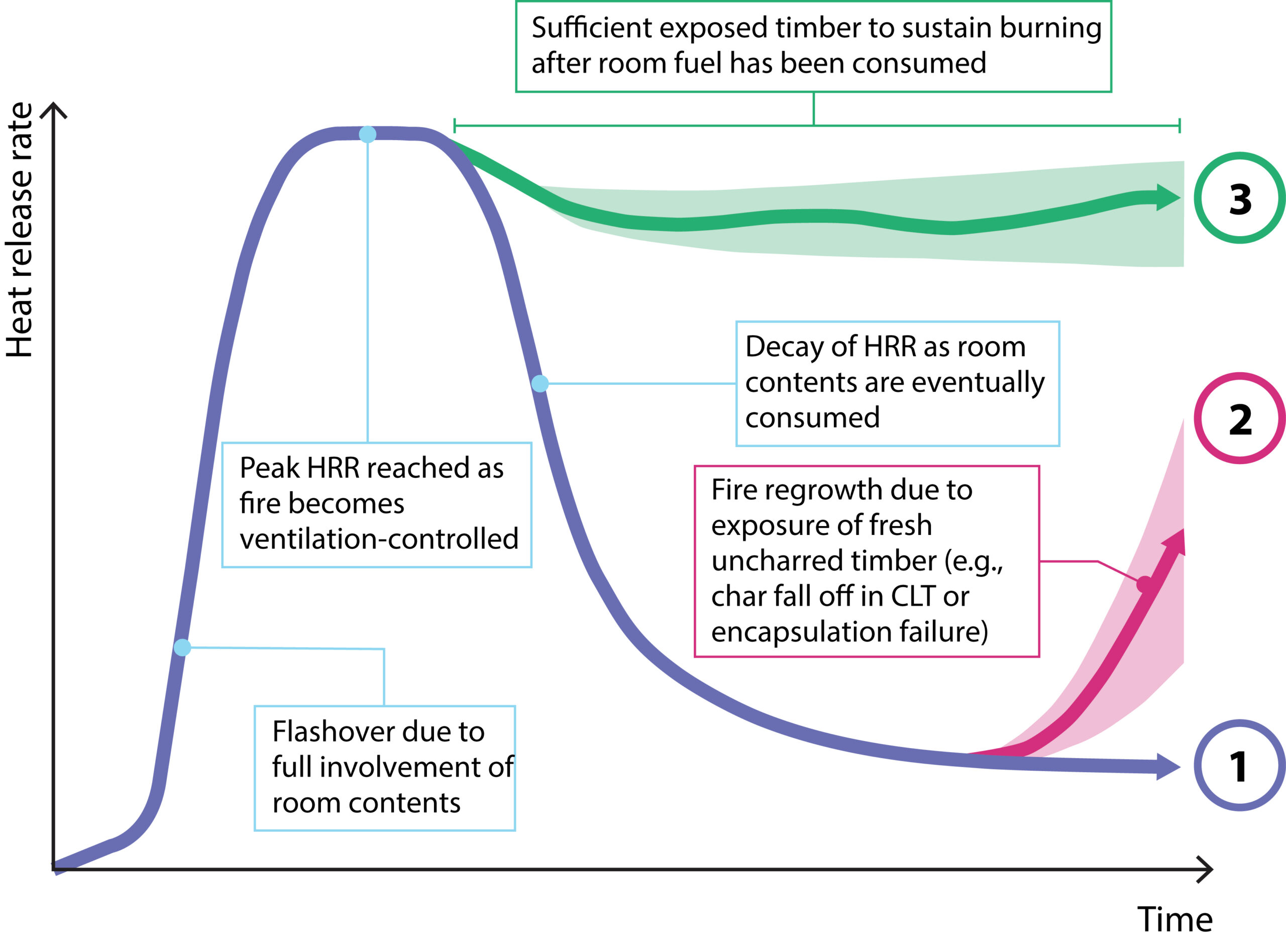
Exposed timber within buildings is not a new issue. Most building codes permit timber as an interior finish, and in many cases, permit timber structures to be exposed for low- and medium-rise buildings. Some codes are unusual, in that they place no explicit limits on the combustibility of the structure, however, limits of application should be carefully considered in these cases. For a high-rise building, where the mass timber structure is desired to be exposed, a performance-based approach is required to determine fire resistance of the structure in the overall context of the fire safety strategy. The design must address the requirement for the load-bearing structure of a high-rise building to withstand the decay of reasonable worst-case fully-developed fires, which must include the impact of exposed timber on compartment fire dynamics (see Figure 2). Among several influences, the added combustible fuel load of the exposed timber structure increases the peak heat release rate (HRR), fire duration, and has implications on the decay of the fire.

For a performance-based design, the fire resistance of the structure needs to be designed to be resilient to cross-section loss due to charring and heat penetration resulting from a fire governed by expected fire load, calculated from fixtures and fittings, plus any structural timber, either because it is already exposed, or because the encapsulation fails during the fire.


Establishing Fire Resistance and LoadBearing Capacity of Timber Members
Historically, timber structural design for fire exposure has been based on sizing sections by applying a constant charring rate over a prescribed fire resistance period to calculate a residual section, and then relying on that residual section for structural stability (see Figure 3). This approach is used in prescriptive design. The procedure for testing fire resistance of all structural elements is the same, i.e., placing a single structural element (e.g., beam, wall, or floor) into a furnace and exposing it to a standard fire curve (ASTM 2016). Guides such as EN 1995-1-2 (CEN 2009) and the National Design Specification for Wood Construction (AWC 2018) provide guidance on determining the capacity of a mass timber structural member, for a prescribed standard fire-resistance period, through the reduced cross-section method, without the need for further testing. The applicability of standard fire testing for combustible elements also needs to be understood, given that a combustible element such as mass timber will release its own energy as it combusts, resulting in lower input energy required to maintain the standard fire temperature time curve, than for a non-combustible element (Wegrzynski et al. 2019). This is but one of many variables of standardized fire testing, and the relationship between standard tests 1,400 and actual fires needs to be considered in this context.

Figure 2. General trend lines of heat release rate (HRR) vs. time plots from experimental data of ventilation-controlled fires within exposed CLT compartments.

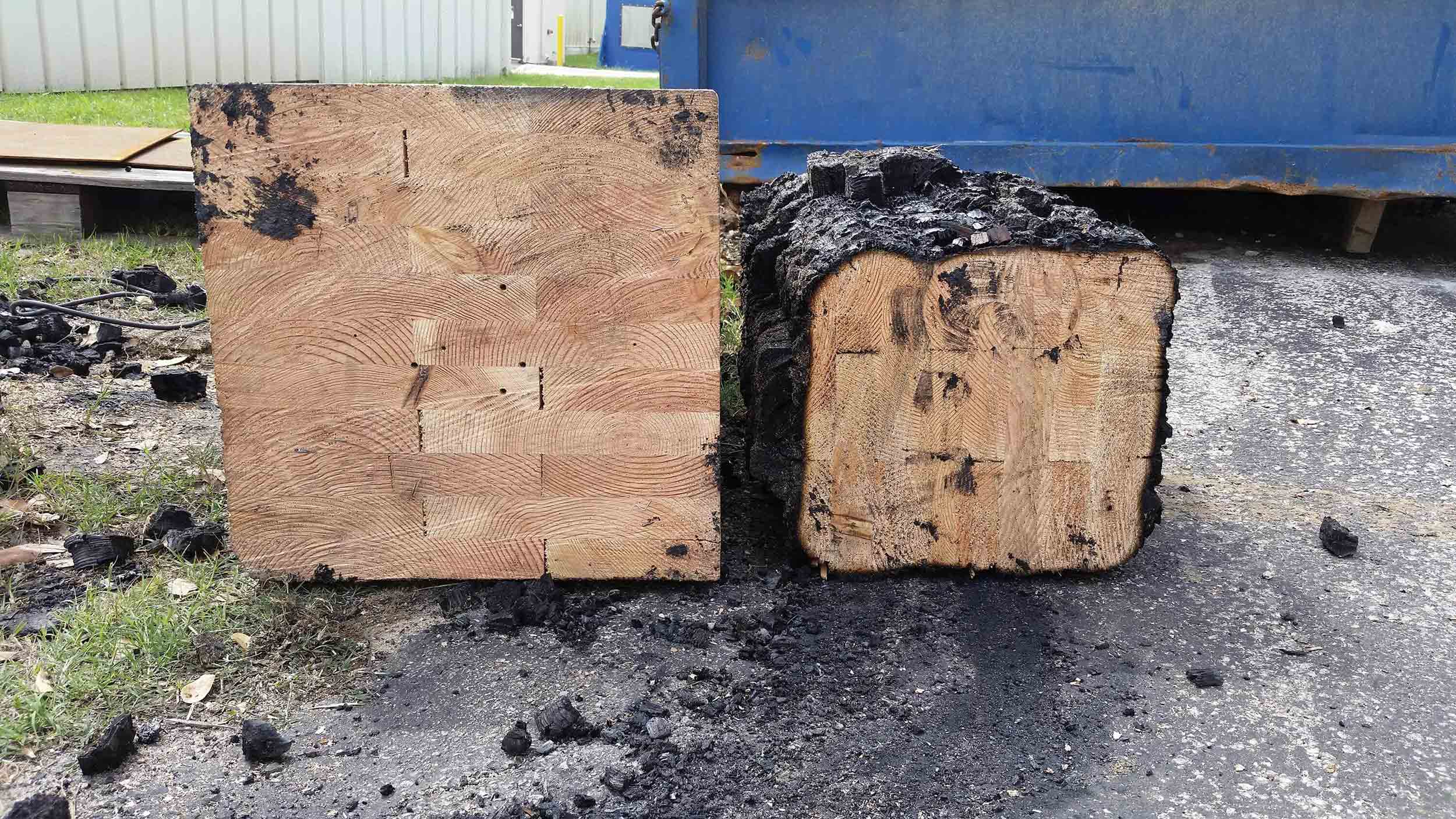
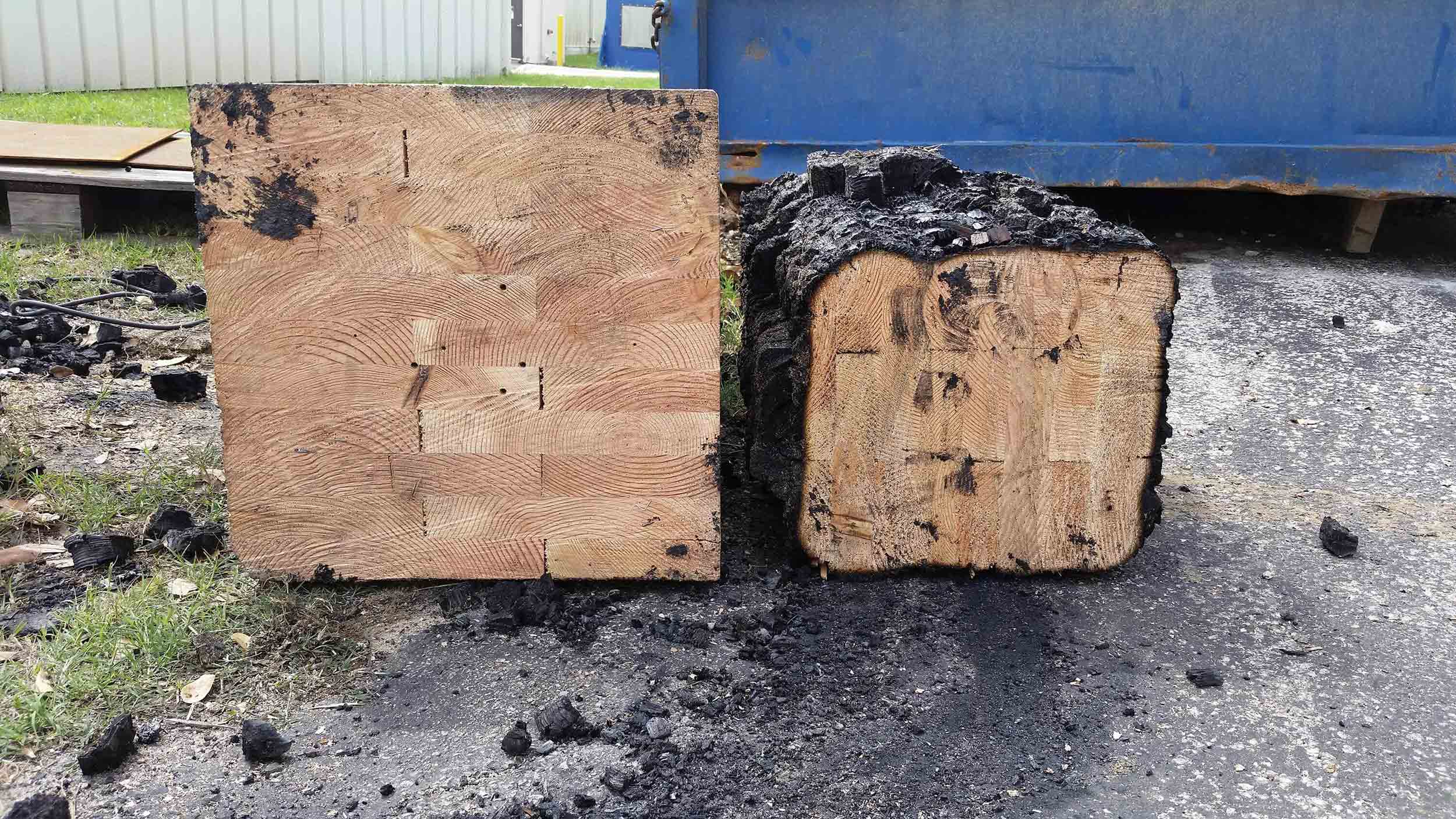
Figure 3. Glulam column, before and after a 90-minute fire-resistance test, showing extent of reduced cross-section.

Quote pattern

“Of concern is the unpredictability of fire regrowth, if there are large amounts of exposed CLT with adhesives that are prone to char debonding under heating. ”

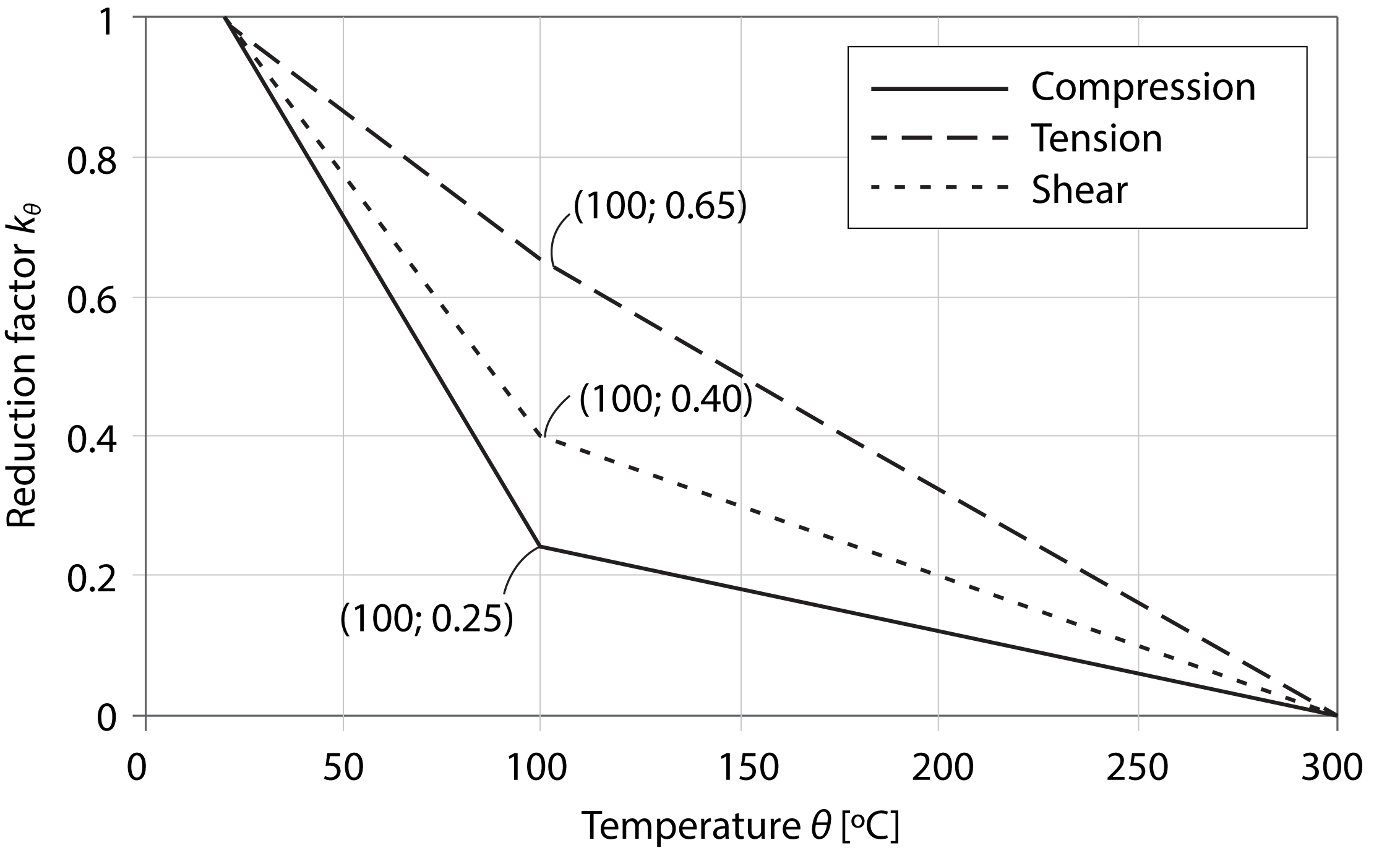
The reduced cross-section method is relatively straightforward to understand and use by designers, but is limited in its applicability, as it is based on a constant char rate and only appropriate when assessing standard fires. The method cannot be used when assessing natural design fires expected in exposed timber structures, which will have a variable char rate throughout the fire growth, peak, and decay cycle (see Figure 4). In addition, the standard fire curve is continuously increasing and does not consider decay. Thus, when assessing structural fire resistance for taller or more complex timber structures, the method of assessment is more complex. Other factors also start to become important, such as the mechanical properties of timber at elevated temperatures. For example, EN 1995-1-2 documents up to 75 percent reduction in compressive strength of timber at 100 degrees Celsius (see Figure 5).

Factors Influencing Fire Behavior of Tall Timber Structures

Additional Fuel
An exposed timber structure provides additional fuel, which influences the fire dynamics. For instance, in recent large-scale experiments with dimensions of 35 x 11 meters (115 x 36 feet) conducted by Arup, which included an exposed timber ceiling, it was conservatively estimated that the ceiling contributed the equivalent fuel load to that of the floor—a wood crib, which was constructed as the primary fuel load (Arup 2021). Thus, the exposed mass timber ceiling doubled the total fuel load burned during the fire.

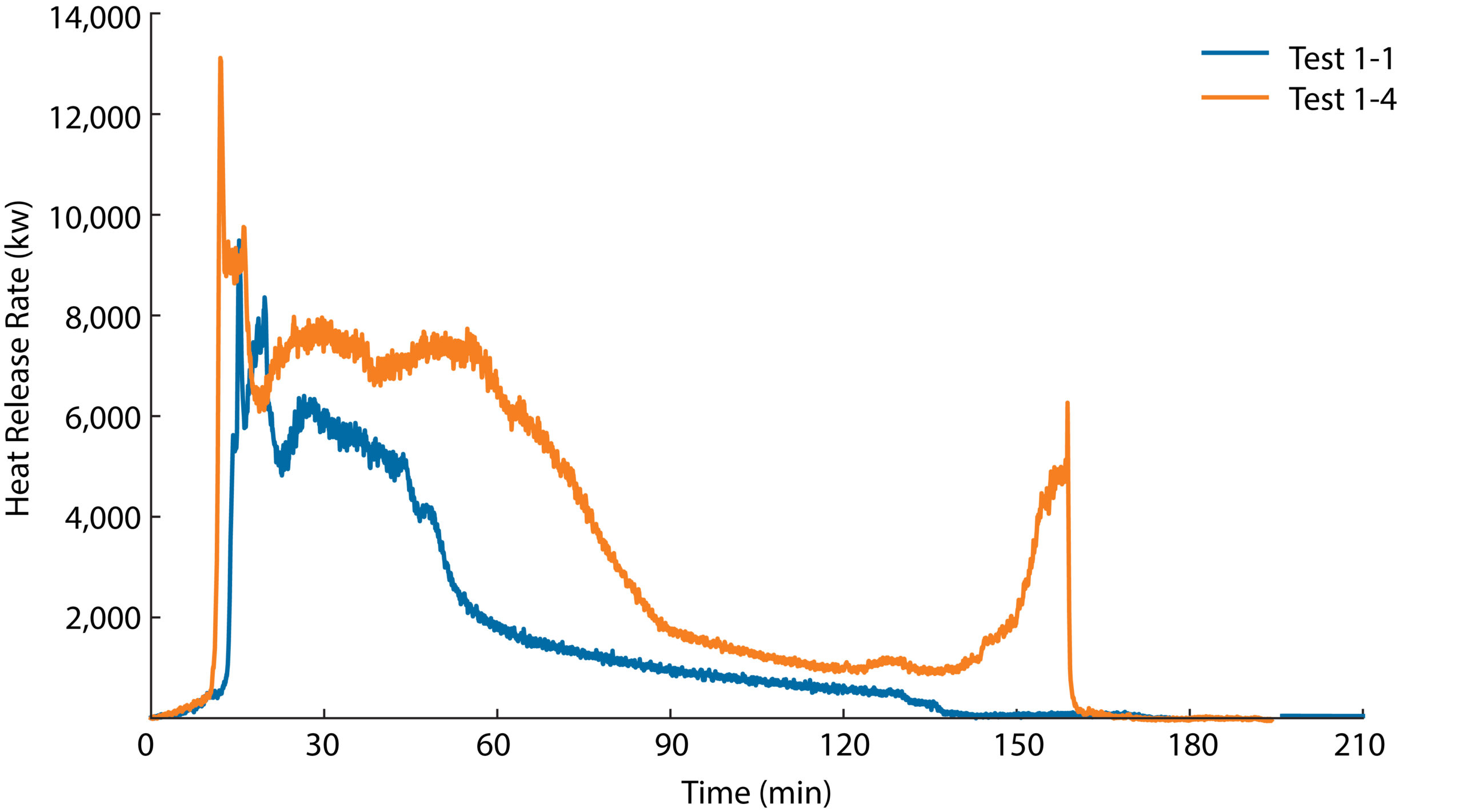
Increases in fuel load have several effects on the fire dynamics of the compartment. These include longer fire duration, greater external flaming, and changes to the fire development, both in the growth and decay phase (see Figure 6). The structural capacity of the load-bearing mass timber members must be designed to withstand the additional challenges presented by such changes in fire dynamics. Hence, the design fires must capture both heating and decay inside the compartment, and the hazard of pyrolysis gases combusting outside the compartment which may present a risk of fire spread to the floor above.

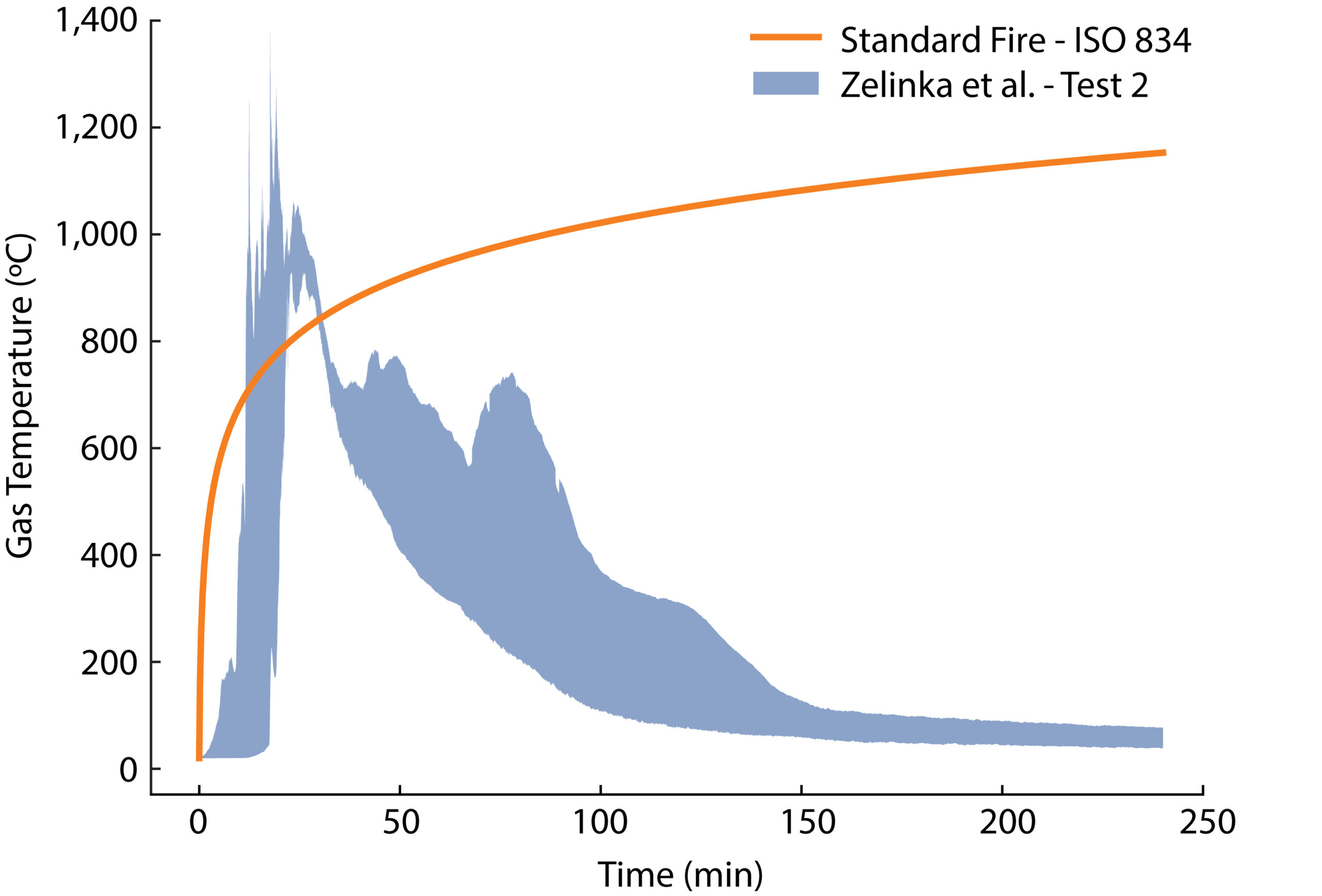
Figure 4. Graph showing the difference between the standard fire (CAN/ ULC S101) and the temperatures from a compartment fire (natural fire curve). Source: Taber et al. 2014

Figure 5. Reduction in compressive strength parallel to the grain in softwoods, plotted against rise in temperature. Source: BS EN 1995-1-2, 2009

Figure 6. Compartment fire with comparison of heat release rate. Test 1-1 has no timber exposed, and Test 1-4 has CLT exposed at the ceiling. Tests were stopped with manual intervention. Source: Su et al. 2018

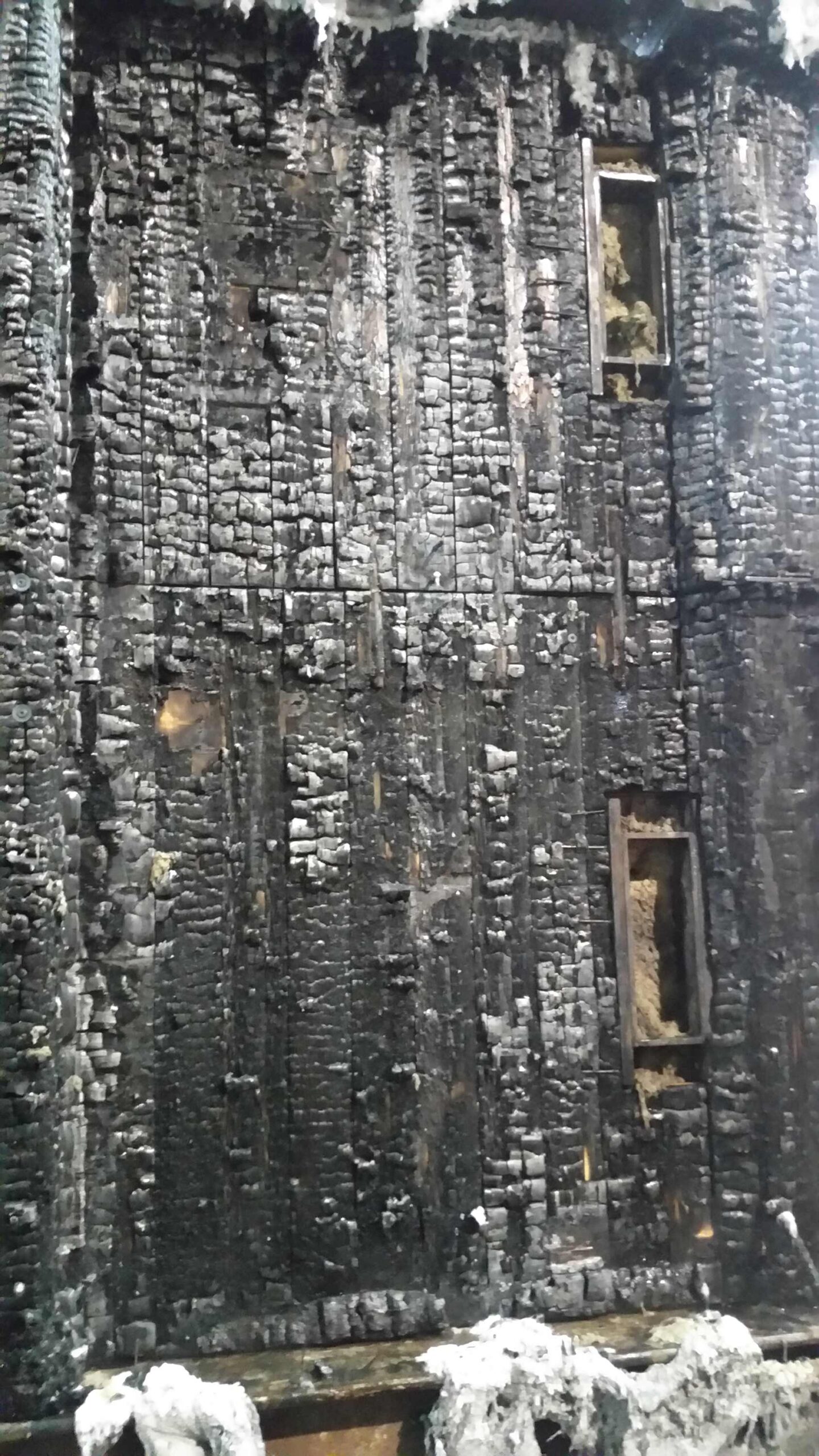
Figure 7. CLT panel, showing char fall-off after a standard fire test.

Char Behavior
Char rate is proportional to the heat flux received, which is a function of the surrounding fire temperature within the compartment (Drysdale 2011) and varies both spatially and temporally. The designer needs to understand the incident heat flux to exposed timber surfaces within the compartment for any point in time of the design fires, to determine total char depth and temperature distribution throughout the structural timber section, which then determines structural capacity. As the temperature development and incident heat flux are influenced by the amount of timber exposed, iterative analyses are needed to evaluate this feedback loop to a point of convergence. Some such methods are discussed later in “Hand-Calculation Approach.“ Encapsulation failure or unpredictable CLT char behavior partway through the design fire significantly complicates analysis and may never lead to convergence.

However, with increasing compartment size, additional complexities arise related to the temperature and heat flux distribution. Brandon et al. (2021), in timber compartments measuring 7 × 6 meters, reported decreasing char depths with height above the floor. This emphasizes the necessity to understand the interaction between timber location and its contribution to fire dynamics. This also implies that structural vulnerability may be more focused near the base of the column or the top side of floor slabs, which the authors’ team is further investigating.

CLT Adhesives CLT performance, when exposed to standard fires, and when exposed in small compartment fires (up to 90 square meters), has been relatively well-studied (Zelinka et al. 2018). When a CLT panel is exposed to a standard fire for a significant period (for example, longer than 60 minutes), the char front can progress through multiple adhesive lines between timber layers. The initial charring behavior in the first ply is similar to that of sawn timber or glulam; when the charring penetrates far enough to impact the adhesive line, one of two events will occur:
1. Charring continues consistently through the adhesive line; or
2. Protective char debonds and falls off in small chunks, due to a lack of adhesive strength under heating, exposing unburnt wood below.

The process of protective char debonding is adhesive-dependent (Frangi et al. 2008). CLT panels that have adhesives that retain strength under heating will have relatively consistent char rates and mass loss in a standard fire test, similar to glulam members, as the pyrolysis front passes through multiple adhesion lines. In panels with adhesives that lose strength when heated, the protective char can debond once the char front is near the glue line, exposing unburnt timber below the char to the fire. This can lead to rapid localized increase of pyrolysis of the fresh timber, increasing the charring and burning rate. This continues until a new insulating char layer is formed, and the normal char rate for exposure to a standard fire returns, until more char debonds. This is more prevalent for exposed CLT ceilings than walls (see Figure 7). This was similarly found by Barber (2019) in a study of more than 30 CLT compartment fire tests (see Figure 8), which noted that this localized increase in burning can then expand, such that large areas of the CLT panel become involved, which causes the fire to grow again.

To design for natural fire scenarios, the CLT needs to perform in a predictable way through all stages of the design fire. Avoiding the unpredictability of char failure in exposed CLT is therefore essential. Of concern is the unpredictability of the regrowth, if there are large amounts of exposed CLT with adhesives that are prone to char debonding under heating. This impacts the ability to design for fire decay before loss of structural stability: a fundamental requirement of any high-rise building performance-based design.

Figure 8. CLT compartment fire from the Fire Protection Research Foundation series of tests.

Test 1: • No timber exposed • 3 layers of fire-rated plasterboard • Test set up: 4.5 x 2.4 x 2.7 m compartment with wood cribs as fire load (550 MJ/m2 ). • Opening of 0.76 x 2.0 m (ventilation factor = 0.03 m1⁄2)

Test 2: • Long wall exposed and 10% of ceiling • Fire-rated plasterboard: 2 layers of 12.5-mm Type X • Ventilation factor = 0.03 m1⁄2

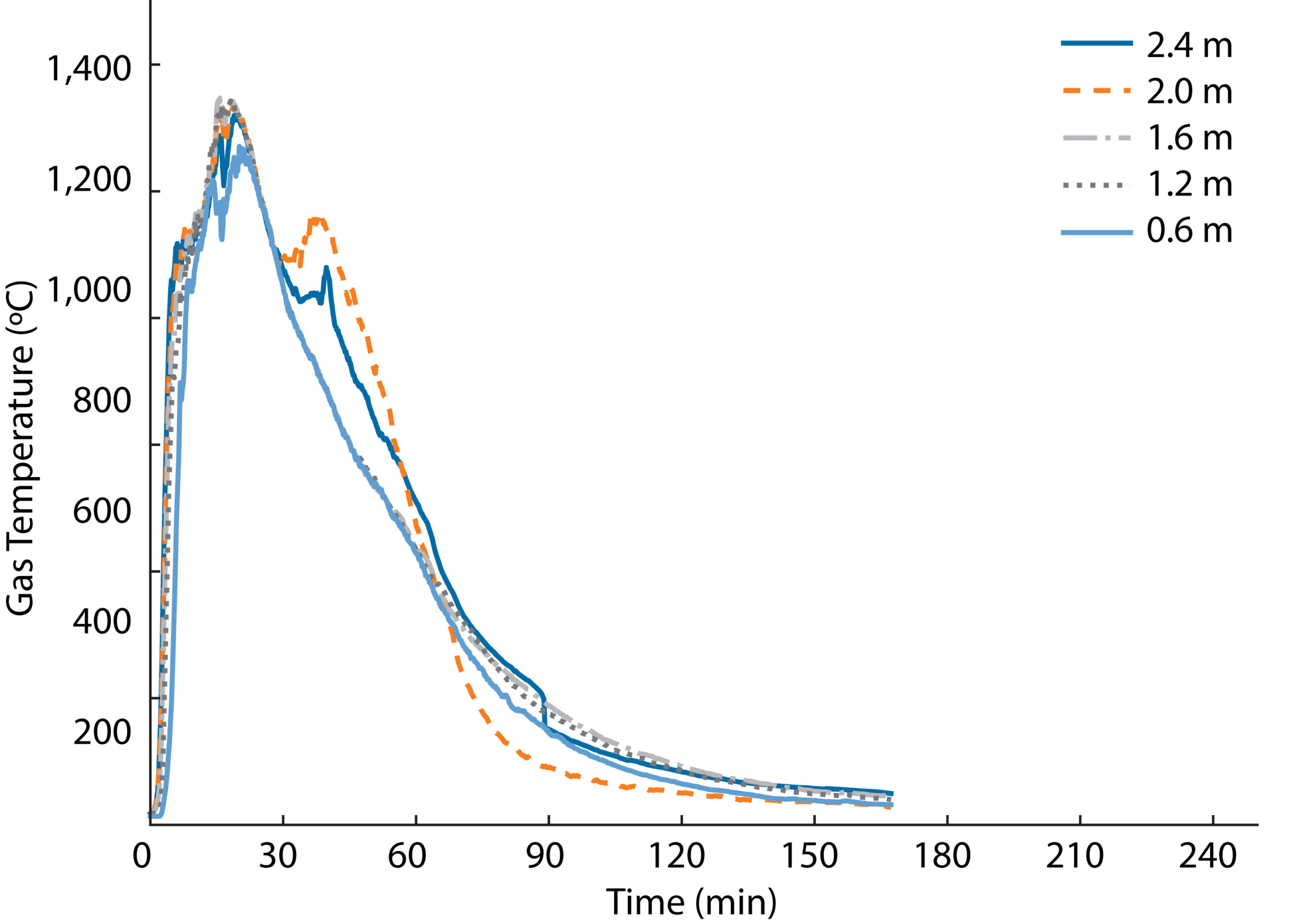
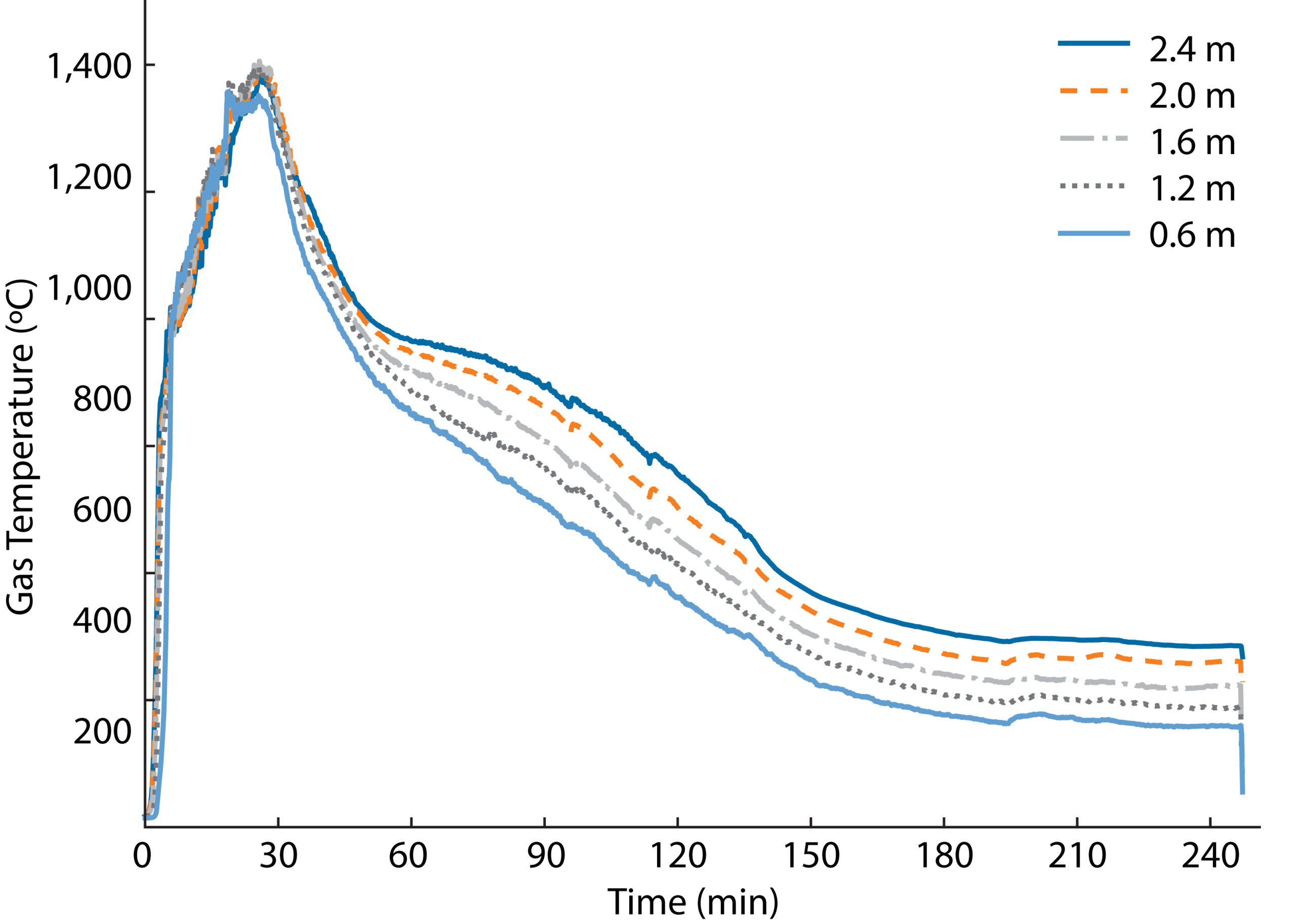
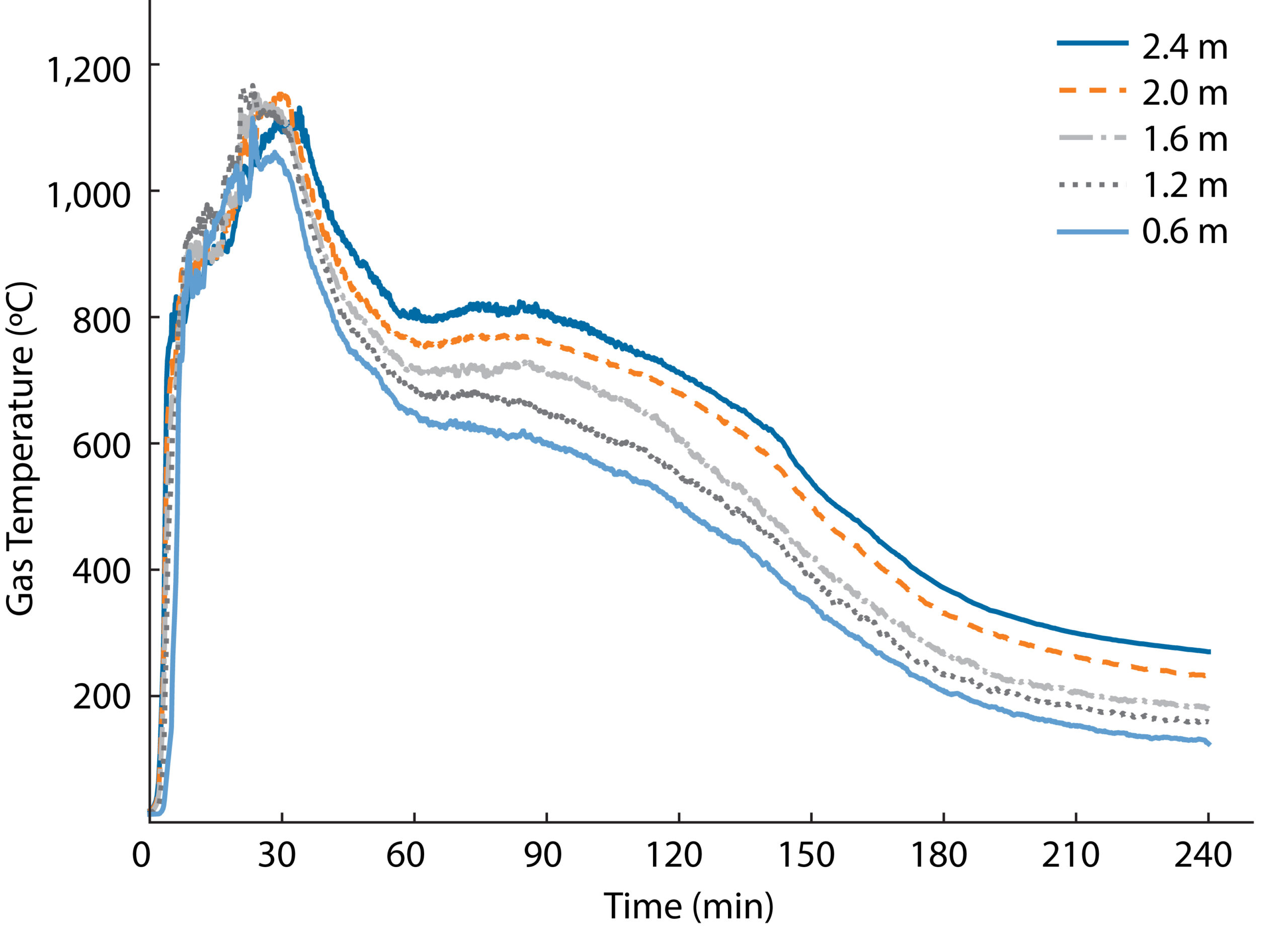
Test 3: • Ceiling exposed and exposed beam and column • 7.27 m2 of exposed beam and column timber • Fire-rated plasterboard: 2 layers of 12.5-mm Type X • Ventilation factor = 0.03 m1⁄2 Figure 9. Summary of NRC Canada fire tests, showing fire decay with differing areas of exposed mass timber (see Su et al. 2018 for details).

To improve CLT performance in fire, the North American manufacturing standard (ANSI 2018) requires that, from 2021, all CLT panels have heat-resisting adhesives that maintain an insulating char layer. The benefit of using CLT with heat-resisting adhesive has been demonstrated by compartment fire testing (Su et al. 2018b) which included exposed CLT that meets the latest edition of PRG-320 and two different configurations of exposed glulam beams and columns. One test was fully encapsulated, with three other tests having differing areas of exposed walls, ceilings, beams, and columns. See Figure 9, where Tests 1, 2, and 3 are shown. The test results show that a fully developed fire can have more reliable decay, given the CLT has a more predictable adhesive performance under long-exposure heating, compared to CLT with adhesives that may allow char debonding.

Ventilation
Available ventilation through window and door openings plays a controlling role in compartment fire dynamics, impacting temperature development, fire growth, external flaming, and fire decay. A reduction in ventilation reduces both the supply of oxygen within the compartment, as well as the exhaust of hot gases. With increasing exposure of a mass timber structure, a greater volume of pyrolysis gases is generated, reducing the effective ventilation factor as noted by Gorska et al. (2021). As a result, external flaming has been found to increase with decreasing ventilation, as greater volumes of pyrolysis gases combust externally (Sjostrom et al. 2021). An increase in severity of the external flaming may not only pose a greater threat to the façade elements, and increased risk of fire impacting the floor above; it may present a greater f lame spread risk to neighboring buildings. Such factors need to be considered in the development of fire-safety strategies for tall mass timber structures.

Ventilation also impacts fire decay, with full-scale fire tests showing that the fire decays very slowly, or not at all, where there is low ventilation and relatively large areas of timber structure exposed (Su et al. 2018a; Su et al. 2018b; Zelinka et al., 2018). However, there is yet to be an empirical correlation developed to link ventilation, exposed timber, and how the fire decay occurs. We caution against over-reliance on expected ventilation availability when designing for fire resistance, as this could result in potentially unconservative design fires for timber structures. Ventilation levels should be varied as part of any assessment.

Determining Exposed Mass Timber Structural Capacity in Fire
Performance-based design for a high-rise building requires a good understanding of fire dynamics to determine accurate char depth for the mass timber, so structural capacity can be assessed. The structural capacity of a timber member subjected to fire is determined by many factors:

  • The fire dynamics, which depend on:
    • Compartment size
    • Available ventilation
    • Internal linings
    • Available fuel load
    • Whether or not the timber encapsulation fails and exposes more timber
    • Whether or not the protective char layer fails and exposes more timber
  • The air temperature, which is a function of the fire dynamics in the compartment
  • The char rate of the member, which is dependent on the temperature in the compartment
  • The residual cross-section, calculated using the heat-flux dependent char rate
  • The residual strength of the cross-section, as a function of temperature
  • The residual load-bearing capacity, calculated with the residual strength and cross-section.

It is important to consider which of the many parameters listed above are dominant, controllable, and can be influenced during design (such as timber configuration, char rate, and encapsulation performance), to create a building where the fire dynamics result in a decaying fire, and hence, a predictable outcome. Through detailed engineering and analysis, each of the factors mentioned previously can be determined, though some do require conservative assumptions and limitations due to a lack of applied research, and hence the need for more work in this area.

Continued Smoldering Combustion
Timber structures are also susceptible to the continued smoldering combustion of structural elements. As smoldering is a flameless form of combustion, and capable of surviving at much lower oxygen concentrations when compared to flaming, it may not be easily observable by firefighters. It presents a continued risk to structural stability after the fire has burnt out. Smoldering may continue to propagate for hours or days after the end of flaming, where this behavior has been allowed to occur for the purposes of research (McNamee et al., 2021). It has also been observed in large scale exposed CLT compartment experiments, eventually burning through the CLT slab (Arup 2021). As it is not possible to predict the occurrence of smoldering, it is necessary to design a building to allow for firefighting intervention to identify and extinguish any smoldering.

Using Compartment Fire Test Data

Small Compartments—Residential Use
Based on the exposed mass timber compartment tests (experiments) undertaken to date, design methodologies for small rooms and compartments, representative of residential buildings, can be validated against full-scale fire test data for sizes up to 90 square meters. Some design methodologies are under development for small compartments (Barber 2016; Brandon 2018; Wade et al. 2018), with limited experimental validation and accuracy in predicting fire decay.

Large Compartments—Office Use
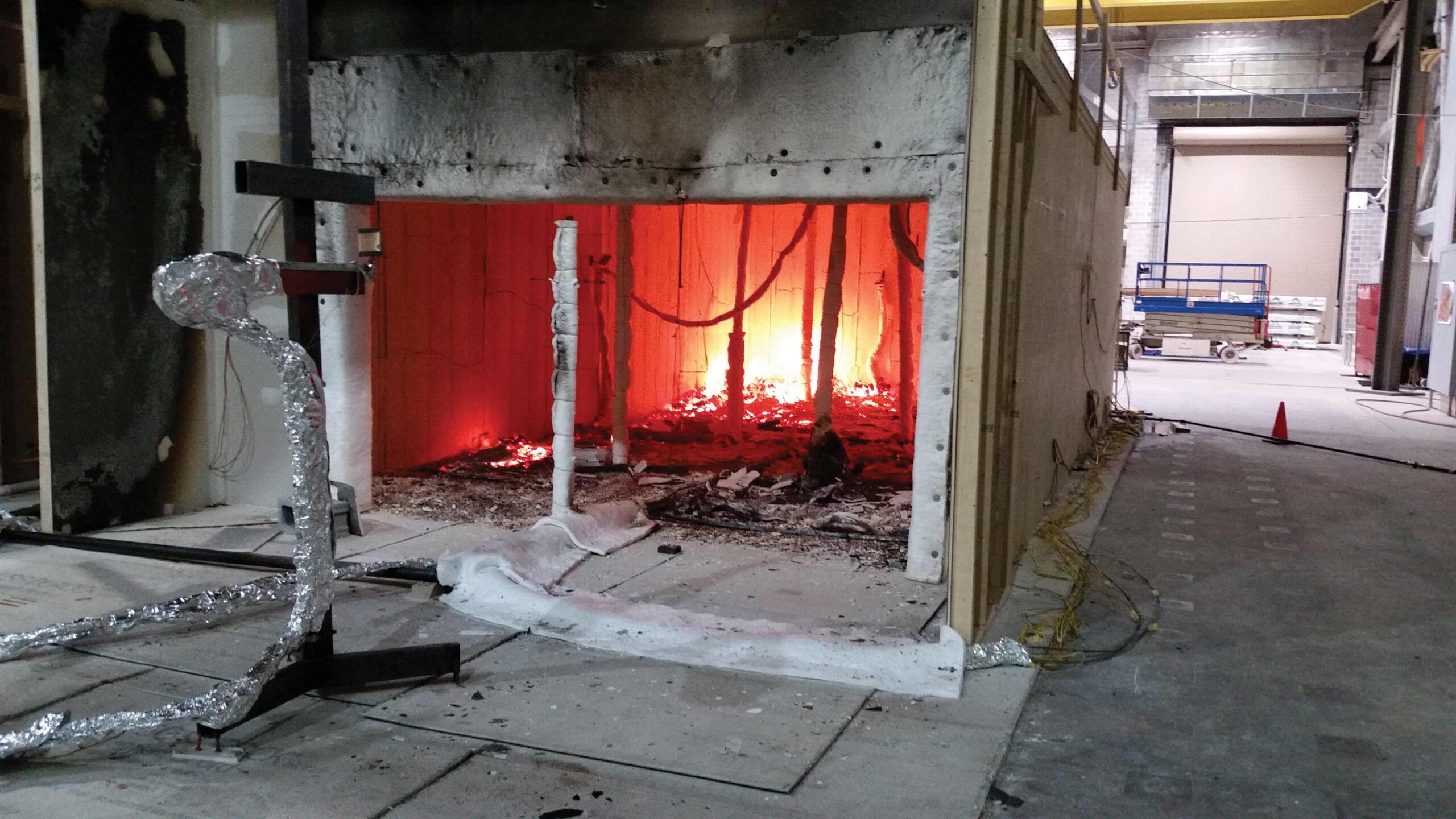
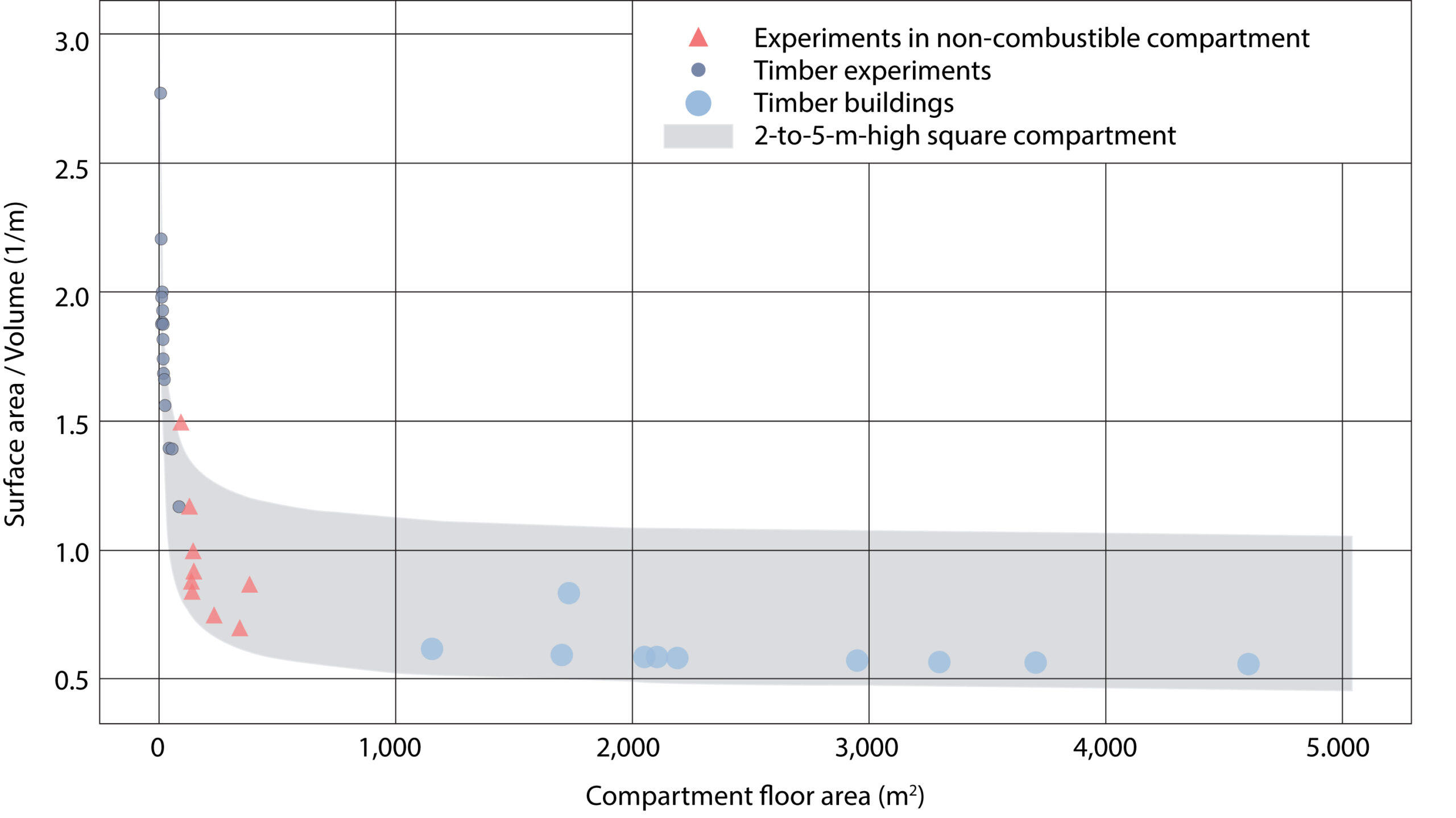
Typical open-plan office configurations (between 1,000 and 5,000 square meters) and fuel loads in the order of 600 to 800 MJ/ m2 (higher than residential fuel loads of around 550 MJ/m2 used in tests to date) are too large for full-scale fire experiments. Figure 10 illustrates the significant area discrepancy between the available timber compartment fire tests and the proposed or constructed high-rise mass timber buildings. Uncertainty about the compartment energy balance mechanisms at this scale gives rise to uncertainty when predicting fire dynamics for large compartments with exposed mass timber structures. This is particularly relevant for high-rise buildings, where more stringent fire safety requirements demand greater confidence in the response of the structure to the anticipated design fires. To help fill this void, the authors’ team, with partners CERIB and Imperial College London, have recently undertaken the largest exposed mass-timber experimental fires, in a space of 385 square meters (4,150 square feet). These large-scale tests have been undertaken to develop design methodologies for quantifying the effect of exposed timber on the fire dynamics in a large compartment typical of modern office architecture. To have confidence in the predictions of fire dynamics of large open-plan office buildings, the large-scale fire tests have varied ventilation and closely-examined external flaming, charring in columns and exposed CLT ceilings, and post-fire smoldering. Until the data from these test results are available for use and backed up by other research, any models predicting fire dynamics in a large compartment containing exposed timber must be used with caution, as they substantially extrapolate beyond available small-compartment fire test data.

Figure 10. Graph illustrating the discrepancy between the available timber compartment fire tests and the proposed or constructed high-rise mass timber buildings.

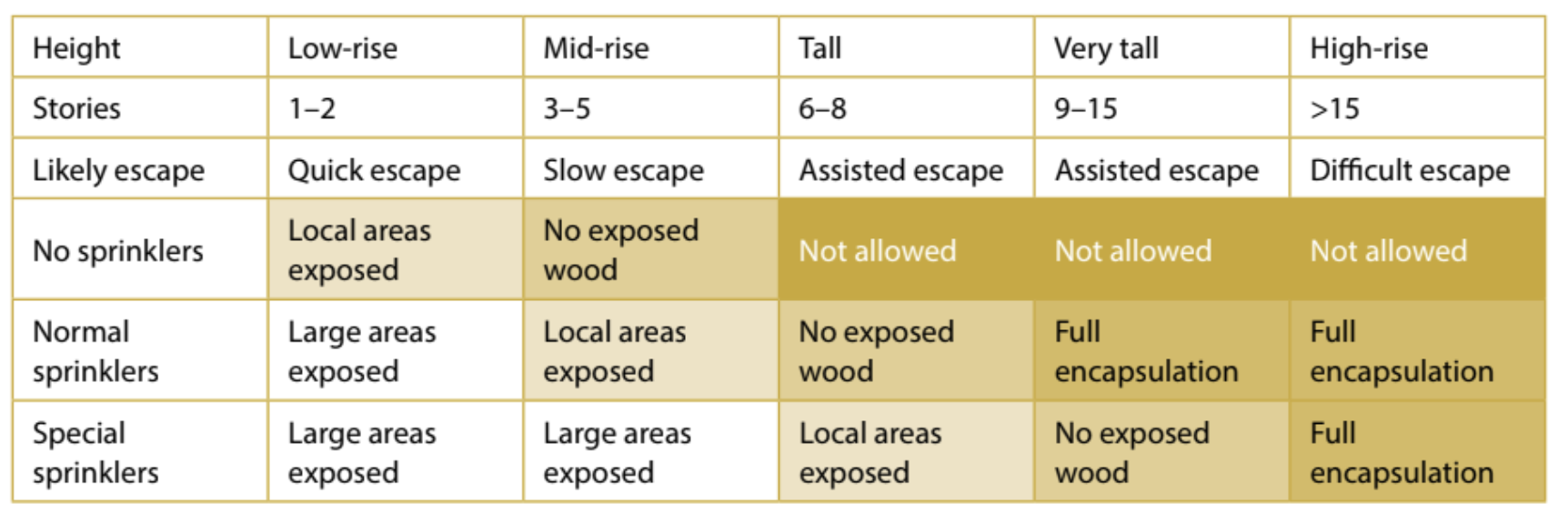
Table 1. Table replicated from Buchanan (2015), showing fire protection based on building height and area of mass timber exposed.

Analysis Methods

Hazard- and Consequence-Based Approach to Fire Safety of High-Rise Mass Timber
Design solutions for a mass timber building can use an approach based on height, fire protection, and area of exposed timber; for example, the methodology developed by Buchanan (2017) (see Table 1). The hazard identification process should also include the extent of exposed mass timber and the type of CLT.

Compartment Fire Model Development
Building on the hazard- and consequenceinformed approach, compartment design fires can be established to determine the maximum permitted area of structural mass timber that can be exposed, before the timber significantly changes the HRR and duration of the fire. The method aims to facilitate design within the framework of recognized fire-safety design approaches for non-combustible compartments. To accurately account for the exposed masstimber charring, it is modeled based on the local heat flux. From that initial char rate, the impact of the pyrolyzing timber on the expected compartment HRR, temperatures, and heat fluxes can then be calculated. Through an iterative process, the decay period of the fire can also be accounted for, provided that the timber chars predictably. Two developing methodologies are briefly discussed hence. Both approaches are less accurate for large compartments, given the lack of fire test data available with exposed timber.

Hand-Calculation Approach
The parametric fire curve can be modified to model a natural fire within a compartment with exposed mass timber (Barber 2016; Brandon 2018). This approach allows for variations in compartment dimensions, fuel load, surrounding materials (including timber) and ventilation. Char depth based on heat flux can be determined for the initial fire input, and then the charred mass of timber is added into the fuel load (lump-sum approach). Fire severity increases with fuel supply, and as new char depths are calculated. The decay phase must also be amended to account for the exposed timber. This iterative approach is repeated until it converges. The final char depth at the end of the decay phase can be compared to the char depth observed under a standard fire test. This approach then allows a “required f ire-resistance rating” to a standard fire test to be determined, based on an equivalent char depth under a standard fire test.

This follows a similar approach to the time-equivalent method for steel structures in natural fires, which compares steel temperatures in natural fires to timeequivalent temperatures in standard fire tests. The analysis method requires several assumptions and, in turn, contains limitations. The assumptions are based on providing conservative outcomes, and the accuracy in predicting fire duration is within 30 percent of actual fire test results, for residential compartments. Conservatism is applied throughout the calculation procedure and within underlying assumptions, including an agreed approach to HRR decay criteria and fire burnout. The use of parametric fire curves is generally limited to compartments up to 500 square meters (including noncombustible structures).

CFD Modeling Approach
A second approach uses a computational fluid dynamics (CFD) modeling program to estimate compartment fire dynamics including pyrolysis, HRR, and char behavior of timber. This novel approach uses the Fire Dynamics Simulator (FDS) pyrolysis model for exposed surfaces. It requires calibration of the material properties in the model, using cone-calorimeter calibration test data for pyrolysis rate and HRR for the type of timber being used. The model is a geometric representation of the compartment, including wall and ceiling materials, furnishings, and fire ventilation, and measures incident heat fluxes and temperatures throughout the compartment and at 10-millimeter (0.39-inch) depths through the CLT. Charring is assumed to occur when temperatures exceed 300 degrees Celsius. Consumption of the timber as additional fuel, influencing the HRR, can also be incorporated.

This approach has been checked against available test data from small compartments with exposed timber and showed reasonable results. It is, however, computationally expensive, and unlikely to be viable as a design optioneering tool. Other CFD software may have the capacity to perform pyrolysis kinetics, however, these have not been investigated by the authors to date, and will form the basis of further research.

Conclusions

High-rise buildings that are constructed with mass timber as the primary structure are in demand, because of sustainability benefits, the increased speed of construction, and the potentially higher financial returns they offer. Exposing the load-bearing timber structure influences the fire dynamics, and research to date shows that exposing mass timber could result in a fire that releases more energy than the structural elements can resist, where influencing parameters are not properly controlled.

Designing fire-safe high-rise mass timber structures is possible, with careful design and material selection, to avoid unpredictable behaviors, such as CLT char debonding and gypsum-board encapsulation failure in long-duration fires. Calculation methods are being developed that address the impact of exposed timber, but these are validated only for smaller compartments seen in residential use currently. Data for large compartments, typical of office buildings, is needed to validate analysis models. Global efforts in mass timber research continue, and more work is required to provide architects and engineers with updated codes and design guidance, to enable robust designs and more efficient building approval, and assure approval agencies of the viability of high-rise buildings with areas of exposed mass timber structure. 

Unless otherwise noted, all image credits in this paper are to Arup.

About the Authors

David Barber is a principal with Arup, based in Melbourne, where he specializes in the fire safety of mass timber buildings. For over 20 years, Barber has assisted with fire testing, developing new timber technologies, authoring fire safety design guides, working with timber product suppliers, and completing fire safety solutions for mid-rise and high-rise timber buildings. Barber leads a global team within Arup that works with researchers, architects, and developers on the fire safety of timber structures. Barber is currently working with project teams on mass timber buildings located around the world.

Egle Rackauskaite is a fire engineer with Arup, based in London, where she specializes in structural fire safety of steel, concrete, and timber structures. In 2017, Rackauskaite completed a PhD at Imperial College London, focusing on the study of traveling fire dynamics in large enclosures, and the response of structures to fires. Rackauskaite has experience in providing expert fire safety and structural fire engineering advice on a range of different project types in the UK, the development of large-scale compartment fire experiments, and modeling structures in fire, using nonlinear finite element analysis.

Eirik Christensen is a fire engineer with Arup and is based in London. In 2020 Eirik completed his PhD at Imperial College London on smoldering fires. During his PhD he also contributed to the experimental research on large scale compartment fires. Currently, Christensen actively applies his experience in research to the analysis of timber fire experiments conducted by Arup and provides fire safety advice on numerous mass timber building projects.

Judith Schulz brings over 16 years of experience as a fire safety engineer, working on numerous highprofile and award-winning projects, such as the 2012 Olympic Main Stadium, and The Shard. Her expertise and collaborative problem-solving skills have proved crucial to enabling innovative designs, most recently UK’s tallest living green wall. She is also a trusted advisor on strategic fire safety matters, to property developers and building owners at the highest levels in the residential, commercial, and educational sectors, informing targeted capital expenditure for fire-safety improvement works across diverse portfolios. She is passionate about outcome-focused research that helps deliver on UN Sustainable Development Goals (SDG).

References

American Wood Council (AWC). (2018). 2018 National Design Specification (NDS) for Wood Construction. Leesburg: AWC.

American National Standard Institute (ANSI). (2018). ANSI/ APA PRG 320-2018: Standard for Performance-Rated Cross-Laminated Timber. New York: ANSI.

Arup. (2021). Mass Timber Fire Safety – Experiment One Update and Experiment Two Initial Findings. London: Arup

ASTM International. (2016). ASTM E119-16 Standard Test Methods for Fire Tests of Building Construction and Materials. West Conshohocken: ASTM International.

Barber, D. (2016). “Fire Safety Engineering of Tall Timber Buildings in the USA.” In Proceedings of the World Conference on Timber Engineering (WCTE 2016), edited by Josef Eberhardsteiner, Wolfgang Winter & Alireza Fadai Martina Pöll, 5761–70. Vienna: TU Verlag.

Barber, D. (2019). “Fire Safety of Exposed Mass Timber in High-Rise Buildings – Research Application, Challenges and Solutions.” In Proceedings of the 3rd International Fire Safety Symposium, June 5–7, Ottawa.

Brandon, D. (2018). Fire Safety Challenges of Tall Wood Buildings – Phase 2: Task 4 – Engineering Methods. Sweden. Quincy: Fire Protection Research Foundation.

Brandon, D., Sjöström, J., Temple, A., Hallberg, E. & Kahl, F. (2021). Fire Safe Implementation of Visible Mass Timber in Tall Buildings – Compartment Fire Testing. Gothenburg: RISE Research Institutes of Sweden AB.

Buchanan, A. & Abu, A. (2016). Structural Design for Fire Safety, 2nd edition. Hoboken: John Wiley & Sons, Ltd.

Buchanan, A. H. (2017). “Fire Resistance of Multistorey Timber Buildings.” In Fire Science and Technology 2015, edited by Harada K., Matsuyama K., Himoto K., Nakamura Y. & Wakatsuki K. Singapore: Springer, 9–16.

CEN. (2009). EN 1995-1-2: 2004. Eurocode 5. Design of Timber Structures – Part 1-2: General – Structural Fire Design. Brussels: CEN.

Drysdale, D. (2011). An Introduction to Fire Dynamics, Third Edition. Chichester: John Wiley & Sons, Ltd.

Frangi, A., Fontana, M., Knobloch, M. & Bochicchio, G. (2008). “Fire Behaviour of Cross-Laminated Solid Timber Panels.” In Fire Safety Science 9, 1279–90.

Gorska, C., Hidalgo, J. P. & Torero, J. L. (2021). “Fire Dynamics In Mass Timber Compartments.” Fire Safety Journal 120.

International Code Council (ICC). (2018). 2018 International Building Code (IBC). Washington, D. C.: ICC.

McNamee, R., Zehfuß, J., Bartlett, A., Heidari, M., Robert, F. & Bisby, L. ( (2021). “Enclosure Fire Dynamics with A Cross-Laminated Timber Ceiling.” Fire and Materials 45(7): 847–57.

Sjöström, J. (2021). Exposure from Mass Timber Compartment Fire to Façades. Gothenburg: RISE Research Institutes of Sweden AB.

Su, J., Leroux, P., Lafrance, P., Berzins, R., Gratton, K., Gibbs, E. & Weinfurter, M. (2018). Fire Testing of Rooms with Exposed Wood Surfaces in Encapsulated Mass Timber Construction. Ottawa: National Research Council of Canada (NRC).

Taber, B. C., Lougheed, G. D., Su, J. Z. & Bénichou, N. (2014). Solutions for Mid-Rise Wood Construction: Apartment Fire Test with Encapsulated Cross Laminated Timber Construction: Test APT-CLT: Report to Research Consortium for Wood and Wood-Hybrid Mid-Rise Buildings.

Wade, C., Spearpoint, M., Fleischmann, C., Baker, G. & Abu, A. (2018). “Predicting the Fire Dynamics of Exposed Timber Surfaces in Compartments Using a Two-Zone Model.” Fire Technology 54(4): 893–920.

Wegrzynski, W., Turkowski, P. & Roszkowski, P. (2019). “The Discrepancies in Energy Balance in Furnace Testing, A Bug or A Feature?” Fire and Materials 44(3): 311–22.

White, R. (2016). “Analytical Methods for Determining Fire Resistance of Timber Members.” In SFPE Handbook of Fire Protection Engineering. Fifth Edition. Gaithersburg: Society of Fire Protection Engineers (SFPE).

Zelinka, S. L., Hasburgh. L. E., Bourne, K. J., Tucholski, D. R. & Ouellette, J. P. (2018). Compartment Fire Testing of a Two-Story Mass Timber Building. Madison: US Department of Agriculture.

Unlock new levels of knowledge.

Explore our entire research archive and its vast collection of documents, reports, and multimedia resources. Hosted on the Engage platform, it is a treasure trove of new ideas and proven best practices.

Go to Engage

You have added this page to your collection.

You can view or share your full collection.