


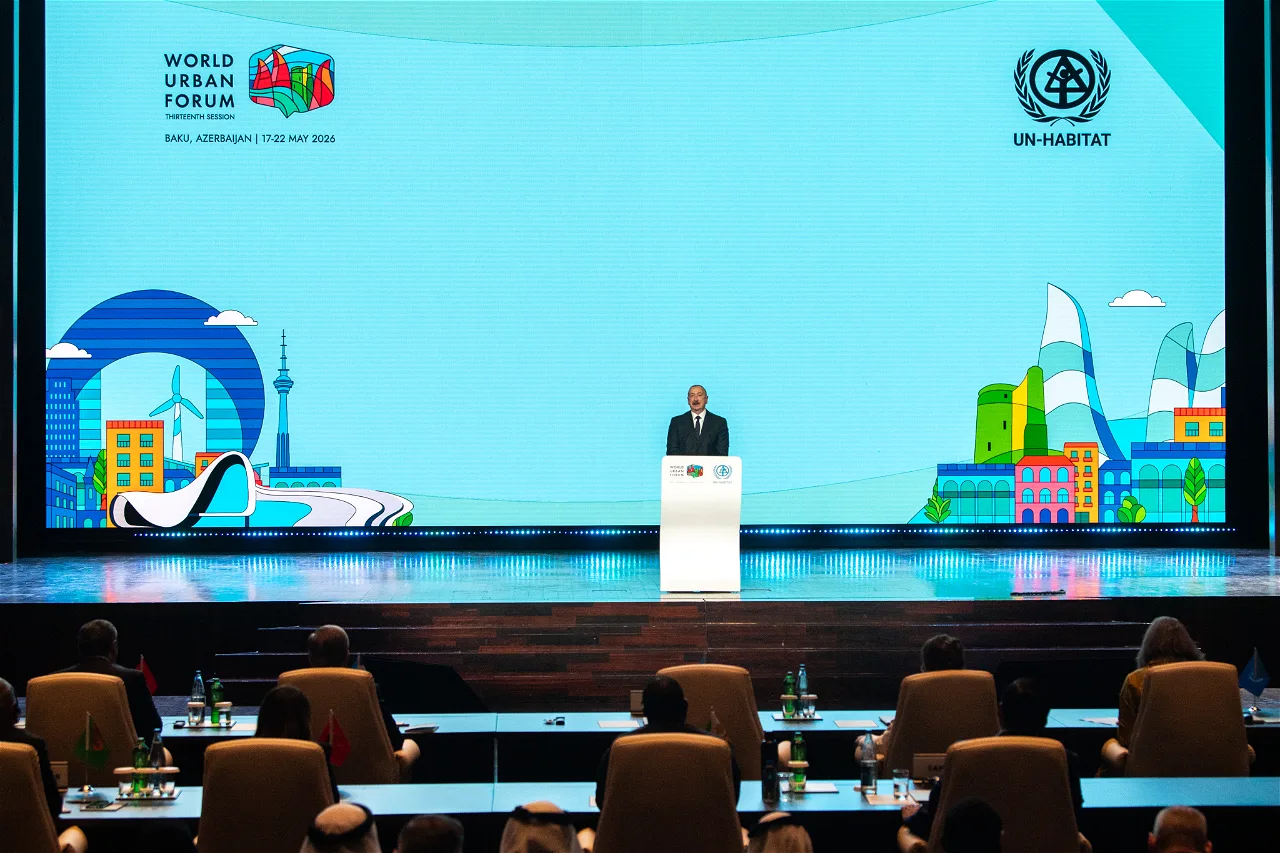
I had the privilege of traveling to Baku from 17 to 22 May, 2026, representing the Council on Vertical Urbanism (CVU) at the 13th session of the World Urban Forum (WUF), hosted in the Azerbaijani capital of Baku. Baku may not be the first place most people picture when they imagine the future of urban housing. The city sits on a hooked peninsula jutting into the Caspian Sea, the built form a diverse but harmonious collision of Soviet apartment blocks, a walled medieval core, a crop of newer glass buildings, and the curl of the triplet Flame Towers sitting as a crown above the city. For one week in May, it was also the center of the global conversation about cities.
Convened every two years by UN-Habitat, the WUF is the largest regular gathering on urbanization anywhere. This year it broke its own records: more than 57,000 people attended in person, with over 3,000 online, filling some 580 sessions across six days and drawing representatives from 176 countries. It also met and exceeded goals of gender parity, with women making up more than 55 percent of all participants.
That collective urbanist energy was directed at a single theme: Housing the World: Safe and Resilient Cities and Communities. This was a deliberate choice. WUF landed at the midpoint of the , and the figures shared across the week made the urgency ever more concrete: more than 1 billion people currently live in informal settlements or inadequate housing, hundreds of millions have no secure home at all, and the shortfall of adequate housing is accelerating globally. Bluntly, the world is under-housed, and the situation is getting worse by the year. The event’s mandate was to convene the world’s urban professionals to discuss solutions and produce recommendations to that end.
Vertical Urbanism and the Global Housing Crisis: Bridging Knowledge Gaps to Advance the Right to Adequate Housing.
My own contribution was in a roundtable of professionals and other researchers, where I shared a summary of CVU’s recent data explorations in a presentation entitled “Vertical Urbanism and the Global Housing Crisis: Bridging Knowledge Gaps to Advance the Right to Adequate Housing.”
The point I came to make is that we are trying to solve a housing problem that we cannot yet fully measure. Many keynote sessions touted big, ominous figures in the millions and billions when talking about the sheer number of people with or without access to adequate housing. But the reality is that housing is studied narrowly, city by city, using data of wildly uneven quality, and the moment we try to compare places, these gaps swallow much of our analytical integrity. A method that holds up in Toronto likely falls apart in another city whose building records are partial, inaccurate, decades old, or in many cases, never gathered at all. At the WUF, the world’s housing experts were divided not only by spoken language—we were also divided by the many different languages of our core data.
Closing that gap is one of the reasons CVU’s research tools exist. Unlike our tall building database, which is derived from records reported and downloaded from each city, the Council’s new Vertical Urbanism Index (VUI) database, which started in 2025, draws from globally consistent remote sensing sources such as LiDAR and high-resolution satellite imagery to reconstruct what local records obscure. Because the method fits all places, a city without a proper tall building inventory ends up with a measurement that can be set beside any other. That comparability is what gives downstream analysis its credibility.
Most of my time in these discussions went to turning the promise of data gap coverage into specifics. Put simply, CVU’s consistent data on vertical development can reveal the lag between the origin of rising housing demand and the supply satisfying that demand. It can separate real homes from high-rises built primarily as financial assets. It can pinpoint where new density is going up without transit and other services nearby that make it more livable, and it can provide cities with a shared barometer in place of incongruent local statistics.
A Call to Action for Housing
WUF concluded with the Baku Call to Action, a stakeholder document handed off to the UN with 15 recommendations for housing the world, based on the discussions held. The final recommendation was of particular interest to me: Use knowledge and data for the public interest. CVU can and will play a role in supporting this important recommendation.
During my time there, I met researchers at the University of Stuttgart whose open database, Urban-Act, had independently arrived at an approach remarkably close to our own at CVU, using high-resolution imagery. I also was introduced to the team behind the Shenzhen Urban Index, a public-sector project that evaluates cities through a set of distinctly Chinese urbanist lenses—innovation, livability, beauty, resilience, civilization, and intelligence—and has begun using this framework to analyze cities beyond China. As the recommendations to the UN move toward implementation, CVU is continuing to enhance its research and data. We are enlarging the building footprint and height data beneath the database, deepening the records on buildings we already track, and stretching the VUI across thousands more cities, with a research tool that will work anywhere in the world.
CVU’s time participating in the WUF and the relationships that I’ve formulated in Baku will only help us get there sooner.