



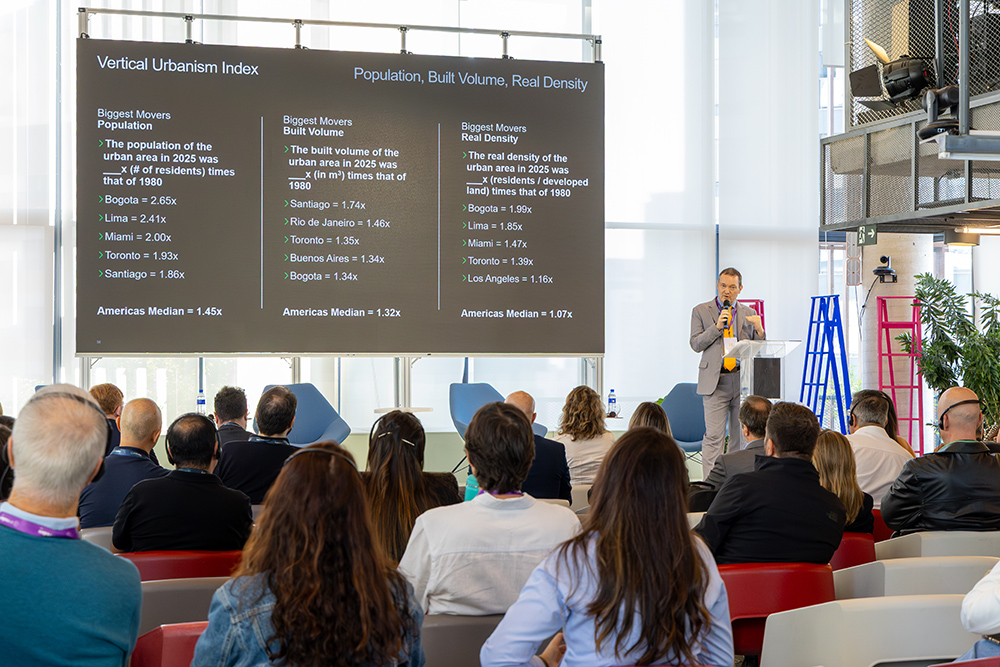
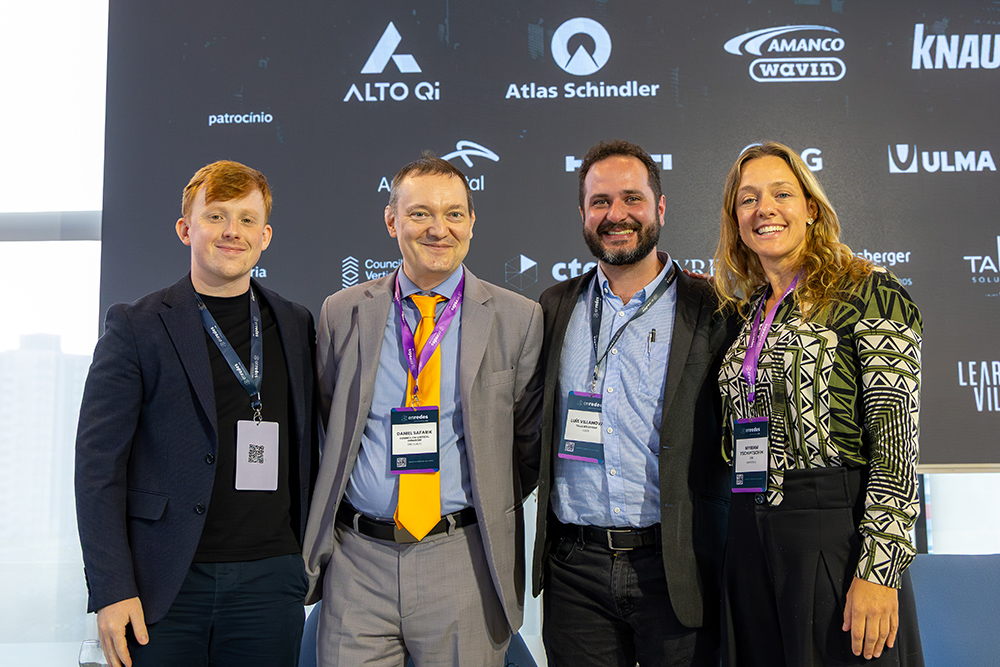
One of my favorite responsibilities in my role at CVU is to share the insights that our Research & Thought Leadership team has developed with a new audience and to participate in events with other urban and building experts, resulting in informative discussions. It was a great privilege and honor to present at the inaugural Fόrum Técnico Edifícios Altos do Brasil 2026 (Technical Forum of the Tall Buildings of Brazil) conference series in São Paulo in early May 2026.
Organized by CTE Enredes and Talls Solutions | Grupo FG, the daylong seminar brought together more than 100 professionals from around the country, to hear from practitioners with a particular interest in vertical urbanism. This included our partners and colleagues from Talls Solutions | Grupo FG, especially Stephane Domeneghini, CVU Brazil Chapter Chair and Executive Director, and by Luis Henrique Bueno Villanova, Head of Urbanism and Vertical Architecture, who was my gracious host for two days during the conference.
As evidenced in our 2026 Americas Global Activity Report, Brazil is a robust tall building market, with thousands of high-rises in Sao Paulo alone, to say nothing of cities rapidly growing their skylines, such as Fortaleza, Goiânia, Joao Pessoa, Recife, and the small-but-mighty Balneário Camboriú, where FG is planning the 544-meter Senna Tower. But skyline growth is not evenly distributed, and, as in many places, it has not solved wider problems of income disparity, housing affordability, and access to transportation and other infrastructure. As Vilanova indicated in his presentations to the Forum, and at the CVU 2026 Americas Conference, followed by a separate research paper from the Responsive Cities Institute in issue 7 of Vertical Urbanism (VU) magazine, titled “The Urban Structure of Opportunity: Residential Density, Building Height, and Employment Accessibility in São Paulo,” Brazil also suffers from skyline homogenization and restrictive zoning driving a mismatch between employment and affordable population centers.
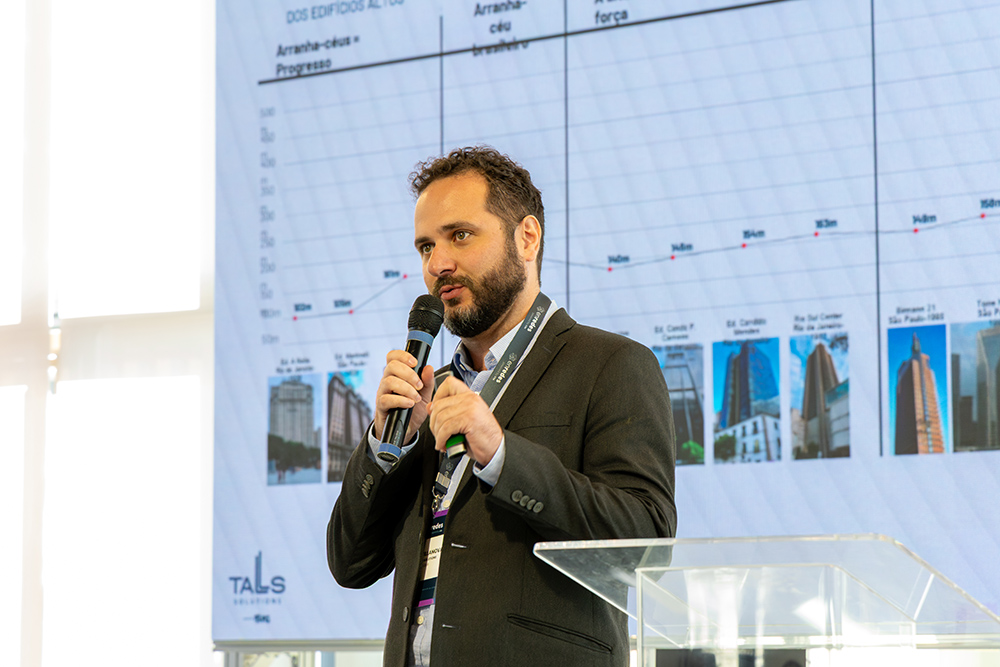
Illustrating the problem further, during the event in São Paolo, speaker Felipe Cavalcante, Founder at ADIT Brasil, pointed to the use of the so-called Adiron Formula, a 1972 zoning law still in force in the city, as a culprit for incentivizing construction of tall and thin buildings on lots with significant setbacks, which does not maximize density. This law tends to discourage mixed-use programs, because the ground floor use cannot have a higher occupancy rate than the rest of the building. This would decrease the “utilization coefficient” that determines how many floors the building can have.
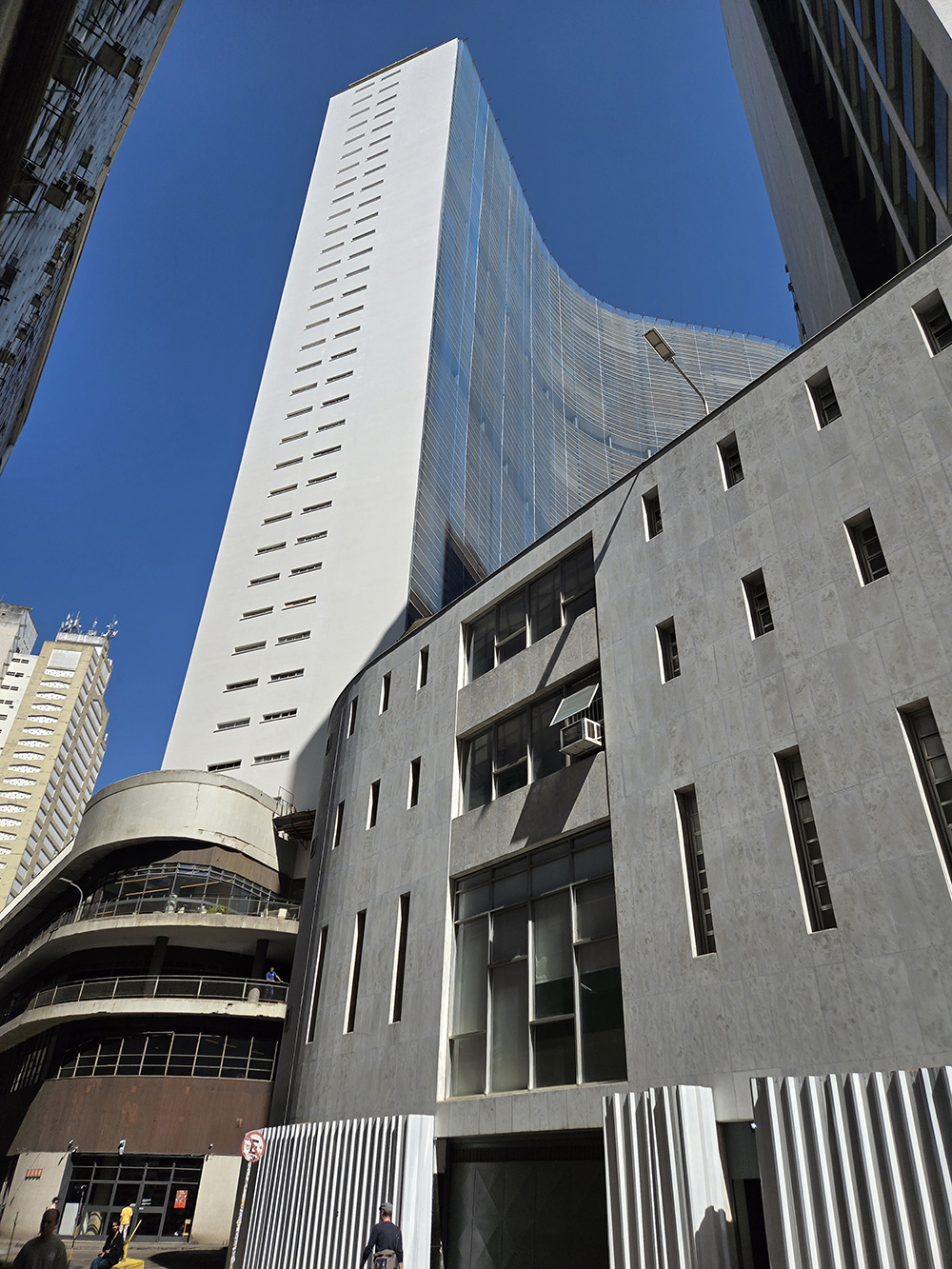
Many of the “classic” tall buildings in central São Paulo, including the legendary Edificio Copan by Oscar Niemeyer, which has thousands of residents and some of the city’s best-loved local restaurants at its base, could not be built today, Cavalante said. More ironic still, Centro is the densest and oldest neighborhood in the city, but has a high number of abandoned buildings, some covered with graffiti that ranges from vulgar to high art, and a significant transient population.
That mismatch of supply and demand that degrades urban quality of life can be felt elsewhere, as one navigates the vast metropolitan area of São Paulo, where even a 17-line consolidated Metro and suburban railway system that moves more than 5 million people a day is not enough to spare millions more from hours-long commutes on clogged roads. Some lights are appearing in the further reaches of these proverbial (and literal) tunnels, however. In the Leste (eastern) district of São Paulo around Tatuapé station, zoning has been relaxed to allow for greater height, and thus more residential units, in projects within 700 meters of the station.
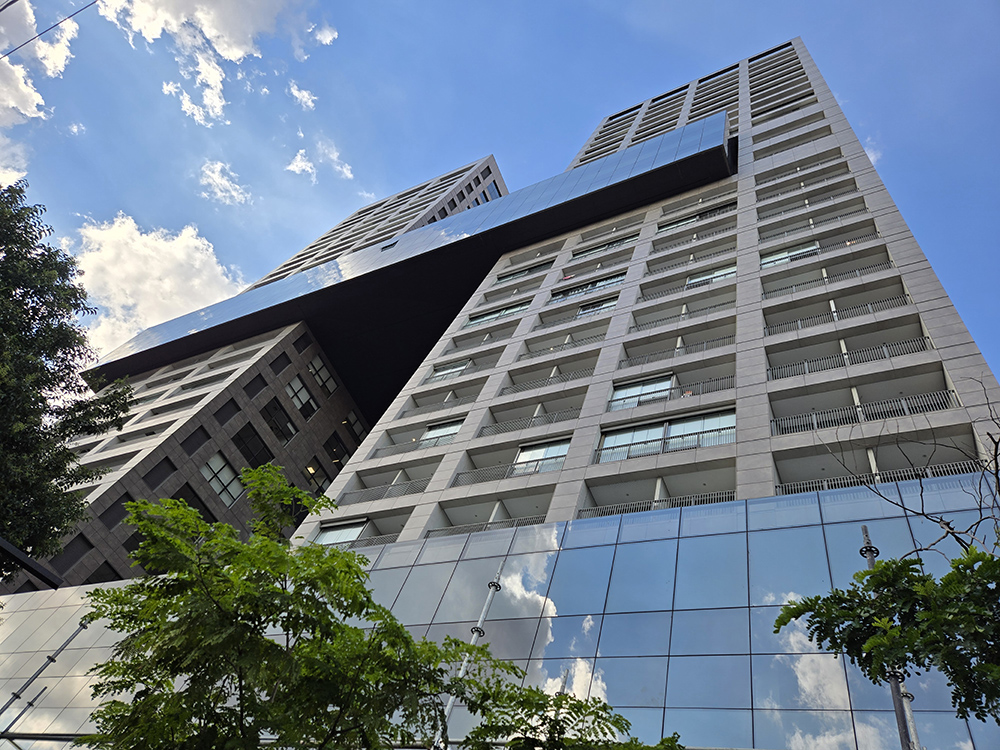
Such zoning liberalization has taken form in Eixio Platina (the Platinum Axis), a multi-block development by Porte, the landmark of which is the mixed-use Platina 220, currently the city’s tallest building. During a walking tour of the neighborhood, Daniel Toledo, CEO, Königsberger Vannucchi Arquitetos Associados, which designed Platina 220 and several other buildings in the district, noted that this was a significant psychological leap forward for the local market, but that the relative success of several of the individual developments was encouraging. A concerted effort was made to ensure Eixo Platina integrated the existing neighborhood, which has small-scale businesses and residences, rather than clearing the site for new development and starting over, Toledo told me. Designed as a mixed-use community, the gambit is that a portion of the population will both live and work in the area, with another substantial portion using rail to commute.
There are other efforts to ameliorate the housing crisis, including encouraging retrofitting and converting old office buildings to residential, but progress has been slow. The “Minha Casa, Minha Vida” program by Caixa Econômica Federal, a federally owned bank that administers social housing, has produced new affordable units, but generally in areas with poor amenities far distant from employment centers, my fellow Forum speakers said.
One of the reasons CVU participated in this Forum was to bring a global perspective to the local discussion. I cited numerous examples of well-integrated vertical urbanism that served positive social, economic and environmental goals at once— nearly all were in Europe and Asia, particularly Japan and Singapore. I was called up to the stage unexpectedly near the end of the event to join in a fairly detailed discussion (in Portuguese, with translation) about the tall buildings versus housing affordability question. When asked to provide further insight on how North American cities had dealt with similar conditions, I frankly stated that examples were few and far between. Sharing upzoning efforts like New York City’s “City of Yes” program— outlined in “Homes for Over a Million New Yorkers,” VU, issue one— are very recent, and it still remains far too expensive to build the quantities of affordable housing needed in the United States and Canada.
There were, of course, no easy answers, but in my conversations with Brazilian vertical urbanists, I left convinced that I had met many people we’d want in the room to try to find those answers for the future density of our cities.